
How to Sell on Multiple Platforms at Once — The Complete Guide
Selling on Depop, eBay, Vinted, and Shopify at the same time doesn't have to mean double the work. Here's how to do it properly.



TL;DR: Selling on multiple platforms (Depop, eBay, Vinted, Shopify, Facebook Marketplace) massively increases your reach and sales. The main challenges are time, overselling, and price management. You can do it manually or use a crosslisting tool like FLUF Connect to automate the entire process — list once, sell everywhere.
Why Sell on Multiple Platforms?
If you’re only selling on one platform, you’re leaving money on the table. Every marketplace has a different audience, and the item that sits unsold on Depop for weeks might fly off the shelves on eBay or Vinted. Here’s why multi-platform selling is worth the effort:
- Massively increased reach — Depop has around 35 million users, eBay has over 130 million, and Vinted is the fastest-growing secondhand marketplace in Europe. Each platform gives you access to buyers who simply don’t exist on the others.
- Faster sell-through rates — More eyeballs means more sales. Sellers who list on multiple platforms consistently report selling items 2-3x faster than single-platform sellers.
- Diversified income — If one platform changes its algorithm or fee structure (and they always do), you’re not dependent on it for all your revenue.
- Different buyer demographics — Depop skews younger and fashion-forward. eBay attracts bargain hunters and collectors. Vinted appeals to budget-conscious shoppers across Europe. Shopify lets you build your own brand. Matching the right item to the right platform increases your margins.
- Competitive advantage — Most sellers can’t be bothered to list everywhere. If you do, you’ll outsell them.
The Challenges of Multi-Platform Selling
Let’s be honest: selling on multiple platforms isn’t easy. Without the right approach, it can become a full-time job just managing your listings. Here are the main challenges:
1. Time and effort
Creating a listing on one platform takes 5-10 minutes. Photos, title, description, pricing, category, shipping — it all adds up. Now multiply that by four or five platforms. A 50-item inventory suddenly means 200+ listings to create and maintain.
2. Overselling
This is the biggest risk. If you sell a one-of-a-kind item on eBay but it’s still listed on Depop and Vinted, someone else can buy it before you manage to take it down. You’ll have to cancel the order, refund the buyer, and potentially damage your seller reputation. For items with limited stock, this can be a nightmare.
3. Price management
Different platforms have different fee structures. Depop now charges UK buyers a marketplace fee rather than a seller commission (UK sellers pay only payment processing), eBay’s fees vary by category (typically 12-15% including payment processing), Vinted charges the buyer rather than the seller, and Shopify has its own subscription model. To maintain the same profit margin, you may need to adjust prices per platform.
4. Order tracking
When orders come in from five different places, keeping track of what’s been shipped, what needs packing, and what’s been returned becomes complicated fast. Without a centralised system, things slip through the cracks.
5. Platform-specific requirements
Each platform has its own listing format, image requirements, category structure, and shipping rules. A listing that works perfectly on Depop might need significant reworking for eBay’s more structured format.
Method 1: Manual Multi-Platform Selling
You absolutely can sell on multiple platforms without any tools. Here’s a step-by-step approach that works:
Step 1: Choose your primary platform
Pick the platform where most of your sales currently happen. This is your “source of truth” — all product information lives here first. For most UK resellers, this is Depop or eBay.
Step 2: Prepare your listing content in advance
Before listing anywhere, prepare everything in a document or spreadsheet: title, description, price, measurements, condition, and photos. Having this ready makes creating listings on each platform much faster than starting from scratch each time.
Step 3: List on your primary platform first
Create the listing where it matters most. Get the photos, description, and pricing right. This becomes your template.
Step 4: Copy across to secondary platforms
Open each additional platform and recreate the listing. You’ll need to adjust the description format, recategorise the item, and potentially tweak the price to account for different fee structures. Keep tabs open for each platform to speed this up.
Step 5: Track everything in a spreadsheet
Create a simple spreadsheet with columns for: Item Name, Photo, Price, and a column for each platform (with the listing URL). When something sells, immediately go to every other platform and delete or pause the listing.
Step 6: Set up notifications
Enable push notifications for every platform so you’re alerted the moment something sells. The faster you delist from other platforms after a sale, the lower your risk of overselling.
The honest truth about manual crosslisting: It works, and plenty of successful sellers do it. But it’s slow. If you have 50+ items and sell on 3+ platforms, you’ll spend more time managing listings than actually sourcing and selling. The time cost is significant — typically 2-4 hours per week just on listing management, not counting the initial listing creation.
Method 2: Using a Crosslisting Tool (Faster)
Crosslisting tools automate the manual process described above. Instead of creating each listing from scratch on every platform, you create it once and push it everywhere with a few clicks.
How it works with FLUF Connect:
- Connect your platforms — Link your Depop, eBay, Vinted, Shopify, and Facebook Marketplace accounts to FLUF Connect.
- Import your existing listings — FLUF pulls in all your current listings from every connected platform. No re-listing required.
- Crosslist in bulk — Select one item or hundreds, choose which platforms to push to, and hit go. FLUF handles the category mapping, image formatting, and platform-specific requirements automatically.
- Inventory sync kicks in — When an item sells on any platform, FLUF automatically removes or updates it on every other platform. No more overselling.
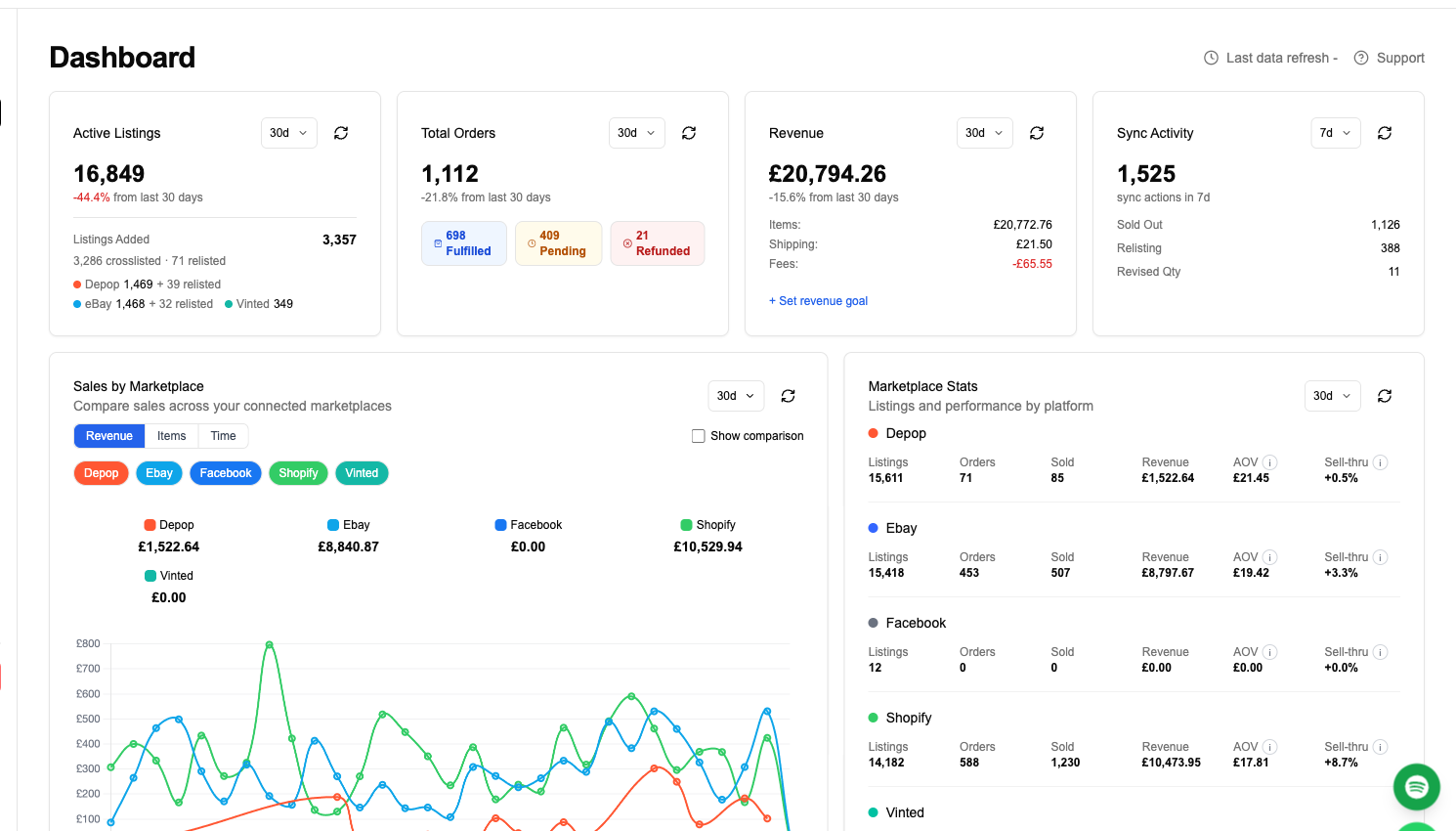
- Manage everything centrally — All your orders, from every platform, appear in one dashboard. Track shipments, manage returns, and see your total revenue at a glance.
The difference in time is dramatic. What takes 10 minutes per item per platform manually takes about 30 seconds total with a crosslisting tool. For a 100-item inventory across 4 platforms, that’s roughly 65 hours of manual work versus about 50 minutes.
Ready to sell on multiple platforms without the headache? Start crosslisting from £9/month.
Platform Comparison: Which Marketplaces Should You Sell On?
Not every platform suits every seller. Here’s a comparison to help you decide where to focus your efforts:
| Platform | Audience | Seller Fees | Best For | FLUF Support |
|---|---|---|---|---|
| Depop | Gen Z, fashion-forward | No seller commission (UK; payment fees apply) | Streetwear, vintage, trendy fashion | Full crosslisting & sync |
| eBay | Broad, all ages | 12-15% total | Electronics, collectibles, branded items, everything | Full crosslisting & sync |
| Vinted | Budget-conscious, Europe-wide | No seller fees | Everyday fashion, high-volume sellers | Full crosslisting & sync |
| Shopify | Your own customers | Subscription-based | Brand building, repeat customers, scaling | Full crosslisting & sync |
| Facebook Marketplace | Local buyers, all demographics | Varies | Furniture, local pickup items, general goods | Full crosslisting & sync |
Our recommendation: Start with two platforms and expand from there. If you’re a fashion reseller, Depop + eBay or Depop + Vinted is a strong starting pair. If you sell a variety of items, eBay + Facebook Marketplace covers the broadest audience. Add Shopify when you’re ready to build a brand identity.
Tips for Selling Across Multiple Marketplaces
Whether you’re managing listings manually or using a tool, these tips will help you get the most out of multi-platform selling:
1. Use the same photos everywhere
Consistency matters. Take high-quality photos once and use them across all platforms. This saves time and ensures your branding is consistent. Make sure your first photo works as a thumbnail — that’s what buyers see when browsing.
2. Adjust pricing per platform
Factor in each platform’s fee structure when setting prices. On Vinted, where there are no seller fees, you might price slightly lower to attract more buyers. On eBay, where total fees can reach 15%, price accordingly. FLUF Connect’s find-and-replace feature lets you adjust prices across all listings in bulk.
3. Prioritise platforms by sell-through rate
After a month of multi-platform selling, look at where your sales are actually coming from. Double down on the platforms that perform best for your inventory type. If 60% of your sales come from eBay and 5% from Facebook, invest your time accordingly.
4. Keep descriptions platform-appropriate
Depop descriptions tend to be casual and short. eBay listings perform better with detailed specifications and item condition notes. Vinted buyers appreciate measurements. Tailor your approach to match buyer expectations on each platform.
5. Use automation where possible
Even if you don’t use a full crosslisting tool, automate what you can. Set up auto-crosslisting rules so new products get pushed to your selected channels automatically. Use bulk operations to update prices or descriptions across all listings at once.
6. Stay on top of delisting
The single most important habit in multi-platform selling: when something sells, delist it everywhere else immediately. If you’re doing this manually, set a strict rule — delist before you even pack the item. Better yet, use inventory sync to handle this automatically.
7. Centralise your order management
Don’t check five different apps for orders. Use a tool that brings all your orders into one place, or at minimum, maintain a master spreadsheet that you update daily. Missed or late shipments kill your seller ratings across every platform.
How FLUF Connect Makes Multi-Platform Selling Easy
FLUF Connect was built specifically for sellers who want to sell across multiple marketplaces without the usual hassle. Here’s what sets it apart:
- 5 supported channels — Depop, eBay, Vinted, Shopify, and Facebook Marketplace. Crosslist from any platform to any other.
- Inventory sync — When an item sells on one platform, it’s automatically delisted everywhere else. No overselling, no cancelled orders, no angry buyers.
- Bulk operations — Crosslist hundreds of items at once. Find and replace across all your listings (update prices, descriptions, or titles in seconds).
- Auto-crosslisting rules — Set rules so that new products are automatically pushed to your selected channels. List once on Depop, and it appears on eBay and Vinted without lifting a finger.
- Order centralisation — View and manage orders from every platform in a single dashboard.
- Smart pricing tools — Daily pricing emails and real-time market data (powered by our Circulaire partnership) help you price competitively across platforms.
Pricing
| Plan | Monthly | Crosslisted products |
|---|---|---|
| Starter | £9/month | Unlimited |
| Seller | £29/month | Unlimited |
| Pro | £99/month | Unlimited |
| Super Seller | Custom pricing — tell us what you need | Unlimited |
All plans include crosslisting, real-time inventory sync, Seller and above add automated relisting, and Seller and above add offer management. No hidden fees. No per-listing charges.
Related Guides
- What is Crosslisting Software? — Overview of crosslisting tools and how they work
- How to Crosslist from Depop to eBay — Step-by-step sync guide
- How to Crosslist from Depop to Vinted — Sync your Depop and Vinted shops
- Inventory Sync: Prevent Overselling — How automatic inventory sync works
- How to Crosslist on Depop — Depop-specific crosslisting guide
- Crosslist from Gumtree to Vinted
- Crosslist from Kijiji to Depop
- Crosslist from Kijiji to eBay
- Sell on GoTrendier — Mexico and Colombia guide
- Kijiji vs Facebook Marketplace — full comparison
New crosslisting guides (May 2026)
- New 2026 guide: complete walkthrough of selling on Poshmark, from $2.95 flat fees to the share economy. How to Sell on Poshmark
Sources & Verification
Last verified: 2026-06-28. Please contact us if any figure is out of date.
- Business of Apps — Depop statistics — Depop registered-user count (~35 million)
- Marketplace Pulse — eBay active buyers — eBay active-buyer count (over 130 million)
- Vinted newsroom — Financial results 2025 — leading/fastest-growing second-hand marketplace in Europe, 100M+ members, 47% GMV growth
- Depop newsroom — Evolving our fee structure (zero selling fees) — removal of the UK seller commission; buyer-paid marketplace fee; payment-processing fee still applies
- eBay Help — Selling fees — category-based final value fees (typically 12–15% including processing)
- Vinted Help — Buyer Protection fee — Vinted charges the buyer, not the seller (no seller selling fees)
Subscribe to seller brief
Choose topics firstFrequently Asked Questions
Yes, absolutely. You can list the same item on Depop, eBay, Vinted, Shopify, Etsy, and Facebook Marketplace simultaneously. The key is to have a system for delisting when the item sells. FLUF Connect handles this automatically with inventory sync — when something sells on one platform, it's removed from all others within minutes.
Overselling happens when an item sells on one platform before you can remove it from others. The manual solution is to enable notifications and delist immediately after every sale. The automated solution is to use inventory sync through a tool like FLUF Connect, which automatically delists items across all connected platforms the moment a sale is made.
The easiest way is to use a crosslisting tool. With FLUF Connect, you create a listing once (or import your existing listings) and push them to any combination of Depop, eBay, Vinted, Shopify, Etsy, and Facebook Marketplace with a few clicks. You can crosslist items individually or in bulk — hundreds at a time.
No. Shopify is just one of six supported channels. You can use FLUF Connect with any combination of Depop, eBay, Vinted, Etsy, Facebook Marketplace, and Shopify. Many sellers start with just Depop and eBay and add more platforms later.
FLUF Connect supports six marketplaces: Depop, eBay, Vinted, Shopify, Etsy, and Facebook Marketplace. You can connect all six and crosslist between any combination of them. There's no limit on how many platforms you use.
For most sellers, yes. Each platform has a different audience, and listing on multiple marketplaces significantly increases your exposure. Sellers who list on 3 or more platforms typically see faster sell-through rates and higher total revenue. The main consideration is the time cost of managing multiple listings, which is why many sellers use crosslisting tools to automate the process.