
How to Sell on Tise — The Complete Guide for 2026
Everything you need to sell on Tise, the Nordics biggest secondhand app — no seller commission, the 20-character title limit, shipping, payouts and where it actually works.



Key Takeaways
- Tise is the Nordics’ default secondhand fashion app — over 2.5 million registered users across Norway, Sweden, Denmark and Finland, with more than one million in Norway alone, and roughly 150,000 people opening it every day.
- Sellers pay no commission and no listing charge. Tise’s revenue comes from a service fee the buyer pays at checkout, calculated as a percentage of the item price before shipping and tax. What a buyer agrees to pay for your item is what lands in your payout.
- eBay owns Tise. The acquisition was announced on 26 September 2025 and closed by the end of that year, with Tise reported at around a $130 million valuation. Tise still runs as its own app and its own brand.
- Germany is the newest market, opened in 2026, and it is the one place where a seller can still arrive early rather than late.
- Titles are capped at 20 characters. This is the single most surprising constraint on the platform and it changes how you write every listing.
- Payments and integrated shipping only work in six countries — Norway, Sweden, Finland, Denmark, Australia and Germany. Elsewhere you can post, but only as a meet-the-buyer listing with no shipping and no payment protection.
- FLUF Connect crosslists to Tise from the same catalogue that feeds your other channels, and pulls Tise sales back in so a sale on Tise takes the item down everywhere else. Plans start at £9/month (Starter). There is no free plan, but every new account gets a 7-day trial for £1.
What’s in this guide
- What is Tise?
- Why sell on Tise in 2026?
- Tise fees explained — what you keep
- Where Tise actually works
- Setting up your account and payouts
- How to create listings that sell
- Shipping, packaging and Meet
- Payments, buyer protection and seller protection
- What sells best on Tise
- Pro tips and common mistakes
- Is Tise worth it? The verdict
- Crosslisting Tise with FLUF Connect
- Sources & verification
What is Tise?
Tise is a secondhand marketplace app built around a social feed rather than a search box. It was founded in Oslo in 2014 by Eirik Rime and Axel Franck Næss and launched publicly in 2016. Individual listings are called “tises”, sellers have followers, and buyers like and comment on items the way they would on a social app. That design is the whole product — Tise’s own framing is that resale should be “fun, easy, and inspiring”, and the interface is closer to Instagram than to a classifieds board.
The numbers behind it are unusually strong for a Nordic-first app. More than 6.5 million items have been sold through Tise since launch, the community sits at over 2.5 million registered users, and around 150,000 people use it daily — spending an average of 17 minutes a day inside the app. That last figure is the one that matters most to a seller. Seventeen minutes of daily browsing per active user is a genuinely engaged audience, and it is why well-photographed items on Tise can move without any paid promotion at all.
Tise covers fashion and accessories, children’s items, interiors and furniture, outdoor goods, art and design, devices and audio, and hobbies. Check the available categories in your Tise account before listing.
Tise at a glance
| Founded | 2014 in Oslo, Norway; app launched 2016 |
|---|---|
| Owner | eBay (acquired 2025) |
| Registered users | 2.5 million+ across the Nordics; 1 million+ in Norway |
| Daily active users | ~150,000, averaging 17 minutes per day |
| Items sold to date | 6.5 million+ |
| Markets with payments & shipping | Norway, Sweden, Finland, Denmark, Australia, Germany |
| Seller commission | None |
| Listing charge | None |
| Buyer service fee | A percentage of the item price, paid at checkout |
| Categories | 357 total, 299 leaf categories, 7 top-level groups |
| Title limit | 20 characters |
| Description limit | 1,000 characters |
| Photos per listing | Up to 8 |
Who owns Tise now?
eBay announced its agreement to acquire Tise on 26 September 2025, with the deal expected to complete by the end of 2025 at a valuation of around $130 million. eBay had already been an investor — it participated in Tise’s €19.4 million round alongside the Norwegian state climate fund Nysnø before buying the company outright.
Oliver Klinck, eBay’s VP and GM of Global Markets Success and C2C, described it as “a natural next step in our investment in Tise, which will allow us to accelerate Tise’s strategy and unlock new opportunities for innovation.” The strategic read is straightforward: eBay’s C2C business skews older, Tise’s skews Gen Z and Millennial, and Tise’s social mechanics — following sellers, liking, commenting — are exactly what eBay’s own marketplace lacks.
For a seller, the practical consequences so far have been light. Tise continues to operate as a separate app with its own listing flow, its own fee structure and its own logistics partners. It has not been folded into eBay, and a Tise listing does not appear on eBay. What the ownership has clearly funded is expansion: Germany opened in 2026, and Australia now appears in the set of markets with full payments and shipping.
Why sell on Tise in 2026?
It is the default app in a region where resale is mainstream
Market leadership matters more in resale than in almost any other kind of commerce, because liquidity compounds. In Norway, Sweden, Denmark and Finland, Tise is the app people already have installed for used clothing. A seller listing there is not educating an audience about secondhand — the audience arrived pre-sold. With over a million registered users in Norway alone against a population of roughly 5.5 million, the penetration is extraordinary; a substantial share of Norwegian adults have a Tise account.
Contrast that with launching into a crowded market. On Vinted a new seller in France or Germany is one of millions competing for the same feed placement. On Tise in Norway, the pool of sellers is proportionally much smaller than the pool of buyers, and the feed rewards recency heavily.
You keep the full sale price
Tise takes no commission from sellers and charges nothing to list. This is the headline reason experienced Nordic resellers use it. On most marketplaces the mental arithmetic before every listing is “what is left after fees” — on Tise, the number you agree with the buyer is the number that reaches your account, minus nothing.
The revenue model shifts that cost to the buyer instead, in the form of a service fee added at checkout. We cover exactly how that works, and what it means for your pricing, in the fees section below.
A social feed rewards consistency, not just SKUs
Tise’s follower mechanic changes the economics of a well-run shop. Buyers who follow you see your new listings in their feed without searching. A seller who lists steadily builds a compounding audience — which is the opposite of a pure search marketplace, where every listing starts from zero and lives or dies on its keywords.
The flip side is that the feed is unforgiving about staleness. Items that sit unlisted-and-relisted for months sink. Fresh listings surface. This is the single biggest behavioural difference between selling on Tise and selling on Etsy or Shopify, where a listing accrues search authority over time rather than losing feed position.
Integrated shipping and payment, with real logistics partners
Tise is not a classifieds board where you meet a stranger with cash. In its payment markets it runs integrated shipping through established carriers — Posten and Helthjem in Norway, Instabox lockers, and PostNord — with tracking events surfacing inside the app chat. Payment is held and released through the platform, which is what makes buyer and seller protection possible at all.
That is a meaningful difference from Facebook Marketplace or Gumtree, where the platform largely steps back from the transaction. It also means Tise is viable for sellers who do not want to arrange their own postage and refunds.
Germany is an early-mover window
Tise launched in Germany in 2026. Germany is the largest secondhand fashion market in Europe and already has an entrenched incumbent in Kleinanzeigen plus enormous Vinted volume — but Tise’s German catalogue is, by definition, young. Categories are thin, competing sellers are few, and the follower mechanic means the accounts that build an audience in the first year keep it. If you sell into Germany, this is the argument for adding Tise now rather than in two years.
Tise fees explained — what you keep
What the seller pays
Nothing. There is no listing charge, no commission on the sale, and no percentage deducted from your payout. Tise’s public positioning and its help documentation are consistent on this: the platform does not bill the seller for a completed sale.
There is one optional exception. Tise offers paid promotion for individual listings — the equivalent of a bump — which pushes a “tise” back up the feed. That is a discretionary marketing spend you choose per item, not a transaction fee, and nothing is deducted if you do not use it.
What the buyer pays
Tise’s Service Fee Policy is explicit about the mechanics. The service fee is “a fee paid by the buyer for the use of our marketplace and safety and support features”, it “is calculated as a flat percentage of the item price (before delivery/shipping and taxes)”, and it “is not paid to the seller”. The policy is equally clear that it “is not an insurance product, guarantee, or any form of buyer-protection program” — buyer protection is a separate policy with its own terms.
Two practical details are worth knowing. First, the fee is a percentage rather than a flat amount, so it scales with the item price. Second, Tise’s own FAQ notes it “may vary from purchase to purchase”, and the policy states that “one Service Fee applies per order” — for a multi-item order it is charged on the combined price, again excluding delivery and taxes.
That last point has a direct commercial implication: a buyer purchasing three items from you in one order pays one service fee, not three. Bundling is genuinely cheaper for your buyer, which makes “message me to bundle” a stronger call to action on Tise than on platforms where fees are strictly per-item.
A worked example
Suppose you list a wool coat at 800 NOK and it sells with Posten shipping.
- You receive: 800 NOK. There is no commission line, no listing charge, and no payment-processing deduction on your side.
- The buyer pays: 800 NOK for the coat, plus the shipping cost for the selected package size, plus the service fee calculated on the 800 NOK item price.
- Your true cost: your time, your packaging, and the risk that the buyer’s total — item plus shipping plus fee — makes them hesitate.
The strategic conclusion is that on Tise you price the item, not the fee. On a commission marketplace, sellers routinely inflate the sticker price to absorb a 10% cut. Do that on Tise and you are simply more expensive than the seller next to you, because the buyer’s fee is added on top regardless. The winning approach is to price cleanly and let the absence of a seller cut show up as competitiveness.
Where Tise actually works
This is the most common source of confusion for sellers outside the Nordics, and it is worth being precise, because the app will let you create a listing in places where you cannot actually complete a protected sale.
Check Tise for the payment and delivery options available at your address before listing. Availability can differ by country and postcode.
What that means in practice:
| If your address is in… | What you can do |
|---|---|
| Norway, Sweden, Finland, Denmark, Australia, Germany | Full selling: integrated payment, tracked shipping via the platform’s carriers, buyer and seller protection, payouts to your bank account. |
| Anywhere else | Meet-the-buyer listings only. No shipping options are offered, no in-app payment is available, and no protection applies. In effect the listing becomes a local classified ad. |
If you are a UK seller, this is the deciding fact. Tise is not currently a channel you can run a shipping business on from Britain. It is a channel worth adding if you are based in, or hold stock in, one of the six markets above. If you are UK-based and looking for equivalent volume, Vinted and Depop are the direct substitutes; if your interest is specifically Nordic and Baltic, Yaga covers Estonia, Latvia and neighbouring markets.
Setting up your account and payouts
Account creation is app-first and takes a couple of minutes, but two setup steps are the ones that actually block sales, and both are easy to skip past.
1. Register a shipping address
Tise resolves which shipping options to offer from your registered address. Without one, the app cannot price a parcel, cannot generate a shipping code, and will not let a buyer check out with delivery — the listing silently degrades into a meet-only item. Set the address before you list anything, not after your first buyer asks why they cannot pay.
2. Register and verify payout details
Payouts go to a bank account, and Tise’s help centre carries a full set of articles on registering payout information, verifying it with documents, finding your IBAN, and what to do when a payout fails. Verification exists because Tise is moving real money on your behalf; it is not optional, and the time to complete it is before you have a sold item waiting on it.
A practical note: an unverified payout is the single most common reason a new seller reports “I sold something but got nothing”. The sale completed, the money is held, and it is waiting on your documents.
3. Set up your profile as a shopfront
Because Tise is a follower-driven feed, your profile does more work than a profile on a search marketplace. A clear profile photo, a one-line description of what you sell, and a consistent visual style across listing photos are what convert a browsing buyer into a follower — and a follower sees everything you list from then on without searching for it.
How to create listings that sell
The 20-character title is the defining constraint
Tise enforces a hard 20-character limit on listing titles. Not 20 words — 20 characters, including spaces. This is genuinely unusual and it is the thing most sellers arriving from another platform get wrong.
For comparison, eBay allows 80 characters and most fashion marketplaces allow 50 or more. A title that reads perfectly well elsewhere — “Vintage Levi’s 501 High Waisted Mom Jeans W28 L30” — is 48 characters and simply cannot exist on Tise. You get about three words.
The implications for how you write are concrete:
- Lead with brand and item. “Levi’s 501 jeans” is 16 characters and tells a buyer everything the title needs to.
- Never spend characters on condition, size or colour. Those belong in the structured fields, where Tise’s filters can actually use them, and in the description.
- Drop emoji entirely. They consume characters you cannot spare, and they add nothing a filter can read.
- Do not keyword-stuff. At 20 characters there is no room, and the attempt just makes the title unreadable.
Keep Tise titles short and review them before publishing. Lead with the brand and item; put size, condition and other detail in the appropriate listing fields.
The description carries the detail
Descriptions allow up to 1,000 characters, which is where everything the title cannot hold belongs: measurements, condition detail, flaws, fabric, fit notes, and the reason you are selling. On a platform where the title is nearly useless as an information channel, the description is doing double duty.
Be explicit about flaws. Tise’s buyer protection covers items that are “materially different from the listing” including “undisclosed damage”, so an unmentioned mark on a sleeve is not a minor omission — it is a valid basis for a claim against you. A photographed and described flaw is nearly never a dispute; an unmentioned one frequently is.
Photos: up to eight, and the first one decides everything
A listing takes up to 8 images. Because Tise is a feed, the first image is not merely the best photo — it is the entire advertisement. A buyer scrolling makes a decision on that thumbnail alone.
- Shoot in daylight against a plain, uncluttered background.
- Make the first frame the full item, filling the frame, unfolded and unobstructed.
- Use the remaining seven for detail: label and size tag, fabric composition, any flaw close-up, the back, and the item worn or styled if it is clothing.
- Keep resolution high — Tise publishes guidance on recommended image resolution, and soft or low-resolution photos read as low effort in a feed full of well-shot items.
Category, gender and size are structured fields — fill them
With 299 selectable leaf categories, Tise’s taxonomy is detailed enough that the right category genuinely improves discovery. Fashion categories additionally carry gender values (female, male, or any), brand, materials, and a defined colour palette running to nineteen options. Size sets vary by category.
Two rules matter here. First, pick the deepest category that genuinely fits — buyers filter, and a listing parked at a top-level category is invisible to a filtered search. Second, never guess a size. Tise offers no universal “one size” value, and inventing one puts an item in front of buyers who will return it. If the true size is not in the set, say so in the description instead.
Price in whole units
Tise rejects fractional currency amounts outright — a price of 9.50 is refused where 9 or 10 is accepted. Prices are whole kroner, whole euros, whole dollars. If you are moving a price list across from another channel, round it before it arrives, and round up rather than down so you are never silently undercutting yourself.
Shipping, packaging and Meet
How integrated shipping works
When you accept an offer on a listing with shipping, Tise issues a unique shipping code in the chat, and the code carries all the information the carrier needs. What that code looks like and what you do with it depends on the carrier:
- Posten — you choose small, medium or large, and must make sure the size you picked genuinely matches the item. You receive a code of the form
LLXXXXXXXXXin the chat, write it clearly on the package, and receive transport events, shipment status and delivery notifications inside Tise. - Helthjem — issues a code of the form
S-XXXXto write on the package, and offers pickup from your address, which is the lowest-friction option if you sell volume. - Instabox — you follow the link sent in the chat, reserve a locker, and drop the parcel there. Delivery to the recipient’s locker is notified in the app.
- PostNord — available in the Swedish and Danish markets, with the same code-in-chat pattern.
Note what is absent from that list: printed labels. On several of these carriers you handwrite the code on the parcel rather than printing a label, which is faster than most marketplace shipping flows but leaves no room for a transcription error. Write it clearly, and check it.
Package sizes are dimensional, and getting them wrong costs you
Tise’s help centre publishes maximum dimensions for small, medium and large packages separately. Selecting a size smaller than the parcel you actually post is a real failure mode: the carrier can reject or resize it, and the difference lands on you rather than the buyer. Measure the packed parcel, not the item.
Packing is a payout issue, not a courtesy
Tise’s shipping guidance is unusually direct about this — proper packaging avoids damage claims that affect your payout. Because payment is held by the platform, a damaged-arrival claim is not an argument with a buyer over messages; it is a hold on money you have already counted as earned. Rigid protection for anything breakable, waterproofing for anything fabric, and a packing slip inside are cheap insurance.
Meet — integrated payment without shipping
Tise supports “Meet”, which keeps the payment inside the platform for an in-person handover. This is the right choice for furniture and bulky interiors items, which are a significant share of Norwegian volume and where shipping economics do not work. You get the payment protection of an in-app transaction without paying to move a sofa across the country.
Payments, buyer protection and seller protection
Tise’s Buyer Protection Policy covers two scenarios, and knowing them tells you exactly where your risk sits as a seller.
Item Not Received (INR) applies where an item “arrives damaged and is not usable due to the damage, or never arrives” and the seller or carrier cannot prove delivery. Significantly Not as Described (SNAD) applies where “the item delivered is materially different from the listing (for example it is a different model or size, counterfeit, missing key parts, or has undisclosed damage).”
The timeframes are tight, and they cut both ways:
- A buyer must report a damaged item within 24 hours of receipt.
- A SNAD claim must be reported within 24 hours of receiving the package, with photos or video.
- A lost item can be reported after 30 days without receipt since the initial shipping event.
The policy also sets out hard conditions. Transactions must stay on-platform for all communication, payment and delivery. Tracked shipping is required. And the exclusions are broad in your favour as a seller: buyer’s remorse, late delivery, fit or colour preference, and normal wear on used items are all explicitly outside the policy.
Read together, the protective posture for a seller is clear and actionable:
- Never take the conversation off-platform. A buyer who moves you to another app has removed your protection along with theirs.
- Always use the platform’s tracked shipping. Proof of delivery is what defeats an INR claim.
- Photograph every flaw and describe it. Disclosed damage is not undisclosed damage, and “normal wear on used items” is explicitly excluded from claims.
- Photograph the packed parcel and the written shipping code before you hand it over. It costs ten seconds and it is the evidence you will want.
Tise additionally publishes a seller protection policy covering the seller side of disputes. Between the two, the platform is materially safer for a seller than an unmediated classifieds sale — the trade-off being that money is held until the transaction completes rather than paid the moment a buyer collects.
What sells best on Tise
The category data tells you where the platform’s weight sits, and the seven top-level groups are a good map of demand.
Fashion and accessories
The core of the platform. Scandinavian brands perform disproportionately well — a buyer in Oslo searching for a specific Norwegian or Swedish label will find far more relevant supply on Tise than on a pan-European app. Outerwear is exceptionally strong for obvious climatic reasons, and technical outdoor clothing crosses from the fashion category into genuine utility demand.
Interior and furniture
Larger on Tise than most sellers expect, and the reason Meet exists as a first-class feature. Scandinavian design pieces, lighting and small furniture move well. This is also the category where the platform meaningfully differs from Depop or Vestiaire Collective, which are fashion-only.
Outdoor
Its own top-level group, which tells you something about the market. Skis, hiking equipment, camping gear and technical outerwear have deep seasonal demand across all four Nordic markets.
Child and baby
Reliable, high-turnover volume. Children outgrow everything, the items are lightly used by definition, and parents buy repeatedly — which makes this the single best category for building a follower base, because a satisfied buyer will be back in three months for the next size up.
Art, design, devices and hobbies
Smaller but genuinely active groups. Art and design in particular fits the platform’s aesthetic-led feed better than it fits a search-driven marketplace.
Timing and seasonality
Nordic seasonality is sharper than most of Europe. Winter outerwear and ski equipment build from September and peak before the first heavy snow. Spring brings a large wave of wardrobe clear-outs, which means more supply and more competition — list early in the season rather than into the peak of it. Evening browsing is the daily peak, consistent with 17 minutes of average daily use spread across commutes and evenings.
Pro tips and common mistakes
Tips that actually move the needle
- List steadily rather than in batches. The feed rewards recency. Twenty items posted over ten days will outperform twenty posted in one evening, because each posting session is a fresh appearance in your followers’ feeds.
- Write for the description, not the title. Given 20 characters, treat the title as a label and the description as the listing.
- Encourage bundles. One service fee applies per order, so a buyer taking three items pays one fee. That is a real saving you can point out.
- Answer fast. A social app sets social expectations. Slow replies lose sales to the seller who answered in five minutes.
- Build the follower base deliberately. Consistent photo style, a clear niche and regular posting turn one-off buyers into an audience that sees every future listing.
- Use Meet for anything bulky. Furniture that would be uneconomic to ship sells perfectly well locally with platform payment protection intact.
Mistakes to avoid
- Arriving with another platform’s titles. A 60-character title does not truncate gracefully into 20. Rewrite it.
- Leaving payout details unverified. Your money waits on paperwork you could have completed before the sale.
- Guessing a size. There is no universal “one size” fallback, and a wrong size is a SNAD claim in waiting.
- Under-declaring package size. Measure the packed parcel; the difference comes out of your side.
- Moving a buyer off-platform. It voids protection for both of you and is explicitly outside the policy.
- Listing from an unsupported country and expecting shipping. Outside the six payment markets you get a meet-only classified, not a sellable listing.
- Letting listings go stale. On a feed-driven app, an item that has not moved in two months usually needs new photos and a new price, not more patience.
Is Tise worth it? The verdict
If you are based in Norway, Sweden, Denmark, Finland, Germany or Australia: yes, unambiguously. There is no commission, no listing charge, a large and genuinely engaged audience, real logistics, and payment protection. The cost of adding it is the time to relist your catalogue, and the platform takes no percentage of the upside.
If you sell into Germany specifically: yes, and sooner rather than later. A 2026 market launch is a rare thing to be early to.
If you are based anywhere else: not yet. Without payments and integrated shipping you have a local classified ad, not a sales channel. Watch for further market launches under eBay’s ownership — Tise’s stated ambition after the acquisition was to enter new European markets — but do not build a workflow around it today.
The honest limitation for a high-volume seller is that Tise is app-first and manual by design. There is no seller dashboard built for bulk operations, no native bulk relist, and the 20-character title means every listing needs a deliberate decision. That is exactly the friction crosslisting software exists to remove.
Crosslisting Tise with FLUF Connect
The reason to crosslist Tise is the same reason to crosslist anything: an item that sits on one marketplace sells at the speed of that marketplace’s audience. The same coat listed on Tise, Vinted, Depop and eBay sells at the speed of whichever audience finds it first. The reason not to do it manually is that maintaining the same item across four apps by hand — and remembering to take it down everywhere the moment it sells — is where resellers lose their evenings and oversell their stock.
What FLUF Connect does with Tise
We are deliberately precise about this, because a crosslisting tool that overstates what it supports costs you more than one that supports less.
| Capability | Supported on Tise | Detail |
|---|---|---|
| Create listings | Yes | Photos, category, gender, size, condition, price and integrated shipping, from your existing FLUF catalogue. |
| Edit listings | Yes | Price and title edits push through to the live Tise listing. |
| Delete listings | Yes | Removing an item in FLUF withdraws it from Tise. |
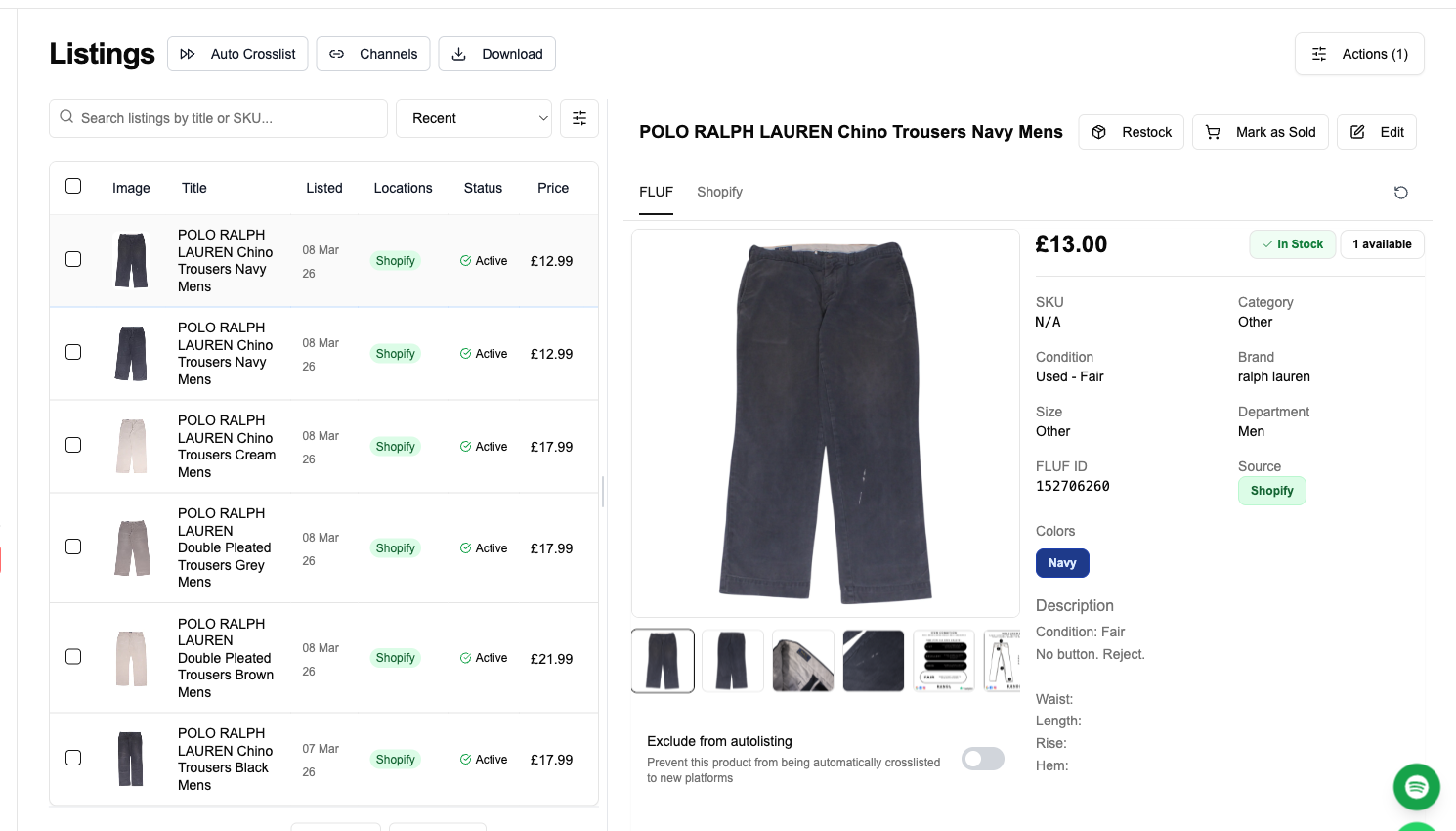
| Mark as sold elsewhere | Yes | When the item sells on another channel, the Tise listing is withdrawn automatically — both for a single item and in bulk. |
| Order sync from Tise | Yes | A sale on Tise is detected and imported, so it stocks the item out across your other channels. |
| Automatic relisting | No | Not supported on Tise. Relisting is available on other channels. |
| Offer management | No | Not supported on Tise. Offers are handled in the Tise app. |
| Messaging | No | Buyer conversations stay in the Tise app. |
Two of those rows deserve a note. Order sync on Tise is unusual under the hood — Tise exposes no order object at all, so a sale is detected from the seller’s own listing rather than from an order feed, and order references are generated on our side. It was wired against a real sale on 31 July 2026 and it works, but the reference you see in FLUF will not match a reference in the Tise app, because Tise does not publish one.
The title limit is handled for you. Titles are trimmed to 20 characters on word boundaries rather than mid-word, and emoji are stripped first so they do not consume characters. Prices are rounded to whole units — always to the nearest, never down — because Tise refuses fractional amounts outright.
How it works
- Connect Tise from the FLUF Connect Channels page. Install the FLUF browser extension and sign in to Tise when prompted.
- Pick the items you want on Tise from your catalogue — or set the channel to receive everything automatically.
- Push. Listings are created with photos, category, gender, size and shipping already resolved.
- Sell anywhere. A sale on Tise pulls the item from your other channels; a sale elsewhere withdraws the Tise listing.
What it costs
FLUF Connect plans start at £9/month (Starter). There is no free plan, but every new account gets a 7-day trial for £1. Automation — relisting, offers and bulk operations on the channels that support them — is included from Seller upwards rather than sold as a paid add-on. See pricing for the full breakdown.
Where to go next
- Browse every marketplace FLUF Connect supports
- Sell on Vinted — the largest European secondhand audience
- Sell on Depop — the strongest fit for vintage and streetwear
- Sell on Yaga — the Baltic equivalent, if your reach is Northern European
- Sell on Kleinanzeigen — Germany’s incumbent classifieds giant
- All crosslisting guides
Sources & verification
Every factual claim on this page traces to one of the following. Platform mechanics and limits marked “FLUF integration testing” were verified by us against a live Tise seller account on the dates given.
- Tise — Service Fee Policy — buyer-paid service fee, flat percentage of item price before delivery and taxes, one fee per order, not paid to the seller, not an insurance product.
- Tise Help Centre — Service Fee FAQ — fee paid by the buyer on completed transactions, varies by purchase.
- Tise — Buyer Protection Policy — INR and SNAD definitions, 24-hour damage and SNAD reporting windows, 30-day lost-item window, tracked-shipping and on-platform requirements, exclusions.
- Tise Help Centre — Posten FAQ — package size selection,
LLXXXXXXXXXshipping code, in-app transport events. - Tise Help Centre — Helthjem FAQ —
S-XXXXshipping code, pickup from the seller’s address. - Tise Help Centre — Instabox FAQ — locker reservation flow and delivery notifications.
- Tise Help Centre — PostNord FAQ — carrier availability.
- Tise Help Centre — Selling collection — payout registration and verification, IBAN, image resolution guidance, package dimension limits, Meet, promotion.
- Digital Commerce 360 — eBay to acquire Tise (26 September 2025) — acquisition announcement, 2.5 million users, Oslo headquarters, Oliver Klinck quote.
- FashionUnited — eBay acquires Norway’s largest resale app Tise — ~$130 million valuation, completion expected end of 2025, 2.5 million Nordic users and 1 million+ in Norway.
- Silicon Canals — Tise raises €19.4M — founded 2014 in Oslo by Eirik Rime and Axel Franck Næss, launched 2016, 6.5 million+ items sold, 150,000 daily users averaging 17 minutes per day, investors including Nysnø and eBay.
- FLUF integration testing, 30–31 July 2026 — full listing lifecycle verified against a live seller account (create with images, category, gender, size and integrated shipping; read; price and title edit; withdrawal on mark-as-sold), and order sync verified against a real Tise sale.
- FLUF Connect channel registry — supported capability set for Tise (create, edit, delete, mark-as-sold, order sync) and hard platform limits (20-character title, 1,000-character description, 8 images, whole-unit prices).
- Sell on Discogs
Last verified: 2 August 2026. Marketplace fees, policies and market availability change — check Tise’s own policy pages before relying on a figure for a business decision.
Selling in Denmark or Finland? You can crosslist from Tise to Vinted. Crosslist from Tise to Vinted.
Related guide
- Crosslist from Vinted to Tise — the Nordic secondhand app, and why Norway is the market Vinted does not serve
- Sell on Tradera — Sweden’s second-hand marketplace, with commission capped at 200 kr
Related guides
Subscribe to seller brief
Choose topics firstFrequently Asked Questions
No. Tise takes no commission on a sale and charges nothing to create a listing, so the price a buyer agrees to is the amount that reaches your payout. Tise earns its revenue from a service fee paid by the buyer at checkout, calculated as a flat percentage of the item price before delivery and taxes. Optional paid promotion for individual listings exists, but it is a marketing choice per item, not a transaction fee.
eBay. The acquisition was announced on 26 September 2025 and was expected to complete by the end of that year, with Tise reported at a valuation of around $130 million. eBay had already been an investor before buying the company outright. Tise still runs as its own app with its own listing flow, fees and logistics partners — a Tise listing does not appear on eBay.
Payments and integrated shipping work in six markets: Norway, Sweden, Finland, Denmark, Australia and Germany. From an address in any other country the app will still let you post, but no shipping options and no in-app payment are offered, so the listing behaves as a local meet-the-buyer classified with no buyer or seller protection. We confirmed this on 29 July 2026 by testing two addresses on one account — a German address returned three shipping size categories, a British address returned none.
Tise enforces a 20-character cap on listing titles — 20 characters including spaces, not 20 words. It is one of the tightest limits of any marketplace, and it means a title that works elsewhere will not fit. Lead with brand and item (“Levi’s 501 jeans” is 16 characters), skip emoji entirely, and put condition, size, colour and measurements in the structured fields and the 1,000-character description instead.
When you accept an offer, Tise issues a unique shipping code in the chat. With Posten you choose small, medium or large and write a code of the form LLXXXXXXXXX on the parcel; with Helthjem you write an S-XXXX code and can have the parcel collected from your address; with Instabox you follow a link in the chat to reserve a locker. PostNord is available in Sweden and Denmark. Tracking events appear inside the app. Measure the packed parcel before choosing a size, and pack properly — damage claims come out of your payout.
The most common cause is unverified payout information. Tise holds funds and pays out to a registered bank account, and verification requires documents you upload in the app. If a sale has completed but nothing has arrived, check that your payout details are registered and verified before assuming the sale failed. Payments are also held until the transaction completes, which is what makes buyer and seller protection possible.
Fashion and accessories are the core, with Scandinavian brands and outerwear performing especially well. Interiors and furniture are a much larger share than most sellers expect, which is why Tise supports in-person handover with platform payment. Outdoor equipment has its own top-level category and deep seasonal demand, and child and baby items turn over reliably and build a repeat following. The live category tree we captured on 29 July 2026 held 357 categories across seven top-level groups.
Yes. FLUF Connect creates, edits and deletes Tise listings from the same catalogue that feeds your other channels, withdraws the Tise listing when an item sells elsewhere, and imports Tise sales so they stock the item out everywhere else. Titles are trimmed to 20 characters on word boundaries and prices rounded to whole units, because Tise rejects fractional amounts. Automatic relisting, offer management and messaging are not supported on Tise — those stay in the app.
They serve different purposes. Tise is the default secondhand app across Norway, Sweden, Denmark and Finland, with over 2.5 million registered users and no seller commission, and its follower feed rewards sellers who list consistently. Vinted has far greater pan-European reach. For a Nordic seller the sensible answer is both — list to each and let whichever audience finds the item first sell it.
FLUF Connect plans start at £9/month on Starter, with Seller at £29/month and Pro at £99/month; every plan is unlimited on listings and marketplaces, and the tiers differ by which automations they include and how often we check your channels for sales. There is no free plan. Automation — relisting, offers and bulk operations on the channels that support them — is included from Seller upwards rather than sold as a paid add-on.