Promote Your Vinted Products on Instagram — Posts and Carousels From Photos You Already Have
Turn the photographs on your Vinted listings into Instagram posts and carousels, with AI captions and scheduling. This is promotion, not crosslisting — Instagram holds no inventory and nothing syncs.
- What this is: turning the photos already on your Vinted listings into Instagram posts and carousels that send people to your Vinted wardrobe.
- What this is not: crosslisting. Instagram holds no inventory. Nothing syncs, no stock moves, no orders arrive, and this page will not tell you otherwise.
- Why bother: Vinted’s discovery is search and feed, both of which reward newness. Instagram is where a following accumulates — and a following is the one audience a marketplace algorithm cannot take away from you.
- Reach: Instagram passed 3 billion monthly actives, per Meta’s Q3 2025 earnings call.
- What FLUF does: search your listings, pull in their photos, build a carousel of up to 10 images, write the caption with AI if you want one, and post now or schedule it.
- Requirement: an Instagram professional account — Business or Creator. Personal accounts are not supported by Instagram’s own publishing API.
- Cost of FLUF: 7 days for £1, then plans from £9/month (Starter — 300 active products). There is no free plan.

On This Page
- What this actually does, stated plainly
- Why a Vinted seller needs somewhere else to exist
- The link problem, and the honest way round it
- How it works
- Building a carousel that is worth posting
- Captions, and what the AI is actually looking at
- Scheduling, and the limits that apply
- Vinted photos are not Instagram photos
- What to post in a week where you listed nothing
- This is not a substitute for bumping
- Four things that catch resellers out
- Pricing
- Sources & Verification
What This Actually Does, Stated Plainly
It is worth being blunt at the top, because the word “crosslisting” attaches itself to anything with two platform names in the title and this is not that.
Instagram is not a marketplace in this workflow. There is no inventory on it, no stock level, no order, no sale. FLUF does not sync your Vinted stock to Instagram, does not import Instagram orders, does not relist anything there, does not manage offers there, and does not mark anything as sold there. None of those things exist in this direction and none are claimed.
What it does is narrower and genuinely useful: it takes the photographs sitting on your Vinted listings — which you have already shot, cropped and uploaded — and turns them into Instagram posts and carousels, with a caption, published now or on a schedule. It is a marketing tool that happens to know what is in your wardrobe, so you stop re-uploading the same photos by hand.
There is only one sensible direction here, and this is it. Instagram holds nothing to pull from, so “Instagram to Vinted” is not a thing that could exist.
Why A Vinted Seller Needs Somewhere Else To Exist
Vinted is an unusually good deal for a seller. It takes no commission and charges no listing fee; its revenue comes from the Buyer Protection charge the buyer pays. For anyone shifting volume, that is close to unbeatable, and it is why so many sellers run Vinted and nothing else.
The catch is not financial, it is structural. On Vinted you have no audience — you have placement. Your items appear because they are recent, because they match a search, because the feed decided to show them. Bump an item and it rises; leave it a fortnight and it may as well not exist. Every day starts from roughly zero, and the relationship with a buyer ends when the parcel arrives.
Instagram inverts that. A follower is a standing permission to appear in front of someone again next week without paying for it or ranking for it. Meta reported that Instagram passed 3 billion monthly active users on its Q3 2025 earnings call, but the number that matters to a reseller is much smaller and much more useful: the four hundred people who like your taste and will look at what you listed this week.
That audience is also the only asset in this whole business that no platform can revoke. Accounts get restricted, algorithms change, categories close. A following moves with you.
The Link Problem, And The Honest Way Round It
Anyone who has tried this already knows the friction: Instagram captions are not clickable. You can write your Vinted username in a caption a hundred times and nobody can tap it.
So the traffic mechanism is the profile, not the post. The link in your bio is the destination, the caption’s job is to make somebody want to go there, and the two have to be written as a pair. “New drop, 14 pieces, link in bio” works because it tells a person there is a reason to leave the app and where the door is. A caption listing a price with no route anywhere is a dead end.
A professional account helps here in a way people underestimate. Business and Creator accounts unlock the professional dashboard, insights and a contact button — so you can actually see which posts moved people rather than guessing. One structural consequence worth knowing before you switch: a professional account cannot be set to private, and pending follow requests are accepted automatically.
It is also worth being clear about what Instagram’s shopping features are now, because a lot of advice is out of date. Meta moved Shops on Facebook and Instagram to website checkout in September 2025; shops and product tagging still exist as discovery surfaces, but the in-app purchase is gone and buyers finish on your own site. For a Vinted seller none of that is the mechanism anyway — your storefront is your Vinted wardrobe, and the bio link is how people reach it.
How It Works
- Connect Instagram. One authorisation, from the Instagram screen in FLUF, and a green Connected badge with your username afterwards. You need a professional account — Business or Creator — because Instagram’s publishing API does not work with personal ones.
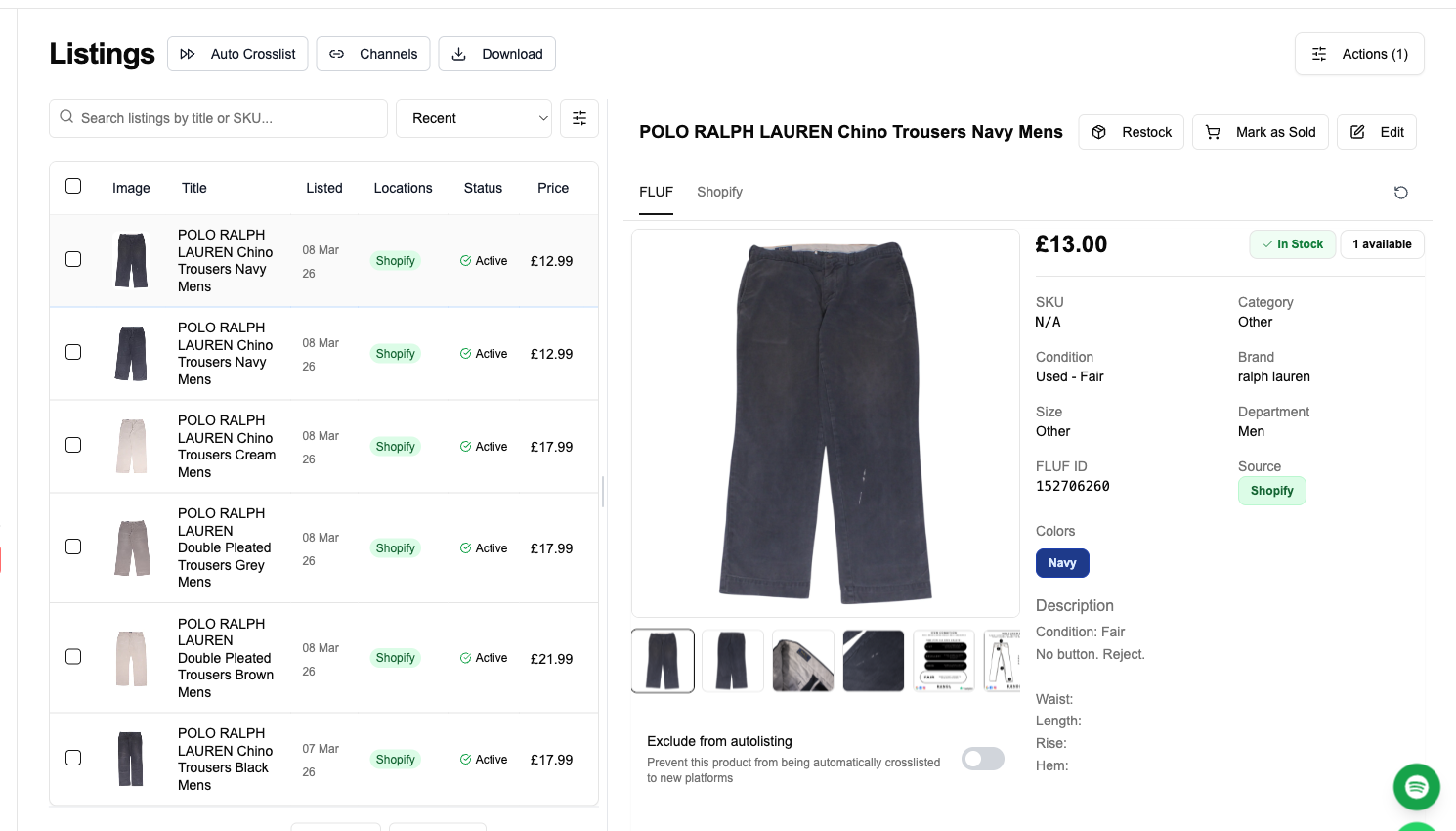
- Search your listings. Type into the search bar and your products appear as you type, most recently listed first, each showing its photos.
- Click the images you want. Click any single photo to add it, or use Add all to pull in every photo from that item at once. You can mix in images from your own device too — drag and drop on the web, camera roll on the app.
- Write or generate the caption. Pick a tone, add any instructions of your own, and generate — or just type it yourself.
- Post now, or schedule it. Pick a date and time and FLUF emails you when it is scheduled and again when it goes out.
The activity log keeps what happened: when each post went out, a preview of the caption, and a link to the published post.
Building A Carousel That Is Worth Posting
A carousel holds between 1 and 10 images. That ceiling is Instagram’s, not a FLUF limit — the app itself now allows up to 20 in a manually created carousel, but Instagram’s Content Publishing API caps a carousel at 10, and any tool that publishes on your behalf goes through that API.
Ten is more than enough, and in practice fewer is better. Three shapes work for resale:
The single item, properly. Five or six photos of one piece — front, back, label, fabric, the flaw. This is the closest thing to a listing and it is what the Add all button is for.
The drop. One photo each from eight or ten items you have just listed. Highest-performing format for most sellers, because it gives a follower a reason to go and look at the wardrobe rather than at one thing.
The theme. Everything you have in one colour, one decade, one category. Costs you nothing — the photos exist — and it is the format that makes a wardrobe feel curated rather than accumulated.
Supported formats are JPEG, PNG and WebP at up to 8MB per image. Instagram’s own recommendation is square at 1080 × 1080 or portrait at 1080 × 1350.
Captions, And What The AI Is Actually Looking At
The caption generator reads the images in your carousel rather than only the product title, which is why it can describe what is actually in the photograph instead of restating the listing.
You pick a tone — Engaging, Professional, Casual, Funny or Minimal — and can add instructions of your own, like mentioning free postage or asking for a specific call to action. It includes up to 15 relevant hashtags and stays inside Instagram’s 2,200-character caption limit. You can edit whatever comes back, and you should: the generated caption is a good first draft and a mediocre final one, because it does not know that the jacket came from a market in Lisbon.
Two things it cannot do for you. It cannot know your prices are negotiable, and it cannot tell somebody where to click. Both belong in the sentence you add yourself.
Scheduling, And The Limits That Apply
Scheduling is where this stops being a convenience and becomes a system. The realistic pattern for a working reseller is a batch: list a run of items on Vinted, then in one sitting build three or four posts from those photos and schedule them across the week.
Two limits are worth knowing. Instagram’s publishing API allows 100 API-published posts within a rolling 24-hour period, which no honest reseller will approach. And the API requires a professional account connected to a Facebook Page — if your account needs Page Publishing Authorization, publishing will not work until that is completed, which is a one-off piece of admin that catches people at the worst moment.
You will also get an email when a post is scheduled and another when it publishes, which matters more than it sounds: a scheduled post that silently failed at 7pm on a Thursday is worse than no scheduling at all.
Vinted Photos Are Not Instagram Photos
This is the part where expectations need managing, and it is better said here than discovered after four posts.
A Vinted photo has one job: show the item honestly to someone who has already searched for it. Flat on a bed, good light, label close-up, a shot of the mark on the sleeve. It is documentation, and it is the right way to photograph for a marketplace.
An Instagram photo has to interrupt somebody who was not looking for anything. The same flat-lay in a scrolling feed is unremarkable — not bad, just unremarkable, which on Instagram is the same thing.
Which does not mean reshooting everything. It means picking your best two or three items each week and giving them one photograph with some intent behind it — worn, styled, hung against a wall that is not your bedroom door — and letting the honest documentation photos fill the rest of the carousel. Your best image goes first, because in a feed the first image is most of the decision.
What To Post In A Week Where You Listed Nothing
The failure mode of every reseller Instagram account is the same: three good weeks, then a fortnight of silence because there was no new stock, then a restart from a colder audience than before.
Having the whole wardrobe searchable inside FLUF is what fixes that, because the constraint was never ideas — it was that assembling a post from old listings meant hunting through the app for photos you uploaded in March. When the images are one search away, a quiet week has plenty to say.
Things that cost nothing because the photographs already exist: the pieces that have been sitting longest and deserve another look; everything under £15; one designer or one era; the item you are most reluctant to part with; a carousel of the five best-condition pieces currently listed. None of these require new stock, new photography or a new idea, and all of them point at the same bio link.
This Is Not A Substitute For Bumping, And Bumping Is Not A Substitute For This
Vinted gives you levers of its own — the paid bump, the wardrobe spotlight, and the simple fact that relisting refreshes an item’s position. Those work on the audience Vinted already has, which is enormous and actively shopping.
Instagram does something different in kind. It is not competing for a buyer who is already browsing resale; it is reaching a person on the sofa who was not shopping at all, and it is building a list of those people so you can reach them again for free next month.
Run both. Vinted’s tools capture existing demand; Instagram creates the audience that makes next season’s listings land on people who already know your taste. Neither replaces the other, and sellers who treat the two as alternatives usually end up doing neither properly.
Four Things That Catch Resellers Out
Posting sold items. Nothing syncs, so FLUF does not know an item went yesterday unless you do. Building a carousel from a search result that includes sold stock is the most common mistake here, and it produces the worst possible outcome: interest you cannot fulfil.
Treating the caption as the shop window. It is not clickable and it never will be. The bio link is the mechanism; the caption exists to point at it.
Batching everything into one day. Ten posts on a Sunday and silence until the next Sunday performs far worse than three posts spread across the week. Scheduling exists precisely to fix this and most people still do not use it.
Expecting attribution. You will not be able to prove which post produced which Vinted sale, because Vinted does not report a traffic source. Instagram’s own insights will tell you what people engaged with, and that is the signal you have. Anyone promising you clean attribution between these two platforms is selling something.
Pricing
FLUF Connect starts with 7 days for £1, with every feature available immediately. After that, plans start at £9/month for Starter, covering 300 active products, then Growth at £19/month and upwards by catalogue size. There is no free plan.
Instagram posting is included on every plan, as is every marketplace channel and the automation that runs on the channels that support it — for Vinted, that means relisting, offer management, order sync and sold-detection, all of which happen on the Vinted side rather than the Instagram one.
Sources & Verification
- Meta — Q3 2025 earnings call transcript (29 October 2025) — Instagram passing 3 billion monthly actives.
- Instagram Help — professional accounts — the Business and Creator distinction, what each unlocks, and the rule that a professional account cannot be private.
- Meta for Developers — Instagram Content Publishing API — carousels limited to 10 items via the API; 100 API-published posts per rolling 24 hours; the professional-account-connected-to-a-Page requirement and Page Publishing Authorization.
- Adam Mosseri, Head of Instagram (9 August 2024) — the in-app carousel limit rising to 20, which is the app’s limit rather than the API’s.
- Meta — changes to Shops and checkout — from September 2025 shops on Facebook and Instagram use website checkout, and post-purchase management in Commerce Manager has been discontinued.
- Meta — product tagging — tagging catalogue products remains available as a discovery surface.
- Vinted UK — price list — the Buyer Protection charge that the buyer pays.
- Vinted Pro (UK) — no seller commission and no listing fee.
Last verified 22 August 2026. Platform features and limits change without notice; where this page and the source disagree, the source is right.
Frequently Asked Questions
No, and it is worth being blunt about it. Instagram is not a marketplace in this workflow — there is no inventory, no stock level, no order and no sale on it. FLUF does not sync stock to Instagram, import orders from it, relist there, manage offers there or mark anything sold there. What it does is turn the photographs already on your Vinted listings into Instagram posts and carousels.
A professional account — either Business or Creator. Personal accounts are not supported, because Instagram's own Content Publishing API does not work with them. Worth knowing before you switch: a professional account cannot be set to private, and pending follow requests are accepted automatically.
Between 1 and 10. That ceiling is Instagram's rather than FLUF's — the app now allows up to 20 in a manually built carousel, but the Content Publishing API that any scheduling tool must use caps a carousel at 10. Supported formats are JPEG, PNG and WebP at up to 8MB per image.
No. Instagram captions are not clickable and never have been, so the traffic mechanism is the link in your bio rather than the post itself. Write the caption and the bio link as a pair — something like “new drop, 14 pieces, link in bio” works because it gives a reason to leave the app and says where the door is.
Yes. Build the carousel and caption, click Schedule, pick a date and time, and you get an email when it is scheduled and another when it publishes. Instagram's API permits 100 published posts in a rolling 24-hour period, which no reseller will approach, and it requires a professional account connected to a Facebook Page — if yours needs Page Publishing Authorization, complete that first.
Not for the purposes of this feature, because nothing syncs in this direction. If you build a carousel from a search result that includes sold stock, you will promote items you cannot supply — which is the single most common mistake here, and the one with the worst outcome. Check before you post.
They work; they rarely stand out. A Vinted photo documents an item honestly for someone who already searched for it, which is exactly right for a marketplace. An Instagram photo has to interrupt someone who was not looking for anything. The practical answer is not to reshoot everything — give your best two or three items each week one deliberate photograph, put it first in the carousel, and let the documentation shots fill the rest.
Not reliably, and you should be sceptical of anyone claiming otherwise. Vinted does not report a traffic source, so there is no clean attribution path between the two platforms. Instagram's own insights on a professional account will tell you what people engaged with, and that is the signal you actually have to work with.