
Crosslist from Wix to Amazon: barcodes, Brand Registry and what syncs
How a Wix brand adds Amazon as a demand channel with FLUF Connect: what Wix's own Amazon connector does and where it stops, why your barcode does not travel with the product, and which direction stock protection runs today.



- Wix already ships an Amazon channel, so the first question is whether you need anything else. It covers 19 Amazon countries, needs your site in one of five languages, and binds one Amazon account to one Wix site. If Amazon is the only marketplace you will ever add, use it. If it is the first of several, read on.
- Your barcode does not travel with the product. Wix stores a barcode or GTIN per variant, but the FLUF Connect import from Wix carries the SKU and not the barcode. You add the EAN, UPC or ASIN to the product record in FLUF before its first Amazon listing.
- An own brand with no barcodes has three routes. Buy GTINs from GS1 (from £50 a year in the UK, $30 each in the US), apply for a GTIN exemption in Seller Central, or enrol in Brand Registry on a pending trademark. FLUF Connect needs the result of route one, or an ASIN produced by routes two and three.
- Amazon’s per-sale cost is a commission; Wix’s is card processing. A £32 homeware item costs about £0.87 to take through Wix Payments in the UK and £4.80 in Amazon referral fee. That gap is the price of demand you did not have to generate.
- Stock protection runs from Wix outward. A Wix sale ends the Amazon offer within minutes. An Amazon sale does not yet reduce your Wix stock through FLUF, so for now you reconcile Amazon orders by hand.
- Relisting, offers and smart pricing do not apply on Amazon. An Amazon offer is not a listing that ages, and Amazon has no seller-side offer inbox to manage. Crosslisting, price and stock updates are what you get, and that is the whole job here.
- Through FLUF Connect: one Wix catalogue, 51 marketplaces, both channels connected without a browser extension. 7 days for £1, then from £9/month, then plans from £9/month.
On this page
- Who this route is for
- What Wix’s own Amazon channel does, and where it stops
- The barcode field: what Wix holds and what arrives in FLUF
- Own-brand stock with no barcodes
- Which Wix products can go at all
- Two cost stacks, side by side
- What transfers, field by field
- What syncs, and the direction that does not
- Setting it up, step by step
- What it costs
- Sources and verification
- Related guides
Who this route is for
The typical Wix store is a small brand that makes or sources its own products: candles, ceramics, skincare, pet accessories, a printed-apparel line. Wix gave the founder a shop that looks like the brand without a developer. What it cannot give them is footfall; every visitor is earned through Instagram, email and markets, and at some point that ceiling shows in the monthly numbers.
Amazon is the opposite trade. Nobody browses Amazon to discover your brand, but people type the kind of product you make into its search box every day, with a card already on file. Adding it as a demand channel means paying a commission per sale for buyers you would never otherwise reach.
This page assumes your products are new, that some have barcodes and some do not, and that Amazon is probably not the last marketplace you will add. A brand that starts with Amazon usually looks at Etsy next, then eBay or TikTok Shop.
What Wix’s own Amazon channel does, and where it stops
Wix is one of the few website builders with a marketplace connector of its own, and it deserves an honest description. The Wix multichannel page lists Amazon alongside eBay, Facebook, Instagram and Wish, and the Amazon connector is built by Wix itself.
Its help article, Connecting and Setting Up an Amazon Shop, sets out what it does. You connect an existing Amazon seller account, choose the marketplace, and either match each Wix product to an existing Amazon catalogue entry or create a new one. Inventory syncs both ways, you can cap how many units of a variant Amazon sees, and an automatic restock setting tops the Amazon quantity back up at a floor you choose. Amazon orders appear in Wix, and Fulfilled by Amazon is supported.
The same article lists its boundaries, and three matter for a growing brand.
Countries. The connector supports 19 Amazon stores: Australia, Belgium, Brazil, Canada, Egypt, France, Germany, India, Italy, Japan, Mexico, the Netherlands, Poland, Saudi Arabia, Singapore, Spain, Sweden, the United Kingdom and the United States. Amazon Ireland, the UAE, Turkey and South Africa are not on that list. FLUF Connect reaches all 23 stores Amazon registers sellers in, including those four.
Language. The article requires that your Wix site is in English, French, German, Spanish or Japanese. A Dutch, Italian, Swedish or Polish store cannot use it, even though the Dutch, Italian, Swedish and Polish Amazon stores are on the supported list.
One account, one site. Each Amazon account can connect to one Wix site. Two Wix sites, or a Wix site plus a storefront elsewhere, cannot share one Amazon account through the connector.
A naming trap, too. Wix has had two Amazon apps. The older Amazon app was a gallery widget showing up to 30 Amazon items on a Wix page; Wix’s article states it stopped being supported on 4 May 2025. The current connector is listed in the App Market as Amazon with Wix.
Where FLUF Connect differs is scope. It connects Wix as a source and Amazon as one destination among 51, so the record that becomes an Amazon offer can also become an Etsy, eBay or TikTok Shop listing without re-entry. There is no language requirement on the Wix side, and one Wix connection can feed several marketplaces. Where Wix’s connector is ahead today is the reverse direction: it pulls Amazon orders into Wix, and FLUF Connect does not yet detect Amazon sales. If Amazon is your only marketplace, that fact alone may decide it.
The barcode field: what Wix holds and what arrives in FLUF
Amazon does not list a product; it lists an offer against a catalogue entry, and to find or create that entry it needs a product identifier. In practice that is an ASIN if the product is already in Amazon’s catalogue, or an EAN, UPC or ISBN if it is not.
Wix has a place for that number. Its product options article says you can give each variant a unique SKU, barcode or GTIN, so a brand that has been diligent may have every EAN typed into Wix already.
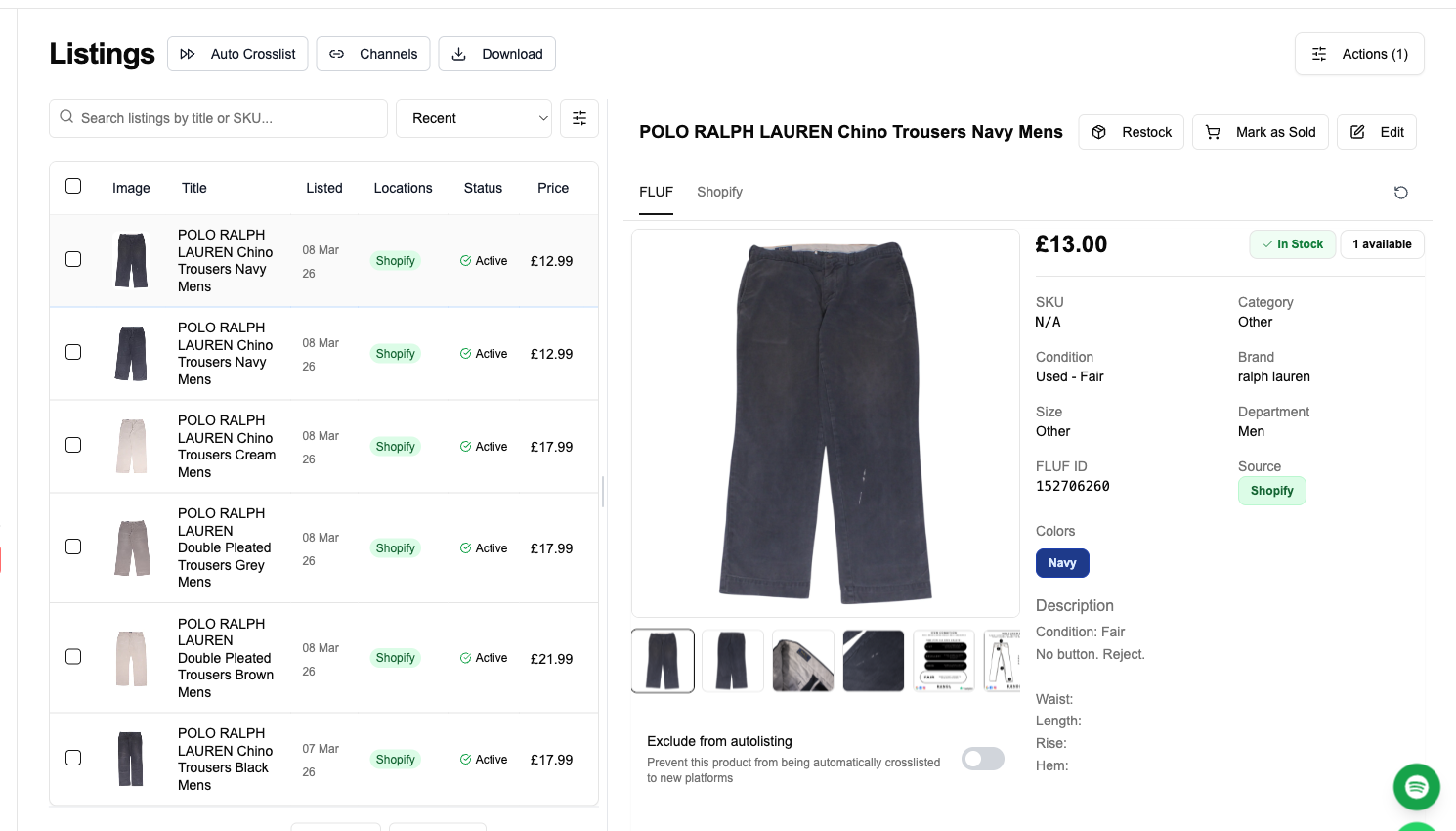
Here is the plain statement this page owes you: the FLUF Connect import from Wix carries the SKU across, and does not carry the barcode. A product that arrives from Wix has its title, description, images, price, stock, category and options, and its SKU, but the barcode column in FLUF starts empty. When you then send that product to Amazon, FLUF refuses it before an attempt is spent and tells you it needs an ASIN or a barcode.
So there is a data-entry step between import and first listing. For each product you want on Amazon, open it in FLUF and add either:
- The barcode, if you own a real GS1 number for it. FLUF checks the length and treats 8, 12, 13 and 14 digits as EAN, UPC or GTIN and 10 or 13 as ISBN; a warehouse label code that happens to be numeric is dropped rather than sent, so do not paste internal codes here.
- The ASIN, if the product already exists on Amazon. This is the lower-friction path: attaching an offer to an existing ASIN needs no product-type form and inherits the page’s photographs and title.
With dozens of products, export the barcode column from Wix and work through the FLUF list in one sitting. It is a one-off per product; once the identifier is on the record, every later Amazon operation uses it.
SKUs do more work on Amazon than on Wix. Amazon addresses every listing by seller ID and SKU, and FLUF Connect uses the Wix SKU as that key. Keep SKUs unique per variant and stable; a changed SKU is, to Amazon, a different listing.
Own-brand stock with no barcodes
Most small Wix brands have never bought a barcode, because nothing in their life required one. Amazon does. There are three ways through, and they are not mutually exclusive.
Route one: buy GTINs from GS1
GS1 issues the barcodes marketplaces recognise, and Amazon checks numbers against its records, so a number bought from a reseller of old prefixes is a risk rather than a shortcut. Pricing differs sharply by country. GS1 UK sells membership by turnover: £50 a year excluding VAT for a business turning over under £100,000, which licenses 10 GTINs, rising to £100 a year for 100 GTINs at the next band. GS1 US sells a single GTIN outright for $30 with no renewal, or a company prefix from $250 with a $50 annual renewal for the smallest tier. A UK brand with a dozen products pays £100 a year; a US brand with four products is done for $120 once.
This is the route FLUF Connect works with directly. Add the GTIN to the product in FLUF and the listing goes through as a full submission, with your title, description, brand and images, and Amazon either matches it to an existing catalogue entry or creates one.
Route two: a GTIN exemption
Amazon’s GTIN exemption help page describes the application: you name the brand exactly as it appears on the product (or enter Generic for unbranded items), pick the category, and upload between two and nine photographs showing every side of the product and its packaging, with no barcode visible. A seller who is not the brand owner also needs a letter from the manufacturer. Amazon answers by email, typically within 48 hours.
FLUF Connect does not use the exemption itself. An exempt product is listed in Seller Central by hand; once it exists, copy its ASIN onto the product in FLUF and the sync takes over. Five products is an afternoon; fifty makes route one cheaper in time.
Route three: Brand Registry
Amazon UK’s Brand Registry page states that enrolment costs nothing and accepts either a registered trademark or a pending application, provided it is a word mark or an image mark containing words, letters or numbers. Once enrolled, the brand owner controls the listing content, gains A+ content and a brand store, and, in practice, has the exemption question settled for that brand. The page also advertises an incentive for new sellers of 10% back on the first £40,000 in branded sales, then 5% through the first year.
For a brand that has already spent on photography and copy, Brand Registry is the difference between Amazon showing your work and showing whatever a reseller uploaded first, and a pending trademark application is enough to enrol.
Which Wix products can go at all
Three filters before you bulk-select the whole catalogue.
Physical, not digital. Wix sells digital downloads and services alongside physical goods. Amazon’s marketplace, as FLUF Connect reaches it, is for physical products. Wix’s own connector states that digital products cannot be listed on Amazon, and the same applies here.
New, in the categories Amazon guards. Amazon’s UK condition guidelines permit only New items in Apparel and in Grocery, and treat beauty and personal care as sealed-and-unused or nothing. A brand selling its own new stock is fine; samples, seconds and returns stay on your own site.
Variants that Amazon can express. Wix’s limits article allows up to six options per product, 100 choices per option and 1,000 variants per product. Amazon’s variation themes are fixed per category and typically run to two dimensions such as size and colour. FLUF Connect imports each Wix variant as its own product record, so a product with a size option becomes one record per size, each carrying its own SKU, price and stock. Those records list on Amazon as separate SKUs; grouping them into a parent-and-child family is done once in Seller Central.
Two cost stacks, side by side
The two platforms charge in different shapes, which is why they are hard to compare on a single line. Wix charges a plan, and then card processing per sale. Amazon charges a plan, and then a commission per sale that already includes payment handling.
On the Wix side, the plans that accept payments are Core, Business and Business Elite, priced by region on the Wix plans page. Wix’s Wix Payments fees article gives the processing rate as 2.9% of the transaction plus $0.30 for standard cards in the United States (3.7% for American Express) and 2.1% plus £0.20 in the United Kingdom (3.1% for American Express). Those are the per-sale costs of a standard store sale through Wix Payments; a third-party processor charges its own rate instead.
On the Amazon side, the UK pricing page lists the Professional plan at £25 a month excluding VAT, or an Individual plan at £0.75 per unit sold, and the US page at $39.99 a month or $0.99 per unit. Referral fees are by category and price band: Home 8% up to £20 and 15% above; Beauty and Health 8% up to £10 and 15% above; Clothing 5% up to £15, 10% to £20 and 15% above; Electronics 7%; Books 15%; Jewellery 20% up to £225 then 5%; with a £0.25 minimum on most categories. The US table is close in shape: Home and Kitchen 15%, Beauty 8% to 15%, Clothing 5% to 17%, Consumer Electronics 8%, Jewelry 20% up to $250 then 5%, minimum $0.30. Fulfilment by Amazon is a separate charge on top, based on size, weight and storage time.
| Line | Wix store (UK) | Amazon (UK) | Wix store (US) | Amazon (US) |
|---|---|---|---|---|
| Monthly plan | Core, Business or Business Elite (regional pricing) | £25 ex VAT Professional, or £0.75 per unit | Core, Business or Business Elite (regional pricing) | $39.99 Professional, or $0.99 per unit |
| Per-sale charge | 2.1% + £0.20 (Wix Payments, standard card) | Referral fee by category, 5–20%, min £0.25 | 2.9% + $0.30 (Wix Payments, standard card) | Referral fee by category, 5–20%, min $0.30 |
| £32 / $40 homeware item | £0.87 | £4.80 (15%) | $1.46 | $6.00 (15%) |
| £18 / $22 skincare item | £0.58 | £2.70 (15%) | $0.94 | $3.30 (15%) |
| Fulfilment | Your own postage | Your own postage, or FBA fees | Your own postage | Your own postage, or FBA fees |
Read the table as a demand price, not a penalty: the Wix sale cost you the marketing that brought the buyer, the Amazon sale cost a commission because Amazon brought them. Many brands price the two channels differently for that reason. What Amazon watches is an Amazon price sitting well above your own site’s, so if Wix runs a sale, mirror it or keep it short.
What transfers, field by field
FLUF Connect reads the Wix product, holds one record per variant, and builds the Amazon submission from it. Because Amazon’s product page belongs to the catalogue rather than to you, how much of your content is used depends on whether you attach to an existing ASIN or create a new entry.
| Wix field | Imported into FLUF | Amazon, offer on an existing ASIN | Amazon, new catalogue entry (barcode path) |
|---|---|---|---|
| Product name | Yes | Not used; the catalogue title shows | Becomes the item name |
| Description | Yes, as plain text | Used as the condition note only (up to 2,000 characters) | Product description, plus the condition note |
| Gallery images | Yes, main image plus gallery | Not used; the catalogue images show | Main image plus up to eight more, fetched from public URLs |
| Price | Yes, per variant | Yes, in the store currency | Yes, in the store currency |
| Stock quantity | Yes, per variant | Yes, merchant-fulfilled quantity | Yes, merchant-fulfilled quantity |
| SKU | Yes | Yes, as the listing key | Yes, as the listing key |
| Barcode / GTIN | No: add it in FLUF | Not needed if you add the ASIN | Required |
| Options (size, colour, brand, condition) | Yes, where the option is named that way in Wix | Brand not needed; condition mapped to Amazon’s grades | Brand sent when present; condition mapped to Amazon’s grades |
| Wix category | Yes, mirrored per store | Not used | Used to suggest the Amazon product type, which you can override |
| Ribbons, SEO settings, custom text fields | No | No | No |
| Hidden products | Imported but flagged as not visible | Not sent unless you choose them | Not sent unless you choose them |
Two rows deserve a sentence. Condition: a product with no condition set goes to Amazon as used in good condition, the conservative default for a marketplace that penalises over-grading, so set New on each product before the first push or your new candles arrive graded as used. Product type: Amazon has no free-form category, only fixed product types with required attributes that vary by country. FLUF suggests a type and lets you choose; a first submission that comes back listing missing attributes is normal, and each is a field to fill rather than a failure.
What syncs, and the direction that does not
The honest map of what moves, once a product is live in both places.
| Event | What FLUF Connect does |
|---|---|
| You sell the item on Wix | Detected through Wix order sync. The Amazon quantity is set to zero, and the same happens on every other channel the item is on. For multi-unit stock the Amazon quantity is reduced rather than zeroed. |
| You sell the item on Amazon | Not detected yet. Wix stock does not change, and other channels stay live. Mark the item sold in FLUF, or reduce its stock, and the update fans out from there. |
| You change the price in Wix | Picked up on the next scan of your Wix catalogue and pushed to Amazon, unless you have set a separate Amazon price in FLUF. |
| You restock in Wix | Picked up on the next scan; the Amazon quantity rises to match. |
| You edit the title or description in Wix | Updated in FLUF; pushed to Amazon where Amazon lets you control that content (your own catalogue entries, or a brand you own). |
| You sell the item on another connected marketplace | The Wix stock is set to zero and the Amazon offer is ended, along with every other channel. |
| Stock held at an Amazon fulfilment centre | Left alone. FLUF recognises an FBA offer and does not try to set its quantity. |
The missing row is the one to plan around. Until Amazon sale detection ships, Seller Central’s order page is part of the morning routine: each Amazon order becomes a stock adjustment in FLUF, which flows to Wix and everywhere else. A handful of orders a day is minutes; at hundreds, Wix’s own connector may be the better fit until this closes.
Relisting strategies, offer management and smart pricing are not part of the Amazon channel. An Amazon offer does not expire or sink with age the way an eBay listing does, so there is nothing to relist, and Amazon has no seller-facing offer negotiation to automate. Those tools apply to the other marketplaces you connect, and they come with the plans above Starter.
Setting it up, step by step
- Prepare Wix. Give every product a unique SKU per variant, a condition option reading New where true, and a physical product type. Export the barcode column if you have one.
- Connect Wix. In your Wix account, create an API key with the Wix Stores and Wix eCommerce permissions, copy your Site ID, and paste both into FLUF. No browser extension is involved. FLUF imports the catalogue.
- Connect Amazon. You need a Professional selling plan. Choose your region and approve FLUF Connect in Seller Central. Again, no extension.
- Add identifiers. For each product, add the barcode or the ASIN in FLUF. Products without one are refused at listing time with a clear message.
- Crosslist. Select the products and send them. Attachments to existing ASINs go through quickly; new catalogue entries may come back asking for product-type attributes, which you fill in and resend.
- Check the first live listing in Seller Central. Confirm the condition reads New, the currency is right, and the description formatting looks right.
- Build the daily loop. Wix sales take care of themselves; Amazon sales are entered in FLUF by hand for now.
What it costs
7 days for £1, then from £9/month, then plans from £9/month. Starter includes crosslisting, inventory sync, order sync and bulk operations with unlimited listings, which covers everything on this page. Relisting, offer management and smart pricing come with the plans above Starter, and apply to marketplaces where those tools make sense, not to Amazon. Save 40% when you pay yearly.
Sources and verification
- Wix Help Center: Connecting and Setting Up an Amazon Shop (supported countries, language requirement, one-account-per-site rule, sync behaviour, digital products excluded)
- Wix eCommerce: multichannel sales
- Wix App Market: Amazon with Wix
- Wix Help Center: Adding and Setting Up the Amazon App (the older affiliate gallery, unsupported from 4 May 2025)
- Wix Help Center: Wix Payments service fees (US and UK processing rates)
- Wix premium plans
- Wix Help Center: Adding product options (SKU, barcode or GTIN per variant)
- Wix Help Center: Wix Stores limits and recommended guidelines
- Amazon UK: selling plans and referral fees
- Amazon US: selling plans and referral fees
- Amazon UK: Brand Registry
- Amazon Seller Central: GTIN exemption
- Amazon UK: Condition guidelines (PDF)
- GS1 UK: membership cost
- GS1 US: barcodes and prefixes
What we could not verify. Wix’s plans page shows regional pricing and prints no transaction-fee line, so this page describes Wix’s per-sale cost as Wix Payments processing rather than quoting a platform commission; check your plan’s terms. Wix’s connector article states no fees or product-count ceiling, and we have not tested its listing flow ourselves. Amazon’s referral bands are as published on the day of writing and change periodically; FBA fees were not itemised. GS1 UK has announced changes to additional-number pricing during 2026. FLUF Connect’s Amazon channel is new, so read the listing log after your first push and check each listing in Seller Central before you send the rest.
Related guides
Frequently Asked Questions
No. The import from Wix brings the SKU, title, description, images, price, stock, category and options, but not the barcode or GTIN field. Before a product’s first Amazon listing you add its EAN, UPC or ISBN, or the ASIN of the matching Amazon catalogue entry, to the product in FLUF Connect. Products without one are refused at listing time with a clear message rather than failing silently.
Use Wix’s own connector if Amazon is the only marketplace you will ever add and you fulfil from Wix: it pulls Amazon orders into Wix, which FLUF Connect does not yet do. FLUF Connect makes more sense when Amazon is one of several channels, because one Wix catalogue then feeds 50+ marketplaces without re-entry, there is no requirement that your Wix site is in English, French, German, Spanish or Japanese, and it reaches Amazon stores the Wix connector does not list, including Ireland, the UAE, Turkey and South Africa.
You need either a real GS1 barcode or an ASIN. GS1 UK licenses 10 GTINs for £50 a year excluding VAT at the smallest turnover band; GS1 US sells a single GTIN for $30 with no renewal. Alternatively apply for a GTIN exemption in Seller Central with two to nine photographs of the product and packaging, or enrol in Brand Registry on a registered or pending trademark, list the product in Seller Central yourself, and add its ASIN to the product in FLUF Connect.
FLUF Connect picks the Wix order up through order sync and sets the Amazon quantity to zero within minutes, along with every other marketplace the item is on. For multi-unit stock the Amazon quantity is reduced rather than zeroed.
FLUF Connect does not yet detect Amazon sales, so your Wix stock and other channels do not change on their own. Reduce the stock or mark the item sold in FLUF Connect and the update flows to Wix and everywhere else. Until Amazon sale detection ships, treat Seller Central’s order page as part of your daily routine.
All 23 stores Amazon registers sellers in: the United States, Canada, Mexico, Brazil, the United Kingdom, Ireland, Germany, France, Italy, Spain, the Netherlands, Belgium, Sweden, Poland, Turkey, the UAE, Saudi Arabia, Egypt, South Africa, India, Japan, Australia and Singapore. You need an Amazon Professional selling plan on the store you sell in, which is £25 a month excluding VAT in the UK and $39.99 in the US.
No, and they would not help there. An Amazon offer does not expire or lose visibility with age the way an eBay listing does, so there is nothing to relist, and Amazon has no seller-facing offer negotiation to automate. Those tools apply to the other marketplaces you connect, and they come with the plans above Starter. On Amazon you get crosslisting, price and stock updates, and sold-elsewhere protection.
Each Wix variant is imported as its own product record with its own SKU, price and stock, and each lists on Amazon as a separate SKU. Grouping them into a parent-and-child family with a variation theme such as size or colour is a one-off task in Seller Central, because that relationship is built on Amazon’s side rather than copied from Wix.
Yes. Every plan is 40% cheaper when paid yearly rather than monthly, with the same features either way. The cheapest plan is Starter at £9 a month with unlimited listings.