
How to Sell on Debenhams — The Complete Guide for 2026
Debenhams is a curated, Mirakl-powered marketplace for registered UK businesses — not an open resale app. Here's exactly who qualifies, what it costs, and the honest status of FLUF Connect's integration with it.
7 days for £1, then from £9/month.



Key Takeaways
- Debenhams is a Mirakl-powered, curated marketplace run by Debenhams Group (formerly Boohoo Group plc, renamed in March 2025) — third-party brands and businesses list stock on debenhams.com and ship it themselves source.
- It is not an open, sign-up-and-list channel like eBay or Vinted. Sellers apply, and Debenhams reviews every application against seller-performance criteria before granting access source.
- Fees: no setup cost; a £25/month subscription waived for your first year; a category-based commission averaging around 20%, with other reporting putting the working range at roughly 15%–25% depending on category source source.
- Scale: the Debenhams brand posted £318.8m in GMV in H1 FY26 (six months to 31 August 2025), up 20% year-on-year, with third-party marketplace sales now over 25,000 partner brands as of mid-2026 — up from roughly 1,500 in early 2023 source source.
- Best for: registered UK businesses with EAN/GTIN-barcoded stock and an existing track record (top-rated Amazon/eBay seller status, or a 4+ Trustpilot score) — not casual individual resellers clearing a wardrobe source.
- FLUF verdict: a genuinely fast-growing, high-traffic UK channel for the right kind of seller, but a curated business marketplace, not a resale app — and, honestly, FLUF’s own connection to it isn’t self-serve yet (more on that below).
What Is Debenhams Marketplace?
Debenhams marketplace is a curated, Mirakl-powered online platform where third-party UK businesses list and sell fashion, beauty, and home products on debenhams.com, fulfilling orders themselves while Debenhams provides the storefront, traffic, and checkout. It is run by Debenhams Group — the listed company formerly known as Boohoo Group plc, which renamed itself in March 2025 after Debenhams became its most important growth driver source.
That’s a very different business to the 242-year-old bricks-and-mortar department store many shoppers remember. Debenhams the physical retailer collapsed into administration and closed its last stores by May 2021. Boohoo Group bought the brand name and online operation for £55 million out of administration in January 2021, and relaunched debenhams.com as an online-only retailer that April source. What trades under the Debenhams name today is legally DBZ Marketplace Online Limited — the department store’s brand and reputation, running on entirely new, marketplace-first infrastructure source.
Debenhams operates on the Mirakl marketplace platform — the same enterprise SaaS technology behind hundreds of large-retailer marketplaces worldwide, including ASOS Marketplace. On Mirakl, “products” (the shared catalogue) are separate from “offers” (a seller’s price, stock, and condition against a product). For Debenhams, sellers attach offers to catalogue items matched by barcode (EAN/GTIN) rather than freely creating brand-new listings from scratch — a model built for established, barcoded retail stock, not one-off or handmade items.
| Metric | Detail |
|---|---|
| Relaunched as marketplace | 5 October 2021, powered by Mirakl source |
| Parent company | Debenhams Group PLC (renamed from Boohoo Group plc, March 2025) source |
| Headquarters | Manchester, UK source |
| Third-party marketplace partners | 25,000+ as of mid-2026 source |
| Debenhams brand GMV (H1 FY26) | £318.8m, up 20% year-on-year source |
| Marketplace share of GMV (H1 FY26) | 31.6%, up from 19% a year earlier source |
| Top categories | Womenswear, menswear, beauty, fragrance, home, sport, kids & baby, jewellery, limited electronics source |
| Revenue model | Monthly subscription + category-based commission per sale (see Fees below) |
From 242-Year-Old Department Store to Mirakl Marketplace
Understanding what Debenhams is today means understanding what it used to be. The original Debenhams traced its roots back to 1778 and grew into one of Britain’s best-known department store chains, with dozens of stores anchoring high streets and shopping centres for generations source. Like much of UK department-store retail, it struggled through the 2010s, entered administration, and — accelerated by the pandemic — closed its remaining stores in 2021, ending 242 years of physical trading source.
Boohoo Group — then a pure online fast-fashion retailer built around its own boohoo, boohooMAN, and PrettyLittleThing brands, plus a string of acquired names including Karen Millen, Coast, Oasis, and Warehouse — bought the Debenhams brand and website for £55 million in January 2021 source. Rather than restock Debenhams as a traditional online retailer buying and holding its own inventory, Boohoo relaunched it in October 2021 as a third-party marketplace built on Mirakl — starting with around 200 brands at launch and growing weekly, with more than 70,000 new products added within the first three months source. The explicit ambition, stated at launch, was to become the UK’s largest marketplace across fashion, beauty, sport, and homeware source.
The growth since has been fast by any retail standard. Debenhams counted roughly 1,500 partner brands in early 2023 source. By August 2024 that had grown to 3,500 (more than double the 1,600 of the year before), with a public target of 10,000 brands by year end source. Through 2025 the platform added roughly 11,000 new partners, pushing the total past 15,000 by the time it launched a self-service retail media network that November source. By mid-2026, reporting put the count above 25,000 partner brands source.
The single biggest corporate development for anyone researching this channel: in March 2025, Boohoo Group plc formally renamed itself Debenhams Group PLC, with shareholders voting 62.04% in favour source. This wasn’t a cosmetic rebrand of the boohoo, boohooMAN or PrettyLittleThing brands themselves — those continue trading under their own names — but it confirms that Debenhams’ lean, capital-light marketplace model is now considered the group’s core growth engine, not a side project source. Frasers Group (Mike Ashley’s retail conglomerate) holds a 26.86% stake in the renamed company, alongside Boohoo co-founder Mahmud Kamani (11.46%) and Camelot Capital Partners (8.34%) source — worth knowing if you’re weighing the platform’s stability, since a major shareholder with its own retail interests sitting on the register tends to keep management’s feet to the fire.
Why Sell on Debenhams in 2026?
The case for Debenhams comes down to one thing: a large, established UK retail brand pointing genuine buying traffic at third-party stock, at a moment when that traffic is growing quickly rather than shrinking. Debenhams Group’s most recent trading update (mid-2026) reported continued sales growth through June and July, two upward profit-forecast revisions in recent months, and management guidance toward £100m+ EBITDA and a multi-billion-pound GMV business for the Debenhams brand specifically source. A separate investor briefing put the specific target at £1bn+ GMV and £50m+ EBITDA for the Debenhams brand alone within three years source.
Three things stand out for a seller evaluating this channel against the more familiar names:
1. A department-store audience your resale app doesn’t reach
Debenhams’ buyer base skews toward shoppers who came for a trusted, mid-market department-store experience rather than a peer-to-peer marketplace vibe. Third-party analysis of debenhams.com traffic puts the core buying group at women aged 25–55, with the fastest-growing segment being 25–34-year-olds, and a meaningful secondary base of over-60 shoppers loyal to household and homeware categories source. That’s a genuinely different audience to Depop‘s Gen Z resale crowd or Vinted‘s value-conscious peer-to-peer base.
2. Real, growing traffic
Debenhams reports over 300 million site visits a year, with third-party monitoring putting recent monthly traffic at around 10–11 million visits source. That’s audience scale most standalone brand websites can’t buy their way to.
3. Marketplace momentum, not decline
Marketplace sales grew from 19% of the Debenhams brand’s GMV to 31.6% in a single year (H1 FY25 to H1 FY26), and brand-level GMV itself grew 20% year-on-year in the same period source. A channel that’s a growing share of a growing business is a materially different bet than one propping up a shrinking one.
Set against that: it’s a curated, application-based, business-only channel with an unpublished exact fee schedule and real, documented complaints about third-party seller quality (covered honestly below). It rewards a specific kind of seller — a registered business with barcoded stock and existing marketplace credibility — far more than it rewards a casual individual reseller.
| Debenhams Marketplace | eBay | Vinted | |
|---|---|---|---|
| Who can sell | Registered UK businesses, application-reviewed | Individuals and businesses, open sign-up | Individuals, open sign-up |
| Listing fee | None published | Free allocation, then per-listing fees vary by category | None |
| Selling commission | ~15–25% category-based, avg. ~20% | Final value fee, category-dependent | None — buyer pays a protection fee |
| Monthly subscription | £25/month (waived year one) | Optional Shop subscriptions | None |
| Stock requirement | Barcoded (EAN/GTIN) catalogue-matched stock | Any condition, new or used | Pre-owned/used items |
Who Can Sell on Debenhams — and Who Can’t
Debenhams is explicit that it runs a curated marketplace: every seller application is reviewed before acceptance, not auto-approved source. The core requirements, drawn from Debenhams’ own onboarding criteria as documented by marketplace integration specialists:
- A UK-registered legal entity — this is a business marketplace, not a consumer resale platform. There is no path for an individual to register as a private seller and list a wardrobe clear-out.
- A UK bank account, with prices and payouts in GBP.
- Demonstrated seller credibility. If you already sell on Amazon or eBay, Debenhams expects performance in line with a top-rated seller: a feedback score above 95% over the trailing 12 months, based on a minimum of 100 reviews. If you don’t have an existing marketplace track record, Debenhams instead expects a Trustpilot score of 4 or above source.
- Catalogue-ready stock. Every product needs a valid 13-digit EAN barcode — see the catalogue model section below for why this matters more on Debenhams than almost any other channel source.
Debenhams reportedly offers two ways in: a Standard Seller route for businesses starting out or wanting a straightforward, self-managed integration, and a Premium Collaboration Package aimed at larger or strategic brands seeking enhanced visibility and dedicated account support source. Debenhams doesn’t publish detailed public terms distinguishing the two beyond that framing, so treat “Premium” as a conversation to have with your account manager once you’re through the door, not a self-serve tier you can select at signup.
| Standard Seller | Premium Collaboration Package | |
|---|---|---|
| Who it’s for | Businesses starting out, or wanting simple, self-managed onboarding | Larger or strategic brands seeking tailored support |
| Onboarding | Self-managed application via the public “Start Selling Today” form | Negotiated relationship, typically via account management |
| Support level | Standard marketplace tools and support | Enhanced visibility and dedicated support |
| Best for | Most FLUF-scale sellers with existing barcoded stock | Brands with scale to negotiate bespoke terms |
If none of that describes you — you’re an individual selling used or one-off items without a registered business, or your stock doesn’t carry retail barcodes — Debenhams is very likely not your channel, and no amount of clever listing copy will change that. Vinted, Depop and eBay remain open to individual and pre-owned sellers in a way Debenhams simply isn’t.
How Much Does It Cost to Sell on Debenhams? Fees Explained
Debenhams’ fee structure is comparatively simple to describe, even though the exact commission a given seller pays isn’t published to the last decimal point. Here’s every cost component, as reported by marketplace-integration specialists who work with live Debenhams sellers.
Setup and listing fees
There is no setup cost and no per-listing fee to get products live on Debenhams source. You aren’t charged simply for having stock in the catalogue — cost is triggered by the monthly subscription and by sales.
Monthly subscription
Debenhams charges a flat £25 per month subscription fee — but waives it entirely for your first year on the platform source. That’s a meaningful, genuinely seller-friendly detail: a new partner can trade for a full year before the subscription line starts costing anything.
Commission on sales
Commission is category-based, and Debenhams doesn’t publish a public rate card. The most consistent reporting puts the average commission at around 20% of the sale price source, with a separate industry report describing the Debenhams Group’s marketplace commission model more broadly as ranging from roughly 15% to 25% depending on the brand and category source. We’re not going to invent a category-by-category rate card Debenhams itself hasn’t published — treat the exact figure for your category as something to confirm at application stage, and budget conservatively at the top of that range until you have your own contract in hand.
| Category | Reported commission band | Notes |
|---|---|---|
| Womenswear / Menswear | ~15–25% | Core categories; volume is highest here |
| Beauty / Fragrance | ~15–25% | A historic Debenhams strength pre-2021 |
| Home | ~15–25% | Fast-growing category since 2021 relaunch |
| Sport | ~15–25% | Part of the “UK’s largest fashion, beauty, sport and homeware marketplace” ambition |
| Kids & baby / Jewellery | ~15–25% | Smaller catalogue depth than core fashion |
| Electronics | ~15–25% | Listed as a limited, restricted category source |
- Listing fee: £0.00 (none charged)
- Commission at the reported ~20% average: £6.00
- Monthly subscription: £0.00 in year one, then £25/month split across your sales volume from year two
- Estimated fees on this sale: £6.00 (20% of sale price)
- You’d keep roughly: £24.00, before your own shipping and packaging cost
Illustrative only, based on the publicly reported average — your actual commission depends on your category and your Debenhams seller agreement.
Hidden and easy-to-miss costs
Two costs sellers frequently under-budget for: your own shipping, since Debenhams runs a self-fulfilment model with no integrated discounted labels documented publicly (see Shipping below), and the second-year subscription, which is easy to forget about after a fee-free first year. Neither is hidden by Debenhams — both are simply easy to overlook when you’re focused on the headline commission rate.
How to minimise your effective fee rate
Because commission is the dominant cost and it’s percentage-based, the practical levers are the same ones that work on any commission marketplace: price to protect margin after the ~20% average rather than after a rounder, lower guess; batch your barcode/catalogue data entry properly the first time so you’re not re-submitting (and re-waiting on) corrections; and treat the free first year as a genuine runway to prove the channel out before the £25/month starts, rather than something to rush past.
How to Apply and Get Set Up
There’s no instant account creation here — Debenhams runs a reviewed application process, described on its own public onboarding page as “Start Selling Today” source. Based on Debenhams’ published criteria and the standard Mirakl onboarding flow used across its integration partners, the realistic path looks like this:
- Confirm you meet the baseline criteria — UK-registered legal entity, UK bank account, and either an existing top-rated Amazon/eBay track record or a 4+ Trustpilot score source.
- Apply via the public seller registration page, providing your business details and category/product overview.
- Wait for review. Because Debenhams curates every applicant, approval isn’t instant — build in lead time rather than assuming same-week access.
- Prepare your catalogue data to spec: valid 13-digit EAN per product, titles capped at 70 characters, descriptions capped at 1,500 characters, and a main image of at least 1,000×1,500px at 300dpi source.
- Connect your integration. Once approved, you’ll get access to a Mirakl seller back-office, where an API key and shop ID let you (or an integration tool) push offers programmatically rather than uploading products one at a time.
- Go live and start fulfilling. Orders route to you for pick, pack, and dispatch, with tracking pushed back to the marketplace and payouts landing twice monthly, on the 14th and 28th source.
Realistically, budget weeks rather than minutes for this process — the application review, catalogue preparation to Debenhams’ exact spec, and back-office access all take longer than opening a Depop account. That’s the trade-off for a curated, higher-trust channel.
Photography and Listing Content on Debenhams
Debenhams’ content requirements read more like a retail buyer’s spec sheet than a resale app’s upload form, and getting them right the first time matters more here than almost anywhere else — a non-compliant image or an over-length title doesn’t just look untidy, it can stop your offer from going live at all.
Image specification
The published minimum is a portrait main image of at least 1,000×1,500 pixels at 300dpi source — meaningfully higher resolution than a typical phone snap uploaded straight from a camera roll. Practical guidance for hitting that bar reliably:
- Shoot on a clean, consistent background. Department-store shoppers expect the same clean, catalogue-style presentation Debenhams itself uses for its own product photography — busy backgrounds and lifestyle staging read as less trustworthy on this kind of channel than they might on a social resale app.
- Check resolution before you submit, not after a rejection. 300dpi at 1,000×1,500px is a specific, checkable number — verify your camera or editing software’s export settings meet it rather than assuming a “big enough” file clears the bar.
- Show the product true to colour and true to size. Because Debenhams’ returns burden falls on you as the seller (see Shipping above), an image that oversells the product invites the exact return-and-complaint cycle that damages the Trustpilot score you needed to get onto the platform in the first place.
Titles and descriptions
Titles are capped at 70 characters and descriptions at 1,500 characters source — tight limits that reward precision over keyword-stuffing. With only 70 characters, lead with the two or three facts a buyer actually filters on: brand, product type, and the defining attribute (colour, size, or material). Save styling detail, care instructions, and provenance for the 1,500-character description field, structured in short, scannable sentences rather than a single dense paragraph — department-store shoppers browsing on mobile skim, they don’t read.
Because every listing is ultimately an offer attached to a shared catalogue product (see the EAN model below), title and description accuracy also protects you from a subtler risk: a mismatched or misleading description on a shared product record can affect every seller attached to that product, not just you, which is one more reason Debenhams’ curation and data-accuracy bar sits higher than a typical resale app’s.
The Mirakl “Attach by EAN” Catalogue Model
This is the single most important technical fact to understand before you commit stock to Debenhams, and it’s the part most casual “how to sell on Debenhams” content skips.
Mirakl-powered marketplaces separate two things: a shared product catalogue (the canonical description of an item — brand, model, specification) and an offer (your price, stock level, and condition against that product). On Debenhams, the standard listing route is to attach an offer to an existing catalogue product, matched by its 13-digit EAN barcode — not to freely create a brand-new product record from scratch for every item you sell.
What that means in practice:
- Barcoded, mass-produced retail stock fits well. If your product already has a real EAN — because it’s a branded item that’s sold through other retail channels — it’s likely to match an existing catalogue entry (or be added cleanly as one), and your offer attaches straightforwardly.
- One-off, handmade, or vintage/pre-owned stock generally doesn’t fit this model. A one-of-a-kind vintage coat or a handmade item has no EAN and no existing catalogue match — the standard Debenhams route isn’t built for it, unlike genuinely pre-owned-native marketplaces such as Vestiaire Collective or resale-first apps like Vinted and Depop.
- Data accuracy matters more here than almost anywhere else. A wrong or missing EAN doesn’t just produce a messy listing — it can mean your offer fails to attach to any catalogue product at all, and the item simply doesn’t go live.
If you’re coming to Debenhams from a resale background, this is the biggest mental shift: it behaves like a structured, barcode-driven retail catalogue system, not a “type a caption and hit publish” resale app. Get comfortable with EAN data hygiene before you apply, because it’s the difference between a smooth onboarding and a frustrating one.
What Sells Best — and Who’s Buying
Debenhams’ published category structure covers womenswear, menswear, beauty, fragrance, home, sport, kids and baby, jewellery, and a more limited/restricted electronics category source. Beauty and fragrance are a particular historical strength — Debenhams was a leading UK skincare and makeup retailer even at the point of its 2021 marketplace relaunch, and the brand’s website traffic and customer trust in those categories carried over source. Home has been one of the fastest-growing categories since relaunch, in line with the platform’s ambition to be the UK’s largest marketplace across “fashion, beauty, sport and homeware” rather than fashion alone source.
| Category | Fit for Debenhams | Notes |
|---|---|---|
| Beauty & fragrance | Strong | Historic Debenhams strength; high buyer trust |
| Womenswear | Strong | Core audience: women 25–55 |
| Home | Strong, growing | Fastest-growing category post-relaunch |
| Menswear | Moderate | Smaller share than womenswear |
| Sport | Moderate | Named ambition category |
| Kids & baby, jewellery | Moderate | Growing but narrower catalogue depth |
| Electronics | Limited | Restricted category with tighter conditions source |
On demographics, third-party audience analysis of debenhams.com describes a buyer base weighted toward women aged 25–55 (reported to generate roughly 70% of revenue), with 25–34-year-olds the fastest-growing group — helped by a reported 20% year-on-year rise in beauty-range sales — and a secondary but meaningful group of over-60 “silver surfer” shoppers loyal to household and value-driven categories source. Treat this as directional third-party analysis rather than an official Debenhams figure, but it’s consistent with a mid-market department-store brand’s natural audience — closer to a traditional retail customer than a resale-app browser.
Shipping, Fulfilment and Returns
Debenhams marketplace runs a self-fulfilment model. There’s no evidence of an integrated, Debenhams-discounted shipping-label programme comparable to eBay’s or Etsy’s — sellers use their own courier arrangements and are responsible for dispatch, tracking, and returns handling themselves source. Two requirements stand out as non-negotiable:
- Tracking is mandatory and is pushed back to the marketplace automatically once you’ve dispatched, so buyers see live status on their Debenhams order source.
- A return slip must be included in every parcel, so buyers can return an item to you (the seller) without having to hunt for your details separately source.
Debenhams ships marketplace orders to the UK, Ireland, the United States, and Australia source — a genuinely international reach for a UK-headquartered platform, though your own courier’s international rates and delivery times will shape whether overseas orders are worth fulfilling for your particular products.
Returns are a genuine point of seller-side risk worth taking seriously. Customer-side reviews of the Debenhams marketplace consistently flag confusion around who they’re actually buying from and how to return an item to a specific third-party seller rather than Debenhams itself, with some shoppers reporting lengthy waits for resolution source. A clear, prominent return slip and prompt, proactive customer communication aren’t optional extras on this channel — they’re what stands between you and the kind of review that damages the Trustpilot score you needed to get in, in the first place.
Getting Seen: Search, Retail Media and AI Discovery
Debenhams doesn’t operate the kind of engagement-driven “likes and follows” discovery algorithm you’d find on a social resale app — visibility here is closer to standard retail search and merchandising, plus a formal paid-visibility layer. In November 2025, Debenhams Group launched a self-service retail media network built on Mirakl Ads, giving its then-15,000+ marketplace brands the ability to pay to promote products directly to Debenhams’ reported 300 million annual site visitors source. If you’re used to eBay Promoted Listings or Etsy Offsite Ads, this is the same basic idea: a paid boost layered on top of organic placement.
Beyond paid promotion, the practical levers for organic visibility on a Mirakl-style catalogue are less about creative flair and more about data completeness and reliability:
- Accurate, complete catalogue data — correct EAN, full title within the 70-character cap, complete descriptions within 1,500 characters. Incomplete or mismatched data can mean your offer never attaches to a product at all, so it isn’t a ranking factor so much as a listing-existence factor.
- Image compliance — the 1,000×1,500px minimum at 300dpi isn’t a suggestion; falling short risks rejection or poor on-site presentation next to compliant listings.
- In-stock reliability — as with any marketplace, sellers who reliably have stock in and ship on time earn more trust (and more prominent placement over time) than sellers who frequently go out of stock or ship late.
- Catalogue breadth — Mirakl’s own leadership has framed this plainly in the context of AI-driven shopping discovery: “AI will only surface what’s in your catalog. If you don’t have the product, you don’t get considered” source — a genuinely useful, if slightly self-serving, reminder that a thin catalogue can’t be marketed around.
| Factor | Impact | What you can control |
|---|---|---|
| EAN/catalogue match accuracy | High — determines whether you’re listed at all | Verify barcodes before submission |
| Image spec compliance | High | Meet the 1,000×1,500px/300dpi minimum |
| Stock reliability | Medium-High | Keep inventory sync accurate; avoid overselling |
| Mirakl Ads (retail media) | Medium, paid | Budget for promoted placement once established |
| Catalogue breadth | Medium | List more of your qualifying range, not just best-sellers |
Payments and Tax Obligations
Payouts on Debenhams marketplace run twice monthly, on the 14th and 28th source — a materially tighter, more predictable cash-flow cycle than many resale apps that batch payouts around individual sales.
Because Debenhams is a business-only marketplace, most of the individual-seller tax questions that dominate resale-app guidance (the UK’s £1,000 trading allowance, “is this a hobby or a business?”) won’t apply to you here in the same way — if you’re eligible to sell on Debenhams at all, you’re already operating as a registered business. What still matters:
- UK VAT. If your business is VAT-registered, you’re responsible for accounting for VAT on Debenhams marketplace sales exactly as you would on any other sales channel.
- Corporation tax and normal business accounting. Marketplace commission and subscription fees are a standard deductible cost of sale; keep Debenhams payout statements alongside your other channel records.
- Cross-border orders. Because Debenhams ships to Ireland, the US, and Australia in addition to the UK source, check whether any of those destinations trigger your own import/export or overseas tax obligations for the products you sell.
This is general guidance, not tax advice. Consult a qualified accountant for your specific situation — particularly around VAT treatment of marketplace commission and any cross-border obligations for shipments outside the UK.
Is Debenhams Marketplace Worth It? Pros, Cons and the “Jumble Sale” Debate
Debenhams marketplace isn’t a universally loved channel, and an honest guide has to say so. A widely syndicated investigation in July 2026 compared over 1,500 Debenhams marketplace listings against roughly 900 equivalent Temu products and found 56 exact matches — with all but three of those items priced higher on Debenhams than on Temu source. The same reporting cited an investor describing the marketplace as having become “too saturated and therefore inefficient for customers to shop,” and referenced a UK Advertising Standards Authority finding (May 2026) that some Debenhams marketplace Black Friday advertising lacked evidence of genuine savings source. Customer reviews cited in the same piece flagged product-quality mismatches and returns friction when dealing with small, unfamiliar third-party sellers rather than Debenhams itself.
None of that should be dismissed — it’s genuinely useful context for deciding how you compete. But it also describes a symptom of rapid catalogue growth (25,000+ partner brands in under five years) more than a reason to avoid the channel outright. The practical takeaway for a seller applying today:
Where Debenhams genuinely wins
- Real, growing buying traffic (300 million annual visits) from a trusted UK retail brand.
- A fee-free first year and a comparatively simple, flat fee structure once commission kicks in.
- A curated seller base — the application bar (top-rated marketplace history or 4+ Trustpilot) filters out the least reliable sellers, which cuts both ways: it’s harder to get in, but you’re not competing against literally anyone.
- Momentum: management guidance and recent trading both point to continued growth, not managed decline.
Where it’s a genuine risk
- Price competition from cheaper direct-from-manufacturer platforms is real and documented — don’t assume the Debenhams badge lets you charge a premium without justification.
- Returns and customer-trust friction sits partly outside your control, but bad experiences reflect on your Trustpilot score, which is itself part of the eligibility bar for staying in good standing.
- No public per-category fee card means you’re negotiating and budgeting with imperfect information until you’re actually in.
The honest verdict: worth applying if you’re a registered UK business with barcoded stock in fashion, beauty, or home, and you can price competitively and service returns properly. Not worth pursuing if you’re an individual reseller, if your stock doesn’t carry retail barcodes, or if you’re hoping to charge a premium purely on the strength of the Debenhams name.
Common Mistakes Sellers Make
- Applying without a valid EAN strategy. If your products don’t already carry real, working barcodes, sort that out before you apply — a Debenhams application isn’t the place to discover your catalogue data isn’t ready.
- Pricing at parity with — or above — cheaper direct-to-consumer platforms. The documented Temu price-comparison criticism is a live risk, not a hypothetical one; know your competitive price before you list.
- Skipping the return slip. It’s an explicit requirement, and its absence is one of the most-cited customer complaints about third-party Debenhams sellers.
- Forgetting the second-year subscription. The £25/month fee-free first year is genuinely generous — don’t let year two’s charge come as a surprise to your margin planning.
- Treating “Debenhams” as a single brand to sell like it’s 2015. The physical department store is gone; the marketplace behind the name today is an entirely different, Mirakl-powered business with its own rules.
- Relying on Debenhams alone. It’s a curated, application-gated channel — a strong addition to a multi-channel strategy, not a sole-channel bet, especially while your application is pending.
Cross-List Beyond Debenhams with FLUF Connect
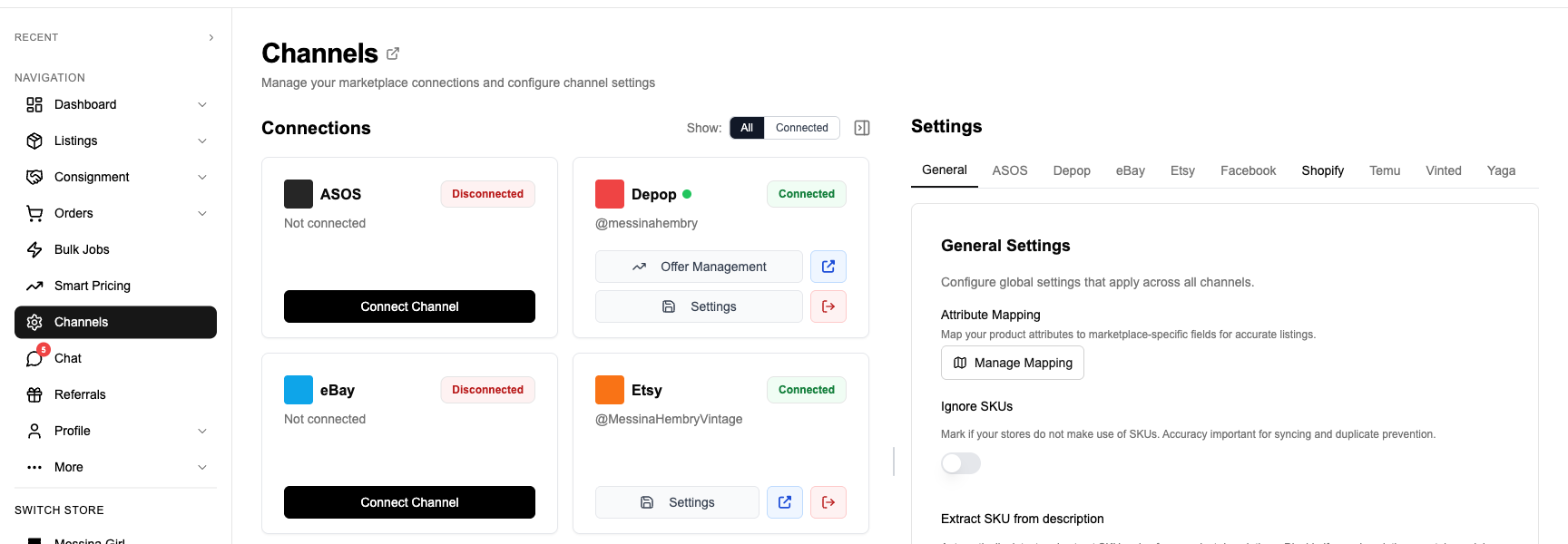
Here’s where we owe you the same honesty this whole guide has tried to give Debenhams. Debenhams already appears as a listed channel inside FLUF Connect — it’s in our channel registry, with its own branding, on the same Mirakl-powered integration engine that already drives our live ASOS Marketplace connection. But at the time of writing, the in-app “Connect” flow for Debenhams isn’t live yet. You’ll see the Debenhams card in your Channels page, and today it links you straight to Debenhams’ own public application page rather than a working Connect button — because until Debenhams accepts your application, there’s nothing for us to connect to.
Self-service connection for Debenhams is not currently available in FLUF Connect. Relisting, offer management and order sync are not available for this channel. Contact FLUF support to discuss your requirements before relying on it.
| Feature | Debenhams via FLUF Connect (today) |
|---|---|
| Channel visible in FLUF Connect | Yes — with a direct link to Debenhams’ official application page |
| Self-serve Connect flow | Not yet live — coming; built on the same engine as our live ASOS integration |
| Crosslisting / inventory sync | Not yet — pending Connect flow launch |
| Order sync | Not yet live |
| Auto-relisting | Not offered — Debenhams’ catalogue model doesn’t have a “relist” concept |
| Offer management | Not yet live |
What FLUF Connect can do for you today, while your Debenhams application is in progress or your integration is pending, is centralise and automate the rest of your selling. If you’re a business seller with barcoded stock going to Debenhams, the odds are high you’re also selling — or should be selling — on eBay, Shopify, Etsy, or Facebook Marketplace. FLUF Connect syncs inventory, prevents overselling, and automates relisting and offer management across all of those channels right now, from one catalogue — so the moment Debenhams Connect goes live, it plugs into a selling operation that’s already working everywhere else, rather than starting from zero.
Start with a 7-day trial for £1, then plans from £9/month (Starter, full automation feature set for the trial). There is no free plan, but every plan — including Starter — includes relisting, offer management, and inventory sync as standard, not as paid add-ons. Yearly billing saves 40% on every plan. Try FLUF Connect
If you’d rather start the Debenhams side of things right now, the fastest path is direct: apply on Debenhams’ own seller registration page, and get your barcoded catalogue data ready to spec while you wait on approval. We’ll update this guide the moment the FLUF Connect Debenhams integration goes self-serve.
Related Guides
- Inventory Sync Across Depop, eBay, Vinted, Shopify, and Etsy
- How to Sell on ASOS — The Complete Guide for 2026
- How to Sell on eBay — The Complete Guide for 2026
- How to Sell on Shopify — The Complete Guide for 2026
- How to Sell on Vinted — The Complete Guide for 2026
- Selling on the Decathlon Marketplace
- Selling on the IBS.it marketplace
- Selling on the B&Q Marketplace
- Selling on the MediaMarkt marketplace
Sources & Verification
Last verified: 2026-08-13. Please contact us if any figure is out of date.
- Debenhams — official seller registration page — application entry point, “Start Selling Today”
- Wikipedia — Debenhams (online retailer) — company history, 2021 collapse and relaunch, legal entity (DBZ Marketplace Online Limited)
- Wikipedia — Debenhams Group — parent company history, March 2025 rebrand, ownership structure, group financials
- Mirakl — Debenhams launches Mirakl-powered marketplace — October 2021 launch details, brand/product counts
- Mirakl — Debenhams Group launches retail media with Mirakl Ads — November 2025 retail media launch, traffic and GMV figures
- Retail TouchPoints — Debenhams debuts self-service retail media network — 15,000+ brand count, November 2025
- e-tailize — Selling on Debenhams — fees, subscription, product data spec, payout schedule, shipping destinations
- ChannelEngine Help Center — Debenhams marketplace guide — seller eligibility criteria, Standard/Premium seller tiers, return-slip requirement
- Just Style — Debenhams Group turnaround delivers return to profitability in H1 — H1 FY26 GMV, marketplace share of GMV, partner count growth
- Retail Gazette — Debenhams eyes £100m profits as marketplace model gains traction — July 2026 trading update, profit targets
- Drapers — Boohoo Group rebrands as Debenhams Group — March 2025 shareholder vote and rebrand rationale
- ChannelX — The Debenhams marketplace opportunity — early 2023 partner-brand count (~1,500), CEO interview
- Yahoo News (syndicated Telegraph investigation) — How Debenhams went from high street icon to Temu-style ‘jumble sale’ — July 2026 price-comparison investigation, 25,000+ partner brand count, ASA finding, customer complaints
- InternetRetailing — Boohoo relaunches Debenhams as a marketplace — commission range (15–25%), brand-count growth to August 2024
- UK Investor Magazine — Debenhams Group’s marketplace focus pays off — three-year GMV/EBITDA targets, partner-count trajectory
- Business Model Canvas Template — Debenhams target market analysis — third-party buyer demographic estimates
Subscribe to the seller news brief
The marketplace news that changes how you list, in one short email.
- Fee, policy and algorithm changes across 60+ marketplaces
- Only the topics you pick — the marketplaces you actually sell on
- Short enough to read in a minute. Daily or weekly, unsubscribe in one click
No spam. We never share your address.
Pick your topics first ›Frequently Asked Questions
No — there is no free plan or free tier to sell on Debenhams. There's no setup fee and no per-listing fee, but Debenhams charges a £25/month subscription (waived for your first year) plus a category-based commission that averages around 20% of each sale, with other reporting putting the working range at roughly 15–25% depending on category.
No setup cost, no listing fee, a £25/month subscription waived for year one, and a category-based commission reported to average around 20% (roughly a 15–25% range across categories). Debenhams doesn't publish an exact public rate card, so confirm your category's specific commission once you're through the application process.
Debenhams marketplace is business-sellers-only. You need a UK-registered legal entity and a UK bank account, plus either a top-rated Amazon/eBay seller history or a Trustpilot score of 4 or above. There's no path for an individual to register as a private seller — for that, open marketplaces like Vinted, Depop or eBay are a better fit.
Beauty and fragrance are a historic Debenhams strength, alongside womenswear. Home is the fastest-growing category since the 2021 relaunch, and the platform's stated ambition covers fashion, beauty, sport and homeware. Electronics is offered but treated as a limited, more restricted category.
Debenhams is a listed channel inside FLUF Connect, built on the same Mirakl integration engine that already powers our live ASOS Marketplace connection — but the self-serve Connect flow for Debenhams isn't live yet. Today FLUF links you to Debenhams' own application page; once Connect goes live, it will sync inventory the same way it already does for ASOS. FLUF already crosslists to eBay, Shopify, Etsy, Depop, Vinted and more today.
Because Debenhams is a business-only marketplace, you're already operating as a registered business if you're eligible to sell there — so normal business accounting, UK VAT (if registered), and any cross-border obligations for orders shipped to Ireland, the US or Australia apply. This is general guidance, not tax advice — consult a qualified accountant for your situation.
Debenhams runs a self-fulfilment model — sellers use their own courier, provide tracking (pushed back to the marketplace automatically), and must include a return slip in every parcel. Debenhams ships marketplace orders to the UK, Ireland, the US and Australia.
For a registered UK business with barcoded (EAN) stock in fashion, beauty or home, yes — it's a fast-growing channel (25,000+ partner brands, GMV up 20% year-on-year in H1 FY26) with real buying traffic. It's not worth pursuing for individual resellers, stock without retail barcodes, or sellers hoping to charge a premium purely on the Debenhams name, given documented price-comparison and returns-friction criticism.
Yes — yearly billing saves 40% versus paying monthly on every FLUF Connect plan, with the same full automation feature set either way.
Debenhams is a curated, application-only marketplace for registered UK businesses selling barcoded (EAN-matched) retail stock, with a £25/month subscription and ~20% average commission. eBay and Vinted are open to individuals and businesses alike, accept any condition of stock including used and one-off items, and don't require an EAN catalogue match to list.