
Shopify to OnBuy: Selling Your Barcoded Products on a Second UK Marketplace
Reach UK buyers on OnBuy with your barcoded Shopify products. When an item sells on Shopify, the OnBuy listing comes down automatically.
7 days for £1, then from £9/month.



- Good fit: UK brand owners selling new, barcoded products like homeware, beauty, toys and electronics accessories on Shopify. OnBuy is UK-only and requires GS1 barcodes for all listings.
- OnBuy is a pure marketplace. No stock is held by OnBuy. Your product competes on price, delivery speed and seller feedback against other offers on the same page.
- Barcodes are the barrier to entry. If your Shopify products carry GS1 barcodes, crosslisting is straightforward. If not, you need to obtain them first. Brand owners register with GS1 UK and pay an annual membership fee starting from £50.
- Inventory sync is one-way. A Shopify sale ends the OnBuy listing automatically. An OnBuy sale is not detected, so you mark it sold yourself.
- Fees: OnBuy charges a monthly subscription (from £25) plus category commission (7–20%), with no listing fee.
- Cost: You can try it with 7 days for £1, then from £9/month.
Before you start: do you have GS1 barcodes?
OnBuy is a catalogue marketplace. Products attach to catalogue records by barcode: a GTIN, EAN, UPC or ISBN. Every product requires a GS1-recognised barcode to publish, with exemptions granted case by case and rarely.
If your Shopify product variants already carry barcodes in the Barcode field, you are set. If they do not, you will need to add them before OnBuy will accept the listings.
As a brand owner making your own products, your barcodes must be registered with GS1 UK. GS1 UK membership is annual and based on your company’s turnover. A business with turnover under £100,000 pays £50 per year for 10 GTINs. Businesses with turnover from £100,000 to £500,000 pay £100 per year for 100 GTINs. The next tier, up to £1 million turnover, is £130 per year for 1,000 GTINs. Brand owners with higher turnover pay proportionally more. Membership includes access to barcode tools and expert advice.
Why sell on both Shopify and OnBuy?
Shopify is a storefront you own. OnBuy is a catalogue marketplace where buyers come searching. The two serve different audiences and fulfil different roles in your sales strategy.
Your Shopify store captures buyers who know your brand or find you through ads and search. OnBuy reaches buyers who are already shopping for your product category and may not have heard of you. The marketplace removes the discovery burden and puts your offer next to competitors’ at the moment a buyer is ready to buy. Sellers who list on both typically see volume from OnBuy as pure addition, not cannibalisation of Shopify sales.
OnBuy reports holding no first-party stock, so you compete only against other sellers’ offers, not against a house brand. That is different from Amazon or eBay where a marketplace can sell its own version of the same product.
Why brand owners have an advantage on OnBuy
Brand owners who make their own products are well-positioned for OnBuy. Your Shopify setup already includes barcodes for every variant: Shopify‘s Barcode field holds the EAN or UPC that OnBuy needs. Other seller types struggle with barcode sourcing or exemption applications, but your registered GS1 identifiers are the exact commodity OnBuy is built on.
The approval process also favours established traders. Your existing Shopify sales history and buyer reviews are your track record. OnBuy wants sellers with a proven record, and a running Shopify store with customer feedback demonstrates that you are a legitimate operator, not a reseller testing the water.
OnBuy is particularly suited to product categories with deep, slow-moving inventory where per-listing fees would bleed margin. Homeware, toys, electronics accessories, beauty and wellness products all fit this profile. Your Shopify inventory is already there. A second UK channel with no listing fees is a low-risk way to add sales without repricing or managing a third warehouse.
How to crosslist from Shopify to OnBuy
- Check your Shopify barcodes. Every product variant needs a barcode in the Barcode field on Shopify. If any are missing, add them or source GS1-registered ones before proceeding.
- Register with GS1 UK if you are not already. Brand owners need their own registered barcodes. Join GS1 UK and pay the annual membership appropriate to your turnover.
- Connect Shopify to FLUF Connect. Sign in to Shopify and add the connection in FLUF’s Channels screen. Your products import with titles, descriptions, images, prices and variants.
- Connect OnBuy. Add OnBuy in Channels and sign in with your OnBuy seller account.
- Select products to crosslist. Choose the variants with valid GS1 barcodes.
- Set price and condition. OnBuy shows your offer on a shared product page alongside other sellers’ offers. The price you set, the dispatch window in your profile and your seller rating all feed into the featured offer position.
- Crosslist. Send a small batch to OnBuy first, check your seller dashboard and then use bulk operations for the rest.
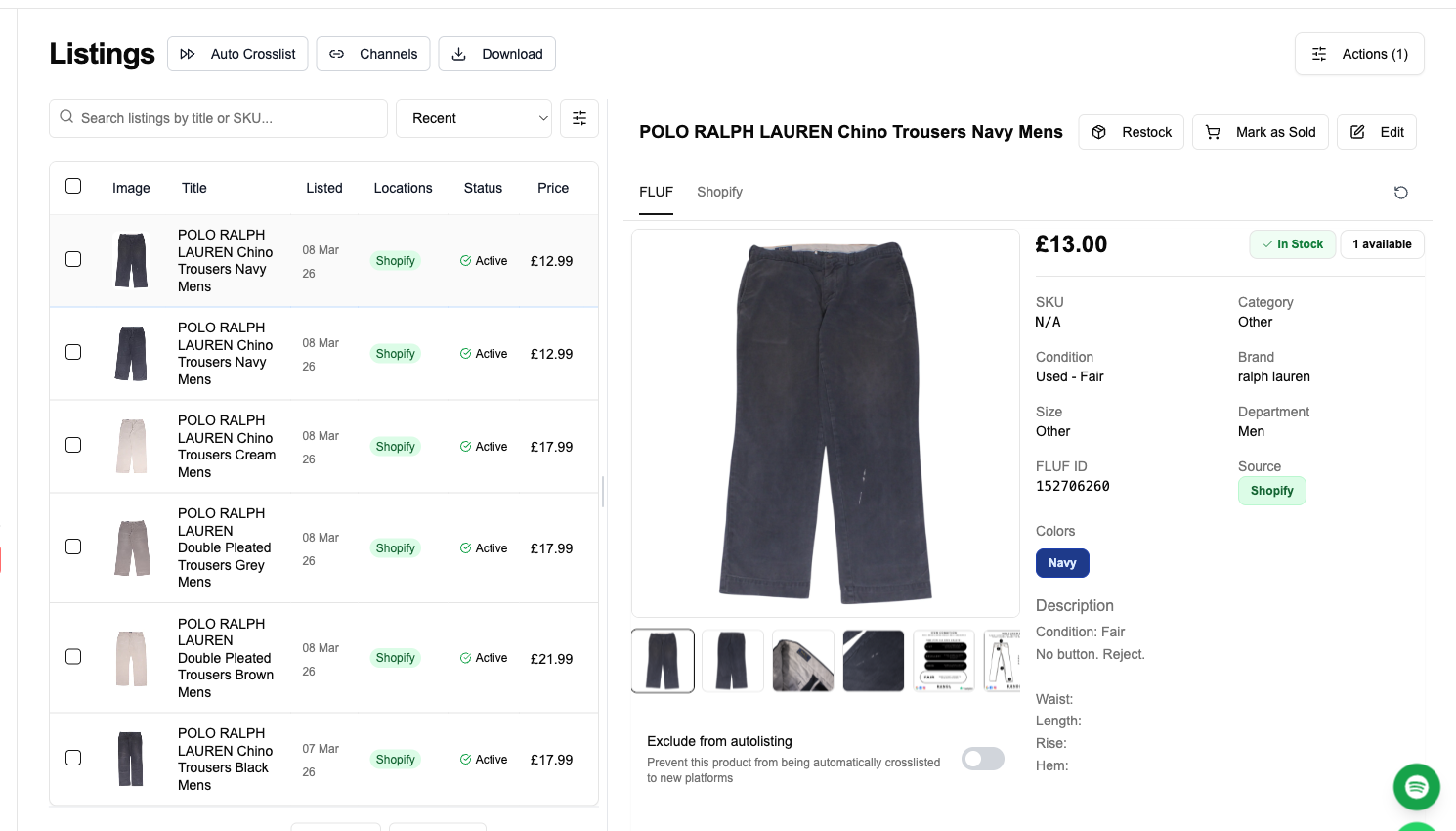
What syncs between Shopify and OnBuy
| Event | What Happens |
|---|---|
| Item sells on Shopify | The OnBuy listing ends or is removed. |
| Item sells on OnBuy | OnBuy sales are not detected. You mark the item sold in FLUF, then the Shopify listing is removed and stock is updated. |
| Price changed on Shopify | Not synced to OnBuy. |
| Title or description edited on Shopify | Not synced to OnBuy. |
Barcodes: why OnBuy is simpler than Amazon for brand owners
On Amazon, barcodes solve the matching problem, but brand owners then face a second hurdle: Brand Registry. Without it, you are one offer among many on a shared product page, and your photos and copy are not shown. With Brand Registry, you get control but need a registered trademark and trademark proof.
On OnBuy, the barcode is the only requirement. You contribute your offer price, delivery time and seller rating to a shared product record. Your offer competes on those factors, not on a title and photos you cannot change. That is a simpler story for brand owners: your GS1 barcode is enough. No trademark registration needed. No exemption application. If you have the barcode, you can list.
Getting your OnBuy account approved
OnBuy vets sellers before they go live. The approval process is designed for registered businesses with a trading history.
You will need:
- A business legally registered in the UK (sole trader or limited company) matching your OnBuy account name
- HMRC registration and business tax ID
- A UK bank account, or a Payoneer or WorldFirst account
- Evidence of at least 50 buyer reviews from the past 12 months on an existing platform, with at least 90% rated 4 or 5 stars
- Proof of address (bank statement or utility bill dated within the past three months)
If you do not yet have 50 reviews on another marketplace, build them before you apply.
Prepare your product data before you apply. Missing barcodes are the most common blocker at approval time, and they are quicker to fix in a spreadsheet than to handle one exemption request at a time.
What you pay OnBuy
OnBuy charges a monthly subscription plus a category commission. There is no per-listing fee.
Monthly subscriptions are Standard (£25), Partner (£69) or Professional (£249). The difference between plans is access to marketing tools and seller support. All plans give you unlimited listings at no extra cost.
Commission is taken when an item sells. The rate depends on the category, ranging from 7% on consumer electronics to 20% on jewellery, with a £0.25 minimum per sale. Commission is charged on the total sale including delivery.
Worked example: you sell a homeware item for £40 with £5 delivery. OnBuy total is £45. If the commission is 13%, that is £5.85. Your Shopify card processing on the same sale, on the Basic plan, would be 2% + 25p, or roughly £1.15. OnBuy‘s subscription cost spreads across all your sales, so at ten sales a month the £25 subscription adds £2.50 per sale on average.
What FLUF Connect costs
7 days for £1, then from £9/month. Starter is £9/month with unlimited listings. It includes crosslisting, inventory sync, order sync and bulk operations for Shopify, OnBuy and any other channels you are on. Relisting, offer management and smart pricing come with plans above Starter, but OnBuy does not use them in FLUF, so Starter covers this route.
| Plan | Monthly | Crosslisted products |
|---|---|---|
| Starter | £9/month | Unlimited |
| Pro | £29/month | Unlimited |
| Super Seller | Custom pricing — tell us what you need | Unlimited |
Sources
- OnBuy: sell with OnBuy
- M2E Pro: OnBuy seller fees
- CedCommerce: barcode requirements on OnBuy
- GS1 UK: official website
- GS1 UK: membership costs
- Nembol: selling on OnBuy guide
- Newcraft: selling on OnBuy from Shopify
- Shopify: how to add product variants
- Shopify UK: pricing and payment processing rates
Sources checked September 2026.
Related guides
- Sell on Shopify
- Sell on OnBuy
- Crosslist from Shopify to Amazon
- Crosslist from Shopify to eBay
- Crosslist from Shopify to Etsy
- All crosslisting routes
- All marketplace guides
- eBay to OnBuy
- OnBuy vs eBay
- Crosslist from WooCommerce to OnBuy
- Crosslist from BigCommerce to OnBuy
- OnBuy vs Amazon
- Crosslist from OnBuy to TikTok Shop
- Crosslist from Etsy to OnBuy
Frequently Asked Questions
Yes. OnBuy is a catalogue marketplace where products attach by barcode: a GTIN, EAN, UPC or ISBN. Every listing requires a GS1-recognised barcode, with rare exemptions granted on request. If your Shopify variants already carry barcodes, you are set. If not, you need to register with GS1 UK and obtain them. Brand owners pay an annual membership fee starting from £50 for 10 barcodes.
The OnBuy listing ends or is removed so you do not oversell the same item on both platforms.
OnBuy sales are not detected automatically. You need to mark the item as sold in FLUF, at which point your Shopify listing is removed and stock is updated across your store.
OnBuy charges a monthly subscription starting from £25 (Standard plan) plus a category commission when items sell, typically 7% to 20% depending on the category. There is no per-listing fee, so a catalogue of 1,000 items costs the same to hold as a catalogue of ten. Commission is charged on the total sale including delivery, so factor that into your pricing.
OnBuy vets sellers and requires a business legally registered in the UK (sole trader or limited company), HMRC registration, a UK bank account or Payoneer/WorldFirst account, at least 50 buyer reviews from the past 12 months on an existing marketplace (90% rated 4–5 stars), and proof of address. Have your product data ready with barcodes present before you apply. Missing barcodes are the most common blocker.
OnBuy requires a GS1-recognised barcode for every product to publish. OnBuy does grant exemptions on a case-by-case basis if you contact them directly, but it is quicker to get GS1 barcodes registered for all your products before you crosslist.
Shopify is a storefront you control. You write each listing and set your own fields. OnBuy is a catalogue marketplace where many sellers contribute to shared product records. The barcode ensures your products match the right catalogue entry and buyers find the exact item they searched for. Without it, the marketplace cannot attach your offer to the correct product page.