Crosslist from Marktplaats to Vinted — Automatically
Reach Vinted's 100 million-plus members with the fashion you already list on Marktplaats. No seller fee on Vinted — FLUF maps the fields, converts the price and keeps stock in sync.



TL;DR: Marktplaats is the Netherlands’ biggest marketplace, but its audience is almost entirely domestic and its clothing sits among cars, sofas and general goods. Vinted is Europe’s largest second-hand fashion marketplace — over 100 million members across the continent — and it charges sellers no selling fee at all. Crosslisting your Marktplaats clothing and accessories to Vinted with FLUF Connect puts the same items in front of a dedicated, EU-wide fashion audience at no extra selling cost; FLUF maps the fields, converts the price and keeps stock in sync so a sale on one side updates the other. Plans start at £19/month (Growth — 1,000 products) and every plan is paid.
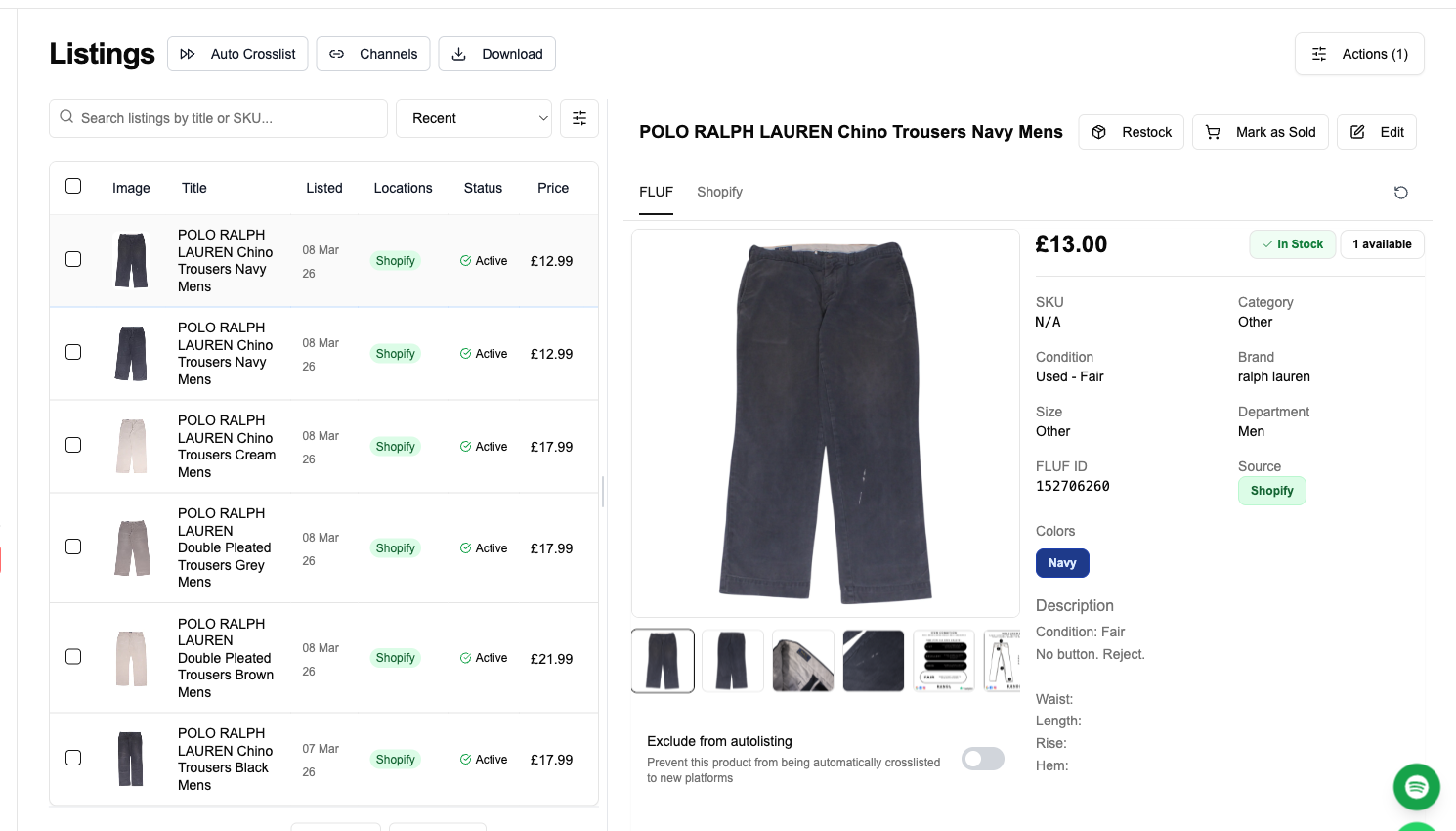
Marktplaats is where Dutch buyers go for almost anything second-hand, and for furniture, electronics and local pickup it is unbeatable. But clothing is a different problem: on Marktplaats a vintage coat competes for attention with car parts and garden sheds, in front of a general, all-ages, Netherlands-only audience. Vinted flips that — it is a fashion-first marketplace where every buyer is there to shop clothing, it spans France, Germany, the UK, Italy and beyond, and it takes nothing from the seller. The historic friction is the listing work: Vinted is built for one-item-at-a-time phone uploads, which doesn’t scale once you have a real wardrobe to clear. Crosslisting from Marktplaats to Vinted with FLUF Connect removes that friction — import your Marktplaats items once, map every field automatically, convert the price, and keep both marketplaces in sync.
Why Sell on Both Marktplaats and Vinted?
Sell on both because they are opposites that barely overlap: Marktplaats is a domestic, general-goods, local-pickup marketplace, while Vinted is a pan-European, fashion-only, ship-everything marketplace with no seller fee. The same jacket reaches a local Dutch buyer who might collect it today and a fashion buyer in Paris or Berlin who’d never have seen it — and adding the second channel costs you only the listing effort, because Vinted doesn’t take a cut.
| Marktplaats | Vinted | |
|---|---|---|
| Catalogue | General goods — cars, furniture, electronics, fashion | Pre-owned fashion, all clothing categories |
| Geography | Netherlands only | EU-wide (FR, DE, UK, IT), expanding in the US |
| Audience | All ages, local buyers | Fashion-focused, large younger cohort |
| Seller fee | None on local sales | None — buyer pays Buyer Protection |
| Selling model | Local pickup or shipped, search-driven | Shipped, built-in labels, app-driven feed |
Vinted’s scale is the reason to bother. Its members traded €10.8 billion in gross merchandise value in 2025, up 47% year on year, and it is the dominant resale platform across Western Europe. For a Dutch seller this matters twice over: Vinted has grown fast in the Netherlands itself, and it opens the rest of the continent to inventory that on Marktplaats would only ever be seen locally. The fee contrast seals it — Vinted charges sellers nothing, funding the platform through a buyer-paid Buyer Protection fee of roughly 5% plus a small fixed amount, set by Vinted (Vinted Buyer Protection). You keep your full asking price, just as you do on a Marktplaats local sale.
What Syncs Between Marktplaats and Vinted
The point of crosslisting is not just to copy a listing — it’s to keep the two in step so you never sell the same item twice. FLUF Connect reads your Marktplaats inventory and creates the listing on Vinted, then watches both sides for sales. When an item sells, FLUF marks it sold and removes the counterpart, so you’re not left fielding a buyer for something that’s already gone.
| Capability | Marktplaats (source) | Vinted (destination) |
|---|---|---|
| Crosslist — create, update, delete | Yes — live | Yes — live |
| Inventory / mark-as-sold sync | Yes — a Marktplaats sale delists the Vinted copy | Yes — a Vinted sale syncs back |
| Order sync | Yes | Yes |
| Automated relisting | Not yet for Marktplaats | Yes — keeps listings fresh in the feed |
| Offer management | Not yet for Marktplaats | Yes — auto-handles buyer offers |
Two of those are worth dwelling on. Vinted rewards freshness — items resurface in buyers’ feeds when relisted — so FLUF’s automated relisting on the Vinted side keeps your crosslisted items visible without manual effort, something Marktplaats’s search-only model doesn’t reward in the same way. And Vinted buyers negotiate constantly, so FLUF’s offer management can handle incoming offers to your rules. Both run on the Vinted destination even though Marktplaats itself doesn’t yet support them.
How Crosslisting from Marktplaats to Vinted Works
The flow is designed to take minutes, not an afternoon:
- Connect both accounts. Link your Marktplaats and Vinted accounts to FLUF Connect. Marktplaats connects through the FLUF browser extension; Vinted connects the same way.
- Import your Marktplaats items. FLUF pulls in your existing Marktplaats listings — photos, titles, descriptions, prices and categories — so you don’t re-type anything.
- Select what to crosslist. Pick the fashion and accessory items that suit Vinted; leave bulky, local-only goods (furniture, white goods) on Marktplaats where they belong.
- Crosslist and sync. FLUF creates the Vinted listings, mapping each field and converting the price, then keeps both sides in sync from then on.
Which Listing Fields Map Across
Most fields carry over automatically. The few that differ are the ones Vinted requires for fashion — size and a structured condition — which FLUF fills from your Marktplaats attributes or prompts you for once.
| Field | Marktplaats | Vinted | How FLUF handles it |
|---|---|---|---|
| Photos | Your in-hand images | Up to 20 images | Carried across in order |
| Title | ~60 characters | Item name | Mapped; expanded with brand/colour where useful |
| Description | Free text | Free text | Carried across |
| Price | EUR | Local currency | Converted; you keep full control |
| Category | Marktplaats tree | Vinted catalogue | Auto-mapped to the nearest Vinted leaf |
| Condition | New / as-good-as-new / used | Vinted’s five-point scale | Mapped automatically |
| Brand & size | Attributes (where set) | Required for clothing | Filled from attributes or prompted once |
Getting the Most from Your Vinted Listings
Vinted is an app-first, feed-driven marketplace, so the habits that work there differ from Marktplaats’s search-and-pickup world. A few things move the needle:
- Lead with brand and size in the title. Vinted buyers filter hard on both; a listing without a size barely surfaces for clothing.
- Use all your photo slots. Vinted allows up to 20 images — show the garment styled, flat, and close on the label and any flaws.
- Let relisting do the work. Because Vinted rewards fresh listings, FLUF’s automated relisting keeps your items near the top of buyers’ feeds without you touching them.
- Price for an EU-wide audience. A piece that’s niche locally on Marktplaats may have a keen buyer two countries away — Vinted’s reach often supports a firmer price than a thin local market.
What Changes When You Move a Listing from Marktplaats to Vinted
The two marketplaces don’t just have different audiences — they have different selling cultures, and knowing the shift saves a lot of friction. On Marktplaats you’re used to local pickup, cash or “gelijk oversteken” pay-on-collection, and the endless “wat is je laatste prijs?” opener before anyone commits. Bids aren’t binding, no-shows happen, and visibility depends on you renewing or bumping a search listing. Vinted works the opposite way: everything ships, payment is handled in-app behind Buyer Protection, there’s no meeting a stranger in a car park, and items resurface through the feed rather than through search bumps. A buyer who taps “buy” on Vinted has paid — there’s no haggling at handover to renegotiate.
That changes how you should list. A Marktplaats description written for a local who’ll inspect the item in person can be sparse; a Vinted listing has to do all the reassuring itself, because the buyer commits before seeing the item. So when you crosslist, lean into measurements, fabric, flaws and a styled photo — the things a remote fashion buyer needs. FLUF carries your Marktplaats content across, but the listings that convert best on Vinted are the ones you’ve rounded out for a buyer who can’t pick it up and look.
A Worked Example: A €40 Vintage Jacket
Say you list a vintage denim jacket on Marktplaats at €40. Locally, you might field a couple of lowball offers and sell it in a week or two to someone nearby — keeping the full €40, minus the time spent on messages and a handover. Crosslist it to Vinted and the same jacket sits in front of fashion buyers across France, Germany and the UK. There’s no seller fee, so a €40 sale still nets you €40 (the buyer pays Buyer Protection on top). If the European audience supports a firmer €45, you keep that. The trade-off is that you pack and ship rather than hand over locally — but FLUF’s inventory sync means the moment it sells on Vinted, the Marktplaats listing comes down, so you’re never juggling two live copies of a one-off item.
Common Mistakes When Crosslisting Marktplaats to Vinted
- Copying a bare local price. A price set for a quick local Marktplaats sale may undervalue the item for an EU-wide Vinted audience — review each price for its new market.
- Skipping size and brand. Vinted buyers filter on both; a clothing listing without a size barely appears in results, even though Marktplaats let you get away with omitting it.
- Thin descriptions. What works for a local who’ll inspect in person fails for a remote buyer — add measurements, condition detail and flaws.
- Listing bulky or non-fashion items. Furniture and electronics belong on Marktplaats (and Facebook Marketplace), not Vinted — crosslist only what fits the fashion audience.
- Managing two live listings by hand. Without sync you risk selling the same jacket twice; let FLUF delist the counterpart automatically.
How Vinted Shipping Differs from Marktplaats Pickup
On Marktplaats, shipping is optional — a huge share of deals are local pickups, and even the integrated PostNL/DHL flow is something you opt into. On Vinted, shipping is the default and the buyer chooses and pays for it at checkout through Vinted’s integrated labels, with the money held under Buyer Protection until delivery is confirmed. For a Marktplaats seller used to pickups, the practical adjustment is simply being ready to pack and post promptly: fast dispatch is one of the few seller behaviours Vinted buyers reward with good reviews, and good reviews feed visibility.
Who Should Crosslist Marktplaats to Vinted?
Anyone clearing clothing, shoes, bags or accessories. If your Marktplaats activity is mostly furniture, cars and general goods, Vinted won’t add much — but the moment you have a wardrobe’s worth of fashion, Vinted is the highest-value, lowest-cost channel to add, because it reaches the largest pre-loved fashion audience in Europe and takes nothing from the seller. The only “cost” is listing effort, and that’s the part FLUF automates.
What Sells Best When You Crosslist Marktplaats to Vinted
Not everything in your Marktplaats fashion section is equally suited to Vinted, so be selective about what you crosslist. Vinted’s buyers reward recognisable brands, everyday wearable pieces and good-condition basics, as well as the vintage and Y2K items that trend across its younger cohort. Womenswear is Vinted’s deepest category, but menswear and kids’ clothing are among its fastest-growing — so a family clearing out across all three has plenty to list. Branded denim, knitwear, coats, trainers, bags and accessories all move reliably, especially when photographed well and sized accurately.
What underperforms is the same on both platforms: unbranded fast fashion, heavily worn items and anything bulky. Those either stay on Marktplaats for a local buyer or don’t sell at all. The practical rule is to let Marktplaats keep the general-goods and local-pickup catalogue, and push the genuinely wearable, brandable fashion to Vinted where a continent of buyers can see it. Because FLUF lets you choose item by item, you’re never forced to mirror your whole catalogue — you send Vinted exactly what fits.
How FLUF Keeps Both in Sync, Day to Day
The work that makes crosslisting sustainable is the ongoing sync, not the initial upload. Once your Marktplaats items are live on Vinted, FLUF watches both marketplaces: a sale, a delisting or a price change on one side is reflected on the other, so you’re never maintaining two diverging copies by hand. If a jacket sells on Vinted while a local buyer is still messaging you on Marktplaats, the Marktplaats listing is already coming down — no awkward “sorry, it’s gone” and no risk of taking two payments for one item. For sellers with more than a handful of listings, that automatic reconciliation is the entire reason to run a tool rather than juggle tabs.
Getting Started
If you’re already on Marktplaats, adding Vinted through FLUF Connect takes minutes: connect both accounts via the browser extension, import your Marktplaats inventory, tick the fashion items you want on Vinted, and crosslist. From there the listings stay in sync automatically, relisting keeps them fresh in the Vinted feed, and offer management handles the back-and-forth. You keep selling locally on Marktplaats exactly as before — you’ve simply added Europe’s largest fashion audience at no seller fee.
A Note on Tax (DAC7)
Both Marktplaats and Vinted operate under the EU’s DAC7 rules, which require marketplaces to report sellers who exceed 30 sales or €2,000 in a calendar year to the tax authority (Belastingdienst — DAC7). Selling your own used clothing is generally not taxable, but trading for profit is. Crosslisting doesn’t change your obligations — it just means keeping one tidy record across both channels. This is general guidance, not tax advice.
Is It Worth Crosslisting Marktplaats to Vinted?
For anyone selling clothing, yes. Marktplaats gives you fast local liquidity; Vinted gives you a fee-free, EU-wide fashion audience that your Marktplaats listings would otherwise never reach. Because Vinted takes nothing from the seller, the only cost of adding it is the listing work — and that’s exactly what FLUF Connect automates. Plans start at £19/month (Growth — 1,000 products) and every plan is paid; crosslisting, inventory sync, relisting and offer management are included in every plan, not a paid add-on. See full pricing or start from the crosslisting dashboard.
Vinted’s Reach Beyond the Netherlands
The strategic reason to add Vinted is geography. Marktplaats stops at the Dutch border; Vinted is the dominant resale platform across France, Germany, the UK and Italy, and it began its major US expansion in early 2026. For a Dutch seller, that means a single crosslisted listing can be discovered by a buyer in any of Vinted’s core European markets, and increasingly in the US too. A piece with a small local audience in the Netherlands may have dozens of interested buyers once it’s visible continent-wide — and none of that extra reach costs you a seller fee. That combination, maximum audience at zero seller cost, is what makes Vinted the single highest-value channel most Marktplaats fashion sellers can add.
Sources & Verification
Related guide: Crosslist from eBay to Marktplaats.
Related guides
Frequently Asked Questions
Vinted charges sellers no fee, and Marktplaats listings are free, so the only cost is your FLUF Connect subscription. Plans start at £19/month (Growth — 1,000 products) and every plan is paid; crosslisting, inventory sync, relisting and offer management are included rather than billed as add-ons.
No. Vinted takes nothing from the seller — no listing fee, no commission, no payment-processing deduction. The platform is funded by a buyer-paid Buyer Protection fee of roughly 5% plus a small fixed amount, set by Vinted. You keep your full asking price, exactly as you do on a Marktplaats local sale.
Yes. FLUF Connect keeps both sides in sync: when an item sells on Vinted, FLUF marks it sold and removes the Marktplaats copy, and a Marktplaats sale delists the Vinted copy. That two-way inventory sync is what stops you accidentally selling the same item twice.
Vinted is a fashion marketplace, so it suits clothing, shoes, bags and accessories. Bulky or general goods like furniture, electronics and car parts belong on Marktplaats (and often Facebook Marketplace) instead. FLUF lets you choose exactly which items go to which channel, so you crosslist only what fits.
FLUF converts your Marktplaats euro price to the destination currency when it creates the Vinted listing, and you keep full control to adjust it. Because Vinted reaches an EU-wide audience, a piece that is niche locally can often hold a firmer price than it would in a thin local market.
Yes — Marktplaats connects to FLUF Connect through the browser extension, which is how FLUF reads your inventory and creates listings. Once connected, the crosslisting and sync run for you; you don't have to keep re-uploading items by hand.
Yes. Vinted rewards fresh listings by resurfacing them in buyers' feeds, so FLUF's automated relisting keeps your crosslisted items visible on the Vinted side without manual effort. Marktplaats itself doesn't yet support automated relisting through FLUF, but the Vinted destination does.