OpenCart vs Shopify: Costs, Hosting and Marketplace Selling Compared
A self-hosted free shop against a hosted subscription: what each costs in a year, who looks after it, and how each connects to marketplaces.
7 days for £1, then from £9/month.



- OpenCart is a free, self-hosted shop you install on a server you rent. Shopify is a hosted subscription. Its Basic plan is £19 a month when billed yearly.
- Shopify charges extra on every sale if you use a payment provider other than Shopify Payments: 2% on Basic. OpenCart takes nothing from sales.
- OpenCart puts hosting, security patches and backups on you. Shopify covers hosting and says its stores are PCI compliant by default.
- If you plan to sell on marketplaces too, check your catalogue first. FLUF Connect reads Shopify products with variants, and only simple stock-tracked products from OpenCart today.
This page is for a small retailer choosing a home for an online shop, or running one of these two and wondering about the other. It suits someone weighing a monthly bill against the work of running a server. If you need phone support and never want to think about PHP versions, skip to the Shopify section. If you already pay for hosting and like owning the code, OpenCart deserves a proper look.
OpenCart and Shopify side by side
| OpenCart | Shopify | |
|---|---|---|
| What you get | Open-source shop software you install yourself | A hosted shop on a monthly or yearly plan |
| Software cost | “Free downloads and updates. Zero monthly fees.” | Basic £19, Grow £49, Advanced £259 a month when billed yearly |
| Hosting | Your own server, or the paid OpenCart Cloud service | Included, with a custom domain and SSL certificate |
| Card rate | Whatever your chosen gateway charges | 2% + 25p on Basic with Shopify Payments, lower on higher plans |
| Fee for other payment providers | None from OpenCart | 2% on Basic, 1% on Grow, 0.6% on Advanced |
| Current version | 4.1.0.4, released 11 August 2026 | Updated by Shopify, nothing to install |
| Add-ons | 13,000+ modules and themes in the OpenCart Marketplace | The Shopify App Store |
What a year costs
Take a shop with £40 average orders. On Shopify Basic paid yearly, the platform line is £19 a month, so £228 for the year. Paying month to month raises it to £25 a month, which is £300. Each £40 order through Shopify Payments then costs 2% plus 25p, so £1.05.
Switch that shop to PayPal or another outside provider as its only checkout and Shopify adds 2% on top of the provider’s own fee. That is another 80p on each £40 order. At 500 orders a year it comes to £400, more than the yearly plan itself. Shopify’s pricing page lists the rates for every tier.
OpenCart’s software bill is zero, and OpenCart does not take a share of sales. You still pay for a server, a domain, your card gateway and any paid extensions. Those costs depend on the host and gateway you pick, so price them before deciding. A cheap host that goes down during a sale is not cheap.
Running the shop day to day
Shopify’s pitch is that the shop keeps working while you sleep. The host, the checkout, security updates and the SSL certificate are its problem. Shopify states that it is certified Level 1 PCI DSS compliant and that stores on it are compliant by default. You pay for that each month, and you live within Shopify’s rules on checkout, themes and apps.
OpenCart hands you the keys. You choose the server, the PHP version and the backup routine, and you apply updates when they come out. In return you can change any file, move host whenever you like and never face a price rise on the software. OpenCart says it powers more than 471,000 stores, and its forum has over 110,000 registered members, which is where most help comes from unless you pay a developer.
Before you commit to OpenCart 4, check that every extension you rely on has a version for it. Shop owners who stayed on older releases often did so because a payment or shipping module never moved over.
Where OpenCart fits better
- You already have hosting and someone who can look after a PHP application.
- Your catalogue is simple: single items with their own stock count, few size or colour choices.
- You want no monthly platform fee, and you want to use the payment provider you prefer without a surcharge from the platform.
- You want to own the shop’s code and data outright.
Where Shopify fits better
- Nobody on the team wants to deal with servers, patches or backups.
- Most of your products come in sizes and colours.
- You want to translate the shop and show local prices without extra modules. Shopify lists both in its plans.
- You are happy to use Shopify Payments, which removes the extra provider fee.
Selling the same stock on marketplaces
Neither shop brings its own buyers. Marketplaces do, which is why many store owners also list on eBay, Etsy or Amazon. FLUF Connect uses your shop as the catalogue and lists it across those channels and the rest of the 65 it supports.
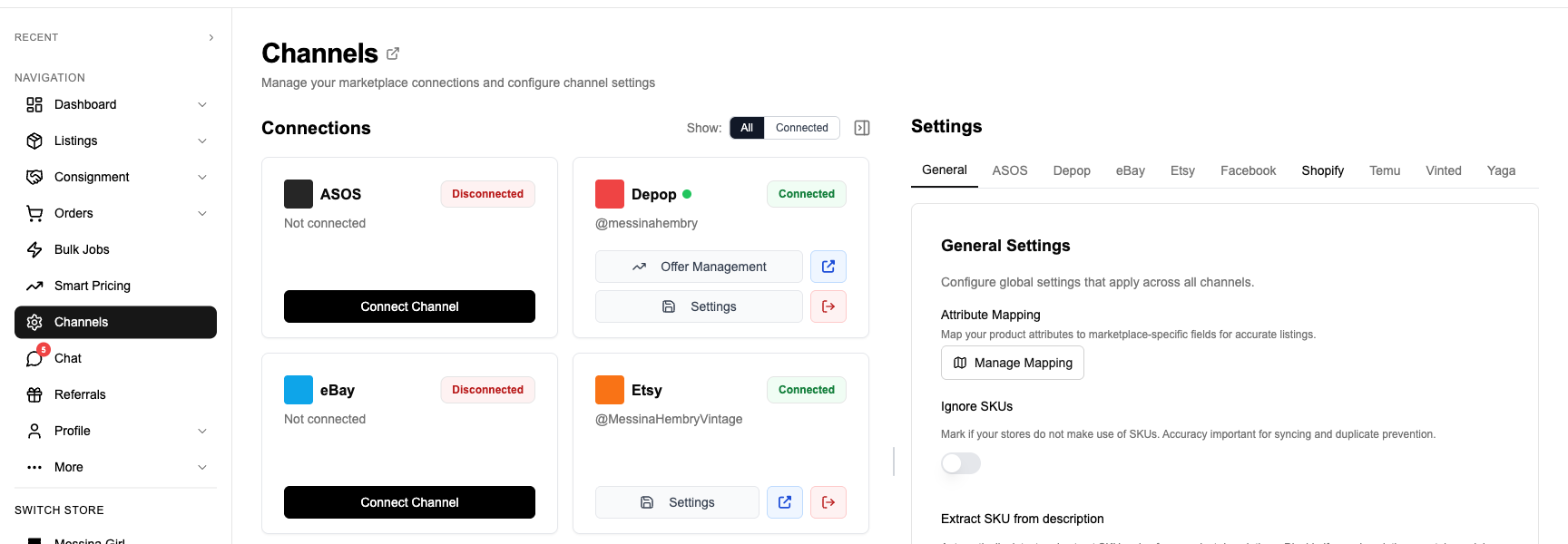
Connecting Shopify takes a sign-in from the Channels screen in FLUF. For OpenCart you download the FLUF Connect extension from the OpenCart Marketplace, install it under Extensions, then Installer, and switch it on under Extensions, then Modules. The module shows a connection key that you enter in FLUF with your shop address.
| What FLUF Connect does | OpenCart shop | Shopify shop |
|---|---|---|
| Shops that can connect | OpenCart 4.1.0.4, the default store, on a public HTTPS address. One OpenCart store per FLUF business. | Any Shopify store |
| Products it brings in | Stock-tracked simple products. Products with options, discounts and specials are outside this release. | Your Shopify products, including variants |
| A shop order comes in | Seen once it reaches processing or completed. Your marketplace listings for that item are updated. | Seen. The item’s other listings are ended. |
| The item sells on a marketplace | OpenCart stock is brought into line, on a periodic basis | Shopify stock is updated |
| Relisting and offer management | Available on marketplaces that support them, on plans above Starter. Not on the shop itself. | |
Because OpenCart stock updates run periodically, two buyers can still pay for the last unit at almost the same moment. Refunds, cancellations and fulfilment stay in your OpenCart admin, and a cancelled order does not put stock back on other channels.
What FLUF Connect costs
FLUF Connect is 7 days for £1, then from £9/month. The OpenCart extension costs nothing to download, and like the Shopify connection it needs a FLUF plan to work.
| Plan | Monthly | Crosslisted products |
|---|---|---|
| Starter | £9/month | Unlimited |
| Pro | £29/month | Unlimited |
| Super Seller | Custom pricing — tell us what you need | Unlimited |
Related guides
- OpenCart vs WooCommerce
- Shopify vs WooCommerce
- OpenCart crosslisting
- OpenCart to eBay
- Shopify to eBay
- OpenCart to Vinted
Sources
Checked October 2026.
Frequently Asked Questions
On software, yes. OpenCart is a free download with no monthly fee and takes no share of sales. Shopify Basic costs £19 a month on a yearly plan or £25 month to month. OpenCart still needs paid hosting, a domain and a card gateway, so compare those against Shopify's all-in plan.
Yes, when it replaces Shopify Payments. Shopify's UK pricing page lists a third-party transaction fee of 2% on Basic, 1% on Grow and 0.6% on Advanced, charged on top of the provider's own fee.
Shopify says it is certified Level 1 PCI DSS compliant and that its stores are compliant by default. On OpenCart you run the server, so updates, backups and security patches are your job or your developer's.
Yes, for OpenCart 4.1.0.4 stores. It brings in stock-tracked simple products. Products with options such as sizes, and products with discounts or specials, are outside the current release.
Yes. FLUF brings in your Shopify products with their variants, sees Shopify orders and ends the item's other listings, and updates Shopify stock when the item sells on a marketplace.
FLUF Connect supports 60+ channels, including eBay, Etsy, Amazon and Vinted. Which ones suit you depends on what you sell and where your buyers are.
A paid 7-day trial, then monthly plans. Crosslisting and inventory sync are on every plan. Relisting, offer management and smart pricing come with the plans above Starter.