Vinted to Kleinanzeigen: Crosslist the Stock Vinted Can’t Carry
A guide for German Vinted sellers adding Kleinanzeigen for furniture, electronics, bulky goods and low-value items that postage labels make unsellable.
7 days for £1, then from £9/month.



Key Takeaways
- This is not a migration. You are not leaving Vinted. You are opening a second shop window for the stock Vinted cannot carry — the coffee table, the monitor, the box of 40 baby vests, the €4 paperbacks — and Kleinanzeigen is where that stock goes.
- Kleinanzeigen is Germany’s biggest classifieds site: Adevinta reports 36m+ monthly users and 50m+ live ads. It dropped the eBay name on 16 May 2023.
- Private ads are largely cost-free, up to a point. Kleinanzeigen’s own fee page allows up to 100 ads in 30 days in the consumer-goods, services and jobs categories, then €1.99 (incl. VAT) per further ad. Vehicles and property are far tighter.
- The gewerblich gate is real and it is a hard stop. Kleinanzeigen states that a commercial seller must be registered with a commercial user account — and a private account cannot simply be converted. If you buy to resell, this applies to you before you post ad number one.
- Selling on Vinted still carries no seller fee (Vinted’s own help page); the buyer pays a buyer-protection fee of usually 5% of the item price plus a flat €0.70. That shapes what you can charge on each side.
- Extension requirements differ. Keep the FLUF Chrome extension available for Vinted listing actions. Kleinanzeigen requires it only for the initial connection.
- Ads age out after 60 days. Kleinanzeigen ads run 60 days and an expired ad cannot be restored. FLUF’s automatic relisting works on Kleinanzeigen and is included from Seller upwards, not a paid add-on.
- Cost: £1 for 7 days, then plans from £9/month (Starter). Every plan is paid. See pricing.
Why A Vinted Seller Opens A Kleinanzeigen Account
You already did the hard part. Your wardrobe is digitised: every item photographed on a plain background, measured, brand-tagged, condition-graded, priced. That is months of work, and on Vinted it earns its keep — Vinted takes nothing from the seller, the postage label prints itself, and a dress moves in a week.
Then you hit the ceiling, and it is always the same three walls.
The first wall is the catalogue. It is a myth that Vinted is fashion-only in 2026 — it has added Home, Entertainment, Hobbies & Collectables, and consumer electronics. But read the category rules closely and the shape of the limit is obvious. Vinted’s Home category rules permit candles, bedding, crockery, kettles, hand tools and plant pots, and explicitly forbid adult mattresses, inflatable mattresses, large rugs, linoleum, standing lamps, outdoor pools and anything permanently installed. There is no furniture tree. A wardrobe, a sofa, a dining table, a washing machine, a bike, a garden bench — none of these have a home on Vinted, because none of them fit in a parcel.
The second wall is the postage-label model. Everything on Vinted moves as a tracked parcel bought through the platform. That is a genuine convenience for a 400g jumper and a hard economic floor for everything else. A €3 paperback loses money the instant a label is attached. A 14kg box of children’s clothes is a nightmare. A 1.2m floor lamp simply cannot ship. On Vinted, “what can I sell?” quietly collapses into “what will a courier carry cheaply?”.
The third wall is who is looking. Vinted’s buyers arrive filtering by size, brand and condition. Nobody browses Vinted for a used dishwasher, a bundle of shelf brackets, or a cot to collect on Saturday from three streets away. Kleinanzeigen’s audience does exactly that, all day, and it is enormous: over 36 million monthly users and more than 50 million ads.
So the reason to open a Kleinanzeigen account is not that Vinted has let you down. It is that the part of your flat which never got listed anywhere — too big, too cheap, or too far outside a fashion catalogue — finally has somewhere to go, sold locally, often collected in person, with no courier taking a cut of a €10 item. Bulky is a feature there, not a disqualification, which inverts the instinct Vinted trained into you.
One boundary: Kleinanzeigen is Germany only. If your reason for expanding is geography rather than product type, see Vinted to willhaben for Austria, or the wider crosslisting guides.
What Kleinanzeigen Is In 2026, And Who Owns It
The name confuses people. The site was eBay Kleinanzeigen for well over a decade. eBay sold its classifieds division to Adevinta, and on 16 May 2023 the platform dropped the eBay prefix and became simply Kleinanzeigen. Adevinta was then taken private: a consortium led by Permira and Blackstone made a voluntary offer of NOK 115 per share in November 2023, completing in 2024 and delisting the company from the Oslo Stock Exchange.
Practical upshot: your eBay account does not log you into Kleinanzeigen and your eBay feedback does not follow you. It is a separate marketplace with a separate identity — if you also sell on eBay proper, eBay to Kleinanzeigen covers that route.
Culturally, Kleinanzeigen is a classifieds board, not a checkout. The default transaction is still: buyer messages you, you agree a time, they turn up with cash, they take the thing away. Payment and shipping were built on top of that, but the local-collection habit remains dominant — and it is why the platform can carry a €5 item profitably when Vinted cannot.
The Private Versus Gewerblich Gate
This section matters more than anything else on this page, and most crosslisting guides skip it.
German law distinguishes a private seller from a commercial one (gewerblich), and the test is not a magic number of sales. It is whether you offer goods or services planmäßig und dauerhaft — systematically and on an ongoing basis — for remuneration. Buying stock specifically to resell at a profit is the clearest single indicator. Selling new goods, or the same category of item repeatedly over a long period, points the same way.
Here is the part that catches Vinted sellers out. Someone clearing a personal wardrobe is plainly private. Someone who sources at car-boot sales, Kilo-Sales and charity shops, cleans and photographs the stock and turns over hundreds of items a year is, on the German test, running a business — whatever Vinted’s interface calls them. Vinted makes it easy not to think about this: no seller fee, no invoice, no accounting furniture at all. Kleinanzeigen makes you confront it on day one.
Kleinanzeigen’s own help centre is unambiguous: to offer goods or services as a commercial provider, you must be registered with a commercial user account, and the platform states you cannot simply convert a private account or post commercial ads from one. It also confirms that an Impressumspflicht applies — you must publish a legally compliant imprint, and Kleinanzeigen puts the responsibility for its correctness on you. Its dedicated guidance for commercial providers adds the rest of the German distance-selling stack: withdrawal instructions (Widerrufsbelehrung), terms, and data-protection notices in the legal information field.
What this means in sequence, before you crosslist anything:
- Decide honestly which side of the line you are on. If you buy to resell, you are almost certainly commercial, and a Gewerbeanmeldung comes before the first ad, not after the hundredth.
- If you are commercial, register a commercial account from the start. Retrofitting is not offered, and building a reputation on a private account you later have to abandon is a genuine waste.
- Fill in the legal information properly: imprint, withdrawal policy, terms. It is dull, and it is the thing competitors report.
- Expect the pricing model to change with you. Kleinanzeigen’s newsroom announced a restructured PRO offering with industry-specific packages, including an entry tariff aimed at small budgets — around €15 a month for up to ten ads for goods priced up to €25 — with existing PRO customers moving over on their own timeline.
FLUF Connect cannot make this determination for you — it publishes to the account you connect. If that account is the wrong type, crosslisting simply industrialises the problem. Sort the account type first.
DAC7: Both Platforms Already Report You
A related point, because Vinted sellers frequently believe the platform’s silence means invisibility. Germany’s Plattformen-Steuertransparenzgesetz (PStTG), which implements the EU’s DAC7 directive, requires platform operators to report sellers to the Bundeszentralamt für Steuern. The exemption is narrow: under § 4 PStTG, a seller is only an exempted provider (freigestellter Anbieter) if, in the reporting period on that platform, they carried out relevant activities in fewer than 30 cases and received less than €2,000 in total. Both conditions must hold. Thirty-one sales of €5 each is reportable; one sale of €2,100 is reportable.
The Bayerisches Landesamt für Steuern guidance sets out how the data reaches the seller’s own tax office. Two things follow. The threshold is counted per platform, so adding Kleinanzeigen does not merge your Vinted count into it — and a report is not itself a finding that tax is owed. Second, once you crosslist at volume you want one record of what sold where and for how much. That is a side effect of using a crosslisting tool, but for a German seller a substantial one.
How Products Move From Vinted To Kleinanzeigen
FLUF Connect does not copy an ad from one site to another. It holds one product record — photos, title, description, price, condition, attributes — and pushes that record out to each channel in that channel’s own shape. Vinted is one destination for it; Kleinanzeigen is another. Full background on the model is in the crosslisting overview, and the two channel guides are sell on Vinted and sell on Kleinanzeigen.
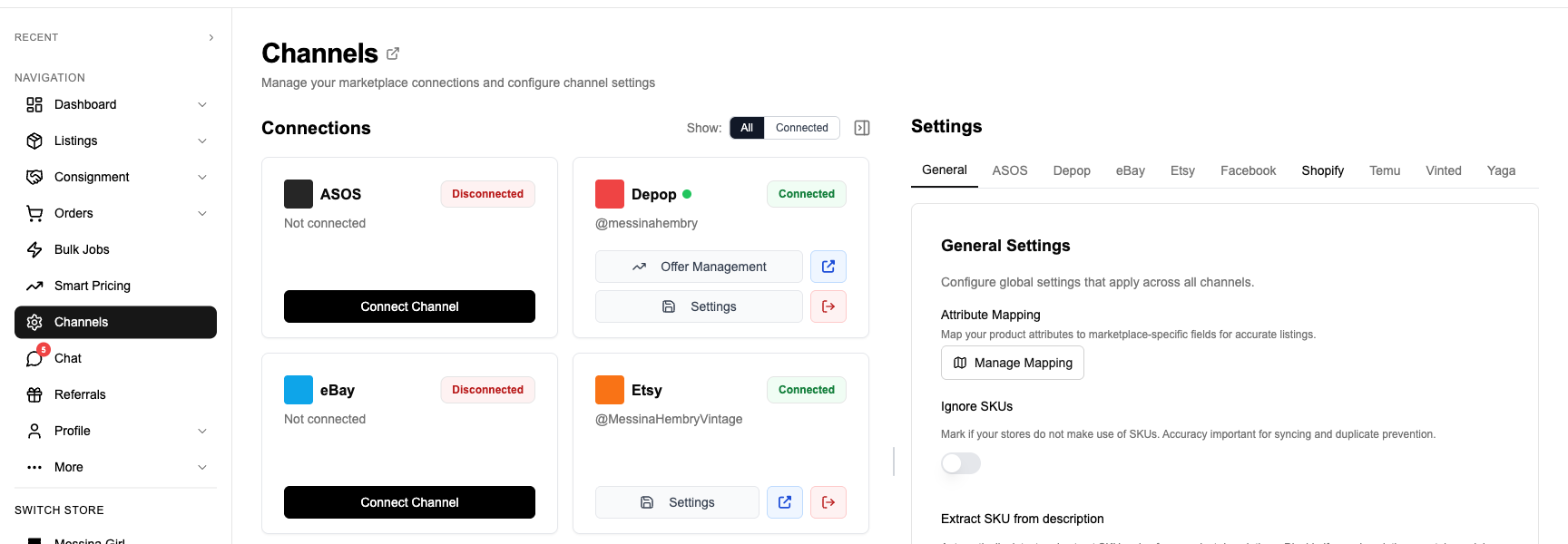
The setup, in order:
- Install the FLUF Chrome extension and connect Vinted. Sign in to your Vinted account and follow the connection prompts. Keep the extension available for listing actions.
- Import your Vinted wardrobe. Your existing items become FLUF product records, with their photos and descriptions attached. This is the step that makes the whole exercise cheap: you are not re-photographing anything.
- Connect Kleinanzeigen through the same extension. You do not need to keep the extension or browser open after this initial setup.
- Add the stock Vinted never saw. This is the actual point. The furniture, the tools, the electronics, the bundles, the low-value books. Kleinanzeigen requires a minimum of 1 photo (Vinted requires 2), so the bar for getting a bulky item live is genuinely lower.
- Set the channel routing. Not everything should go to both. Garments to Vinted and Kleinanzeigen; furniture and appliances to Kleinanzeigen only; anything sub-€8 to Kleinanzeigen only, because Vinted’s postage economics will eat it.
Be clear-eyed about the asymmetry, because it changes your day. Vinted work — creating, editing, relisting, marking sold — happens when your machine is on and the extension is running. Kleinanzeigen work does not. Kleinanzeigen becomes the channel that keeps working while your laptop is shut; Vinted is the one you leave a browser window open for.
Field And Category Mapping
Moving in this direction is mostly a lossy translation, and that is fine — you are translating a structured fashion record into a free-text classified ad. The work is in deciding what to do with the structure you are about to lose.
| Vinted field | Kleinanzeigen equivalent | What FLUF does, and what you lose |
|---|---|---|
| Title | Anzeigentitel | Maps directly. Kleinanzeigen ads are found by keyword search far more than by filter, so a title that reads like a search query outperforms a stylish one. |
| Description | Beschreibung | Maps directly, and should be longer here. Everything the Vinted attribute chips carried needs to be written into the prose. |
| Photos (min. 2 on Vinted) | Bilder (min. 1) | Carried across. The lower minimum is what lets you list a wardrobe from a single phone snap. |
| Price | Preis, plus VB / Zu verschenken / Festpreis | Price maps. The negotiation flag is a Kleinanzeigen concept with no Vinted counterpart — decide it deliberately rather than accepting a default. |
| Size (structured, e.g. DE 38) | No structured equivalent | Kleinanzeigen has a coarse clothing size field in some fashion subcategories but nothing resembling Vinted’s per-brand size taxonomy. Put the size in the title and the description. |
| Brand (structured, filterable) | No structured equivalent | Brand is text on Kleinanzeigen. Buyers find it by typing it. If the brand is the selling point, it belongs in the title. |
| Condition (Vinted’s five grades) | Zustand (coarse, category-dependent) | FLUF maps to the nearest available value. “Sehr gut” is doing a lot of work; describe wear explicitly in the text. |
| Colour, material, style attributes | Free text only | Folded into the description. No filter will read them. |
| Category (deep Vinted tree) | Kleinanzeigen category + Ort | Mapped to the nearest node. Kleinanzeigen’s tree is far shallower but far broader — it covers whole domains Vinted has no concept of. |
| Nothing on Vinted | PLZ / location | Mandatory on Kleinanzeigen and central to how buyers filter. Set on your account. Local range is a ranking factor in a way it never is on Vinted. |
| Nothing on Vinted | Versand oder Abholung | You choose per ad. Collection-only is a legitimate, common and often optimal setting for bulky goods. |
| Vinted parcel size | DHL S/M/L/XL, Hermes Päckchen and S/M/L | If you offer shipping, Kleinanzeigen’s own shipping options are picked at sale time, with the label delivered as a QR code. |
The lesson: Vinted rewards well-filled attribute fields, Kleinanzeigen rewards well-written text. A description that was adequate on Vinted because the chips carried the facts will underperform here. Rewriting descriptions once, for the items you expect to sell on both, is the highest-return hour in this exercise. A side-by-side of the two platforms’ mechanics is in Kleinanzeigen vs Vinted.
What Syncs, And What Does Not
Both channels are live and self-serve in FLUF, but their feature sets differ, and the differences are the ones you will actually notice.
| Capability | Vinted (source) | Kleinanzeigen (destination) |
|---|---|---|
| Listing | Yes — requires the Chrome extension for every listing action | Yes — extension needed for initial connection only |
| Automatic relisting | Yes | Yes |
| Order sync | Yes | Yes |
| Mark as sold / delist | Yes | Yes |
| Offer management | Yes | No |
| Minimum photos | 2 | 1 |
| Countries | 27, including Germany | Germany only |
Two honest caveats.
Offer management does not exist on the Kleinanzeigen side. FLUF handles offers on Vinted; on Kleinanzeigen it does not. Kleinanzeigen haggling happens in chat, in German, in your own words, and it is not something FLUF automates. If you mark an ad as VB, expect messages, and expect to answer them yourself. This is a real cost of being on the platform and you should price it into your time.
Sold-state timing differs. Vinted completes a sale in one atomic step: the buyer pays and the item is gone. A Kleinanzeigen sale is a conversation that ends on a doorstep, sometimes days later. FLUF syncs sold-state both ways, but the gap between “someone said they’ll take it” and “money has changed hands” is a human interval, not a data one. For anything single-copy and listed on both, delist on Vinted when you agree the collection, not when the buyer arrives. The reverse case is covered on Kleinanzeigen to Vinted.
Before And After — The Real Workflow
Before. Your wardrobe is on Vinted and it works. The rest of the flat is a mental to-do list: the desk you have meant to photograph since March, three boxes of books, the old monitor, a bag of cables. None of it is on Vinted because none of it can be. What you did list on Kleinanzeigen was typed by hand into the app, one item at a time, photographed a second time. Ads expired and you did not notice.
After. Every product is one record in FLUF Connect. Garments publish to Vinted and Kleinanzeigen together. Furniture, appliances, tools and cheap books publish to Kleinanzeigen only, as collection-only ads, using the photos you already have. New stock is added once and routed by rule rather than by memory. When something sells on either side, sold-state propagates and the other listing comes down. Kleinanzeigen ads that approach their expiry are relisted automatically instead of dying quietly.
The measurable difference is not “more sales” in the abstract — it is that stock which previously generated €0, because listing it was too much friction, now generates something.
Relisting And Ad Ageing
Kleinanzeigen is a classifieds board, and classifieds age. Kleinanzeigen’s help centre states that an ad runs for 60 days; you are emailed a week before it ends and you get a window in which to extend it by another 60 days from the “Meins” overview. Miss that window and the ad expires — and an expired ad cannot be restored or reactivated. It has to be created again.
Two consequences for a Vinted seller, who is used to listings that simply persist.
First, the arithmetic. Two hundred ads with staggered start dates means three or four expiry emails a day, indefinitely. Nobody keeps up with that by hand. The failure mode is a slow leak: your live ad count drifts down by a few each week and you notice six months later that half your stock is gone from the site.
Second, freshness. Kleinanzeigen surfaces by recency in a way Vinted does not — which is why it sells the Hochschieben bump at all. An ad unchanged for eight weeks is, in practice, invisible.
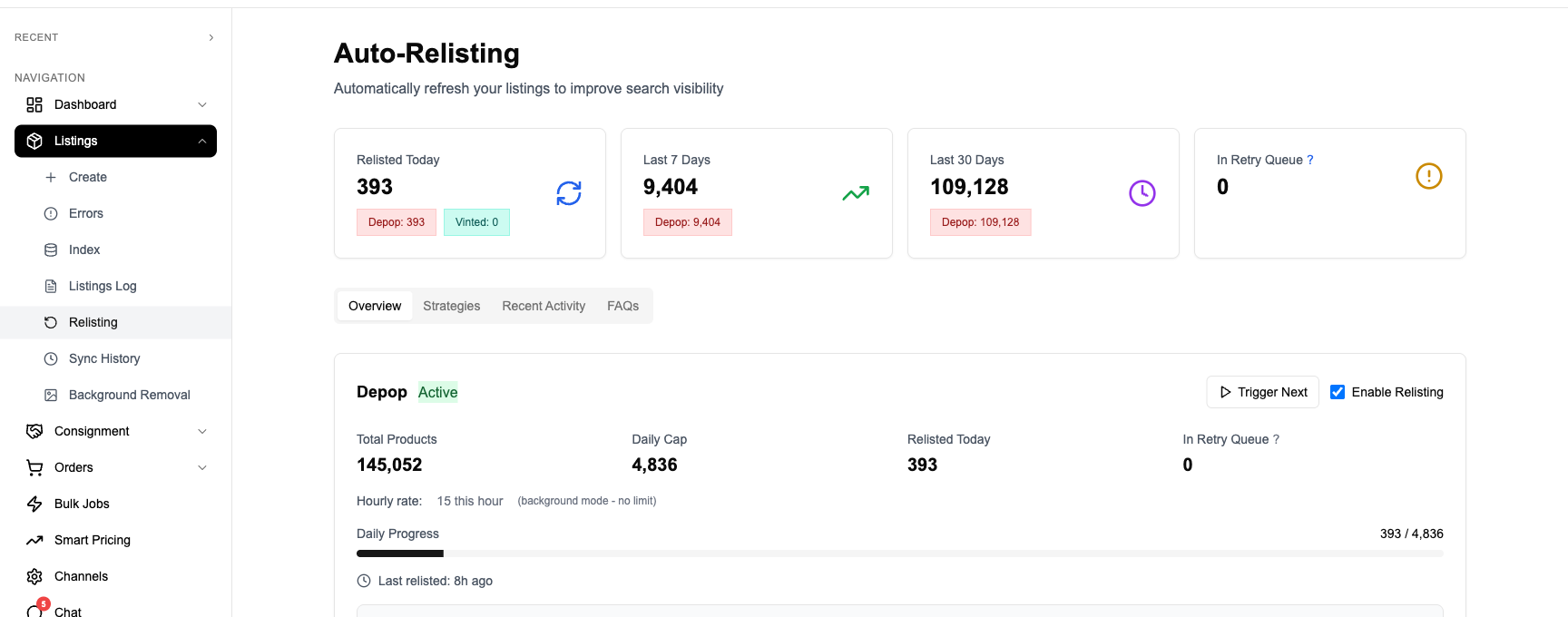
FLUF’s automatic relisting handles both. It works on Kleinanzeigen, and it is included from Seller upwards rather than sold as a paid add-on. Note that renewal itself is cost-free in the consumer-goods, services and jobs categories — Kleinanzeigen’s fee page confirms ads there can be extended without limit and without charge — but that is not true everywhere; in the car category, for instance, the €9.99 fee applies to renewals as well. Know which categories you are in.
The Money On Both Sides
Vinted. Selling is free of seller fees: Vinted’s help centre states there is no listing fee and no commission on the sale. The cost sits with the buyer as a buyer-protection fee, described by Vinted as usually 5% of the item or bundle price plus a fixed €0.70, added at checkout, on top of shipping. It is worth knowing that this fee has been litigated in Germany: the Verbraucherzentrale Bundesverband reports that the Kammergericht Berlin ruled on 2 December 2025 that Vinted may not pre-select the paid buyer protection as a non-removable default. The seller-side position — no fee — is unaffected.
The effect on pricing is subtle: because the buyer sees a marked-up total, your headline Vinted price is not what the buyer pays, and low prices are disproportionately penalised — on a €4 item the fee is roughly 22%.
Kleinanzeigen. Placing ads is where most private sellers will never pay anything. The fee page allows up to 100 ads in 30 days across consumer goods, services and jobs, with €1.99 incl. VAT for each ad beyond that and a 60-day runtime on the chargeable ones. Vehicles are much tighter: two ads per 30 days for cars under €30,000, then €9.99 per ad, with €9.99 applying from the first ad on cars at €30,000 or more, and five ads before charges in the motorbike, boat, caravan and commercial-vehicle subcategories. Property runs at €19.99–€21.99 per listing beyond a small allowance. The same page notes that from 21 May 2026 a mandatory €9.99 fee applies from the first ad to anything priced at €45,000 or more, whatever the account type.
On top of that sit optional visibility extras — Hochschieben, Highlight, Top-Anzeige and Galerie — bought per ad as one-offs rather than subscriptions. Kleinanzeigen prices these dynamically by category and region rather than publishing a single list price, so check the figure shown in the booking flow before you commit; we are not going to invent a number here.
Payment and shipping on Kleinanzeigen. If you use Sicher bezahlen, Kleinanzeigen’s help centre puts the service fee at €0.50 plus 4.5% of the purchase price, alongside the item price and shipping, with buyer protection covering non-delivery, significant deviation from the description, counterfeits and wrong or incomplete goods — for shipments within Germany only. Compare that with Vinted’s 5% + €0.70 and the two look similar. The difference is that on Kleinanzeigen it is optional, and on a local collection nobody pays it at all. That is the real economic argument for putting your cheap and bulky stock here: a €10 item collected in person nets you €10.
What FLUF Connect Costs
FLUF Connect is £1 for 7 days, then plans from £9/month (Starter). Every plan is paid. Every plan is unlimited on listings and marketplaces; the tiers differ by which automations they include and how often we check your channels for sales — every 90 minutes on Starter, down to every 15 on Super Seller. Annual billing saves 40%.
Automation — relisting, offer management, bulk operations and sync — is included from Seller upwards, not a paid add-on. That matters specifically for this pair: the Kleinanzeigen relisting behaviour described above is not something you buy separately, and it is the feature that stops your ad count leaking.
What FLUF does not do: it does not decide whether you are a private or commercial seller, it does not write your Impressum, it does not negotiate with Kleinanzeigen buyers in chat, and it does not manage offers on Kleinanzeigen at all. It moves your product data, keeps sold-state consistent, and keeps ads alive against a 60-day clock. For German-market context on the source side, see selling on Vinted in Germany.
Sources & Verification
All figures verified 23 August 2026 against primary sources.
- Adevinta — “Adevinta’s eBay Kleinanzeigen is now Kleinanzeigen”
- Adevinta — Kleinanzeigen brand page
- Adevinta — Permira and Blackstone voluntary offer at NOK 115 per share
- Kleinanzeigen Help Centre — Gebühren bei Kleinanzeigen
- Kleinanzeigen Help Centre — Wie lange ist meine Anzeige online?
- Kleinanzeigen Help Centre — Was muss ich als gewerblicher Anbieter beachten?
- Kleinanzeigen — Besondere Pflichten für gewerbliche Anbieter
- Kleinanzeigen Help Centre — Was ist “Sicher bezahlen”?
- Kleinanzeigen Help Centre — Wie versende ich mein Paket?
- Kleinanzeigen newsroom — Kleinanzeigen modernises PRO
- Vinted Help — Ist das Verkaufen auf Vinted kostenlos?
- Vinted Help — Käuferschutz-Gebühren auf Vinted
- Vinted Help — Home-Kategorie: Was du verkaufen darfst (und was nicht)
- Vinted Help — Kategorie Hobbys & Sammlerstücke
- Verbraucherzentrale Bundesverband — Vinted darf kostenpflichtigen Käuferschutz nicht voreinstellen
- § 4 PStTG (gesetze-im-internet.de)
- Bayerisches Landesamt für Steuern — Informationen zum Plattformen-Steuertransparenzgesetz (PDF)
- Crosslist from Etsy to Kleinanzeigen — no commission and no quantity field — and you cannot refuse local pickup
- Causee vs Vinted
FLUF channel capabilities (extension requirements, supported features, photo minimums, country coverage) verified against the FLUF Connect channel registry on 23 August 2026.
Frequently Asked Questions
No. Most sellers who make this move keep their Vinted wardrobe exactly as it is and add Kleinanzeigen for the stock Vinted cannot carry: furniture, bulky goods, appliances, tools, bundles and anything too cheap to survive a postage label. FLUF Connect keeps one product record per item and lets you route each item to one channel, the other, or both.
Kleinanzeigen requires the FLUF Chrome extension only for initial setup. Vinted requires it to remain available for listing actions.
Kleinanzeigen's fee page allows private sellers up to 100 ads in 30 days across the consumer-goods, services and jobs categories, then charges 1.99 euros including VAT per further ad, with a 60-day runtime. Vehicles and property are far tighter: two ads per 30 days for cars under 30,000 euros, then 9.99 euros each, and 19.99 to 21.99 euros per property listing beyond a small allowance. From 21 May 2026 a mandatory 9.99 euro fee applies from the first ad to anything priced at 45,000 euros or more.
German law treats you as commercial once you offer goods systematically and on an ongoing basis for payment. Buying stock specifically to resell is the clearest indicator. Kleinanzeigen states that a commercial provider must be registered with a commercial user account, and that you cannot simply convert a private account or post commercial ads from one, so decide before you start. Commercial accounts also carry an Impressum requirement plus withdrawal instructions, terms and data-protection notices.
No. Vinted's help centre confirms there is no listing fee and no commission on the sale. The cost sits with the buyer, as a buyer-protection fee that Vinted describes as usually 5 per cent of the item or bundle price plus a fixed 0.70 euros, added at checkout on top of shipping. In December 2025 the Kammergericht Berlin ruled that Vinted may not pre-select that paid protection as a non-removable default.
Most of it is lost, because Kleinanzeigen has no equivalent structured attributes. Brand is free text there, and outside a few coarse clothing size fields there is nothing resembling Vinted's per-brand size taxonomy. FLUF carries the values into the title and description, but no Kleinanzeigen filter will read them, so buyers find those items by typing keywords instead. Write the size, brand and measurements into the text.
Kleinanzeigen ads run for 60 days. You get an email about a week before expiry and a short window to extend, and Kleinanzeigen states that an expired ad cannot be restored or reactivated. With a couple of hundred staggered ads that is several expiries every day. FLUF's automatic relisting works on Kleinanzeigen and is included from Pro upwards, not a paid add-on.
No. FLUF supports offer management on Vinted but not on Kleinanzeigen. Kleinanzeigen negotiation happens in chat, in German, in your own words. FLUF publishes and maintains the ad, syncs orders and marks items sold, but the conversation with the buyer is yours.
Yes, above a narrow threshold. Under the Plattformen-Steuertransparenzgesetz, a seller is only an exempted provider if, on that platform in the reporting period, they had fewer than 30 relevant transactions and received less than 2,000 euros in total. Both conditions must hold. The count is per platform, so adding Kleinanzeigen does not merge your Vinted totals, but neither platform hides anything.
1 pound for 7 days, then plans from 9 pounds a month for Starter, which covers unlimited listings with sales detection every 90 minutes. FLUF Connect plans start at £9/month on Starter, with Pro at £29/month and custom Super Seller plans above that; every plan is unlimited on listings and marketplaces, and the tiers differ by which automations they include and how often we check your channels for sales. Annual billing saves 40 per cent. Every plan is paid.