
How to Sell on La Redoute Marketplace — The Complete Guide for 2026
Everything you need to know about La Redoute's Mirakl-powered marketplace — fees, seller eligibility, listing rules, shipping and tax — plus how it fits alongside FLUF Connect's other channels.



Key Takeaways
- La Redoute Marketplace is a closed, Mirakl-powered 3P marketplace — it sells brand-new stock from vetted registered businesses alongside La Redoute’s own catalogue. It does not take individual or resale sellers on its main marketplace.
- Seller fees: a flat €49.90 HT/month subscription plus an 8–20% category commission (standard rate ~17%; jewellery and accessories sit at the top of the band, 20%). No separate listing fee.
- Highly selective: La Redoute reports approving roughly 1% of applicants, and approval can take from a few days to several months.
- Best for: registered EU businesses (SIRET + intra-community VAT number) selling new fashion, home, furniture, jewellery, beauty, sport, toys or pet products who already deliver to France.
- Not a fit for most FLUF sellers: if you resell pre-owned stock as an individual, this isn’t the right La Redoute channel — La Redoute’s separate pre-owned marketplace, La Reboucle, is (see below).
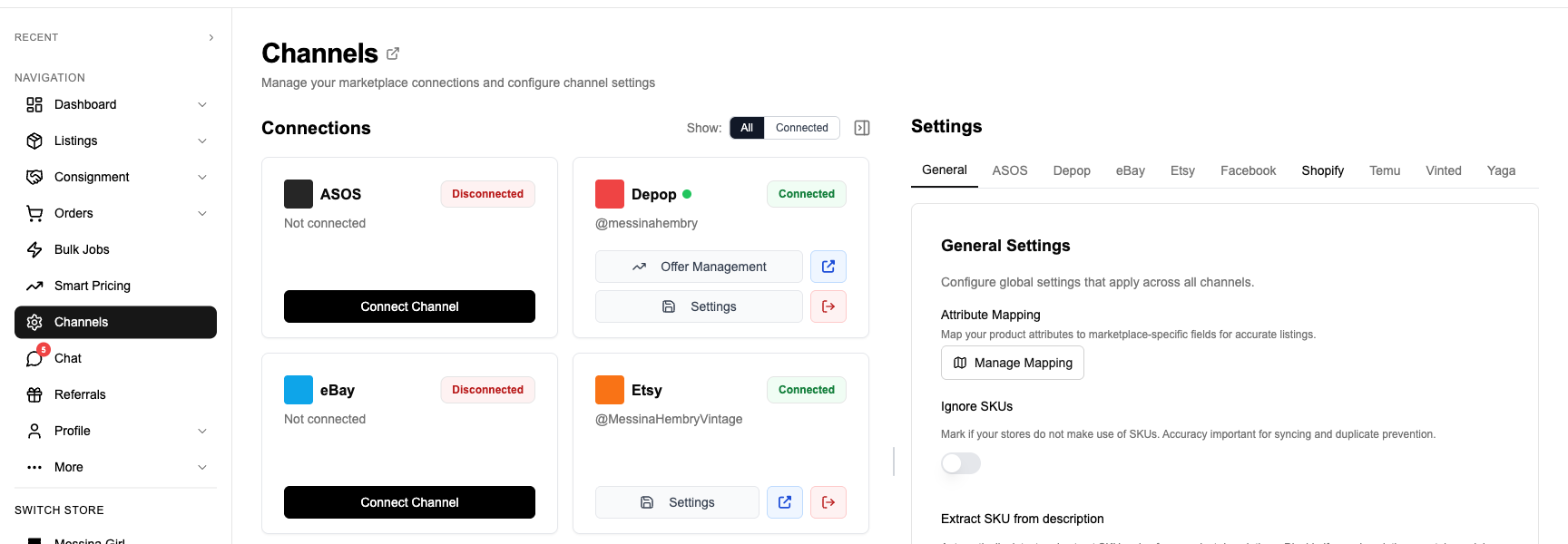
- FLUF Connect status: La Redoute is part of FLUF’s growing Mirakl-powered channel family. You can apply to sell today via the official link below; in-app connect, crosslisting and inventory sync for La Redoute are in active development and not yet live — see Cross-List section for exactly what works now.
What Is La Redoute Marketplace?
La Redoute Marketplace is the third-party (3P) selling programme bolted onto laredoute.fr, France’s long-running fashion-and-home retailer. Approved businesses list new stock alongside La Redoute’s own products, under La Redoute’s brand, using the Mirakl marketplace platform for catalogue matching, order routing and seller management.
La Redoute itself dates back to 1837 as a Roubaix wool-spinning mill, and became a household name after launching its mail-order catalogue in 1928 — the format that defined French home shopping for most of the 20th century[1]. The company built its own in-house 3P marketplace in 2010, then migrated the whole operation onto the Mirakl platform starting in 2021, completing the switch in April 2023 to improve the seller experience and speed up international expansion[2].
That migration matters for anyone researching how to sell here, because it means La Redoute Marketplace now runs on exactly the same underlying engine as roughly 450 other Mirakl-powered marketplaces worldwide — including ASOS Marketplace and, closer to home for La Redoute specifically, sibling programmes like Debenhams and Decathlon Marketplace. The seller-facing mechanics (API structure, offer/catalogue split, EAN-based product matching) are near-identical across the Mirakl family; what differs per operator is category mix, commission, and — critically for La Redoute — how selective the vetting is.
Today the platform gets an estimated 11 million-plus monthly visits and ranks fourth in France’s marketplace pecking order behind Cdiscount, Leroy Merlin and ManoMano[3]. Third-party marketplace sales made up roughly 18% of La Redoute’s total GMV in 2025, with the remaining 82% still coming from La Redoute’s own first-party stock[4] — a useful reminder that, unlike Amazon or eBay, this is still primarily a retailer’s own storefront with a marketplace layered on top, not a marketplace-first platform.
La Redoute Marketplace at a Glance
| Metric | Detail |
|---|---|
| Retailer founded | 1837 (Roubaix, France); mail-order catalogue since 1928 |
| Marketplace launched | 2010 (in-house); migrated to Mirakl 2021–2023 |
| Headquarters | Roubaix, France |
| Marketplace engine | Mirakl (closed, curated 3P programme) |
| Monthly site traffic | ~11 million visits (2026) |
| 3P share of total GMV | ~18% (2025) |
| Seller eligibility | Registered EU businesses only — no individuals, no resale |
| Reported approval rate | ~1% of applications |
| Top categories | Fashion, home & décor, furniture, jewellery & accessories, beauty |
| Revenue model | Flat monthly subscription + category commission |
Why Sell on La Redoute in 2026?
La Redoute is not a marketplace you join casually — it’s an application you make deliberately, usually because you already have a brand with a French or European following and want a distribution channel with built-in trust. Here’s what makes it worth the effort for the businesses it accepts.
A Built-In, High-Trust French Audience
La Redoute has more than 10 million active customers and nearly a century of brand recognition in France[5]. For a business trying to break into the French market, that’s a very different proposition to cold-starting a Shopify store — you inherit a slice of an audience that already trusts the retailer’s returns policy, delivery promises and customer service standards.
Curated, Not Crowded
Because approval is deliberately scarce — La Redoute’s own guidance describes itself as one of the most selective marketplaces available, screening for brand fit rather than simply accepting anyone with a VAT number[6] — sellers who do get through face materially less race-to-the-bottom price competition than on an open marketplace like Amazon or Cdiscount, where anyone can list the same SKU.
Fashion and Home, in One Storefront
Most marketplaces specialise in one vertical. La Redoute spans both fashion (women’s, men’s, children’s ready-to-wear, accessories, jewellery) and home (furniture, décor, textiles, small appliances) under a single brand, so a homeware or lifestyle business doesn’t need two separate marketplace relationships to reach the same buyer.
How La Redoute’s Costs Compare
The trade-off for that curation is a flat monthly cost that exists whether you sell one item or one thousand — unusual among the marketplaces FLUF sellers typically use, most of which charge purely per-transaction. Here’s how the model compares:
| La Redoute | eBay | Shopify | |
|---|---|---|---|
| Monthly subscription | €49.90 HT (fixed) | £0–£27.99 (optional Shop tiers) | From $/£19–$2,300+/mo depending on plan |
| Listing fee | None published | Free allowance, then per-listing | None (you build the store) |
| Transaction fee | 8–20% commission (category-dependent) | ~13–15% final value fee | 0–2% (plan-dependent) if not using Shopify Payments |
| Who can sell | Registered EU businesses only | Individuals & businesses | Anyone (you own the storefront) |
| Seller access | Application, vetted (~1% approval) | Self-serve | Self-serve |
The honest read: La Redoute is more expensive and slower to access than a self-serve marketplace, and it’s closed to the individual resellers who make up most of FLUF’s user base. It earns its place on this list for one specific seller — a registered brand or established retailer wanting curated access to French and wider European shoppers — not for the casual or part-time reseller Vinted, Depop or eBay serve.
La Redoute Fees Explained
La Redoute’s fee structure is simple in shape — a flat subscription plus a commission — but the commission varies enough by category that “how much does La Redoute cost” doesn’t have one answer. Here’s every component broken down.
Monthly Subscription
Every seller pays a fixed €49.90 HT (excluding VAT) per month for access to the marketplace, regardless of how much — or how little — they sell that month[7]. There is no lower-cost entry option, and per available public documentation, no separate setup fee to apply[6][7]. Because this cost doesn’t scale with volume, it behaves more like rent than a transaction fee: a seller doing €5,000/month absorbs it easily; a seller doing €200/month is paying a de facto ~25% surcharge before commission even applies.
Commission by Category
On top of the subscription, La Redoute takes a percentage commission on each sale, published sources put the range at 8% to 20% depending on category, with a standard/general rate around 17% and jewellery & accessories sitting at the top of the band at 20%[7][8]. Exact rates for every individual category aren’t published outside the seller back office — treat the table below as a planning guide, not a quote, and confirm your actual rate card during onboarding.
| Category | Typical Commission | Notes |
|---|---|---|
| Fashion — ready-to-wear (women’s, men’s, kids) | ~17% (standard rate) | La Redoute’s largest listed category group |
| Jewellery & accessories | 20% | Top of the published commission band |
| Home & décor, textiles | Within 8–20% band | Confirm exact rate at onboarding |
| Furniture | Within 8–20% band | Higher average order value offsets rate |
| Beauty | Within 8–20% band | Confirm exact rate at onboarding |
| Sport, toys, pet supplies | Within 8–20% band | Smaller categories on the platform |
Payment Processing
La Redoute collects payment from buyers on the seller’s behalf through Mangopay, its payment services provider, then settles funds to the seller[9]. Public documentation doesn’t break out a separate seller-facing payment-processing percentage the way, say, Whatnot or Depop do — based on what’s published, that cost appears to be absorbed into the subscription and commission rather than itemised separately. If you’re quoted a different structure during onboarding, that supersedes anything here.
Worked Example: What You Pay on a €30 Sale
- Monthly subscription: €49.90 HT (fixed — not tied to this specific sale)
- Commission (17%): €5.10
- You keep from this sale: €24.90, before your share of the monthly subscription
- Total cost as a % of this one sale: 17%, plus whatever fraction of €49.90/month you allocate to it
That last line is the number sellers underestimate. At 10 sales a month, the subscription alone adds roughly €5 of overhead per sale on top of commission — closer to a combined ~34% take rate on a €30 item. At 200 sales a month, the subscription’s per-item share drops to about 25 cents, and the effective rate converges on the 17–20% commission. La Redoute only makes financial sense at a sales volume that dilutes the flat fee.
Hidden Costs to Budget For
- Free delivery threshold: La Redoute requires free delivery to be offered on orders above €29, unless your specific seller terms state otherwise[7] — build that into your pricing rather than treating shipping as a pass-through cost.
- Return shipping: return shipping is generally charged to the buyer, but sellers can choose to offer free returns — and mandatory free returns are increasingly the norm buyers expect on La Redoute[7][10].
- The flat subscription during ramp-up: the first few months after approval, before your catalogue and sales volume build, are the most expensive per item — plan for that runway.
How to Minimise Fees
The main lever is volume: because the subscription is fixed, the single biggest cost-reduction move is listing a deep enough catalogue, with accurate EAN matching (more on that below), to generate consistent monthly sales rather than treating La Redoute as a side channel for a handful of SKUs. Beyond that, prioritise your highest-margin categories for La Redoute specifically and route lower-margin, higher-competition stock through cheaper self-serve channels instead.
How to Set Up Your La Redoute Seller Account
Unlike Vinted, Depop or eBay, there is no “sign up and start listing” option on La Redoute. Every seller goes through an application and review, and the platform is explicit that it is not open to private individuals or resellers[6][11] — only registered businesses selling new stock.
What You Need Before You Apply
| La Redoute | Vinted / Depop (for comparison) | |
|---|---|---|
| Who can apply | Registered businesses only | Individuals and businesses |
| Required documents | SIRET/Kbis certificate, intra-community VAT number, ability to invoice with VAT | None (personal account) / business registration (business account) |
| New/resale stock | New stock — direct brand or authorised distributor, not resale | Both new and pre-owned |
| Delivery footprint | Must be able to deliver to mainland France (plus Corsica and Monaco) | Varies by platform |
| Approval | Vetted application, ~1% approval rate reported | Instant / same-day |
Step-by-Step Application Process
- Go to La Redoute’s official “Devenir vendeur Marketplace” page and complete the online application form.
- Provide company information: business name, SIRET number, VAT number, contact details, and business address[6][11].
- Specify whether you’re the brand owner or an authorised seller, your product vertical, approximate catalogue size, and your presence on other marketplaces.
- Confirm you hold the rights to sell the products you’re proposing — the form requires an explicit declaration to this effect[11].
- Provide your logistics setup: warehouse location(s), delivery zones, and return-handling process.
- Wait for review. La Redoute evaluates applications against brand fit, customer-service quality (including Trustpilot-style review signals), product-data readiness, and commercial potential[6][11] — reported timelines range from a few days for a straightforward, well-documented application to several months for a more involved review[12].
- If approved, you’ll get access to the Mirakl seller back office to complete technical onboarding: API key generation, base URL confirmation, and your first catalogue upload.
- Complete your seller profile and submit your first EAN-matched offers before going live.
Approved sellers can find their connection credentials in the seller back office. Follow the channel setup instructions in FLUF Connect.
How to Create La Redoute Listings That Sell
La Redoute doesn’t work the way Depop or eBay listings do. Instead of writing a free-text listing from scratch, Mirakl-powered marketplaces like La Redoute primarily use attach-by-EAN: you match your product to an existing item in La Redoute’s catalogue using its barcode (EAN/GTIN), then attach your price, stock and condition as an “offer” against that catalogue entry[13]. If no catalogue match exists, the item generally can’t be listed until one is created — this is the single biggest mechanical difference from writing a listing on a peer-to-peer marketplace.
EAN Matching (Not Free-Text Titles)
Every SKU needs a valid EAN code. Get this wrong — or list a product with no existing catalogue entry and no proposal pathway — and the offer simply won’t attach. Before applying, audit your product data to confirm you hold accurate EAN codes for your full catalogue; missing or incorrect barcodes are one of the most common reasons a seller’s early offers fail to go live.
Titles and Product Data
Where you do control text, keep it tight: published guidance limits product titles to around 45 characters[7], so lead with brand and product type rather than a long descriptive string. Because titles are constrained, most of your differentiation has to come from clean, complete attribute data — size, colour, material, dimensions — rather than marketing copy.
Language Requirement
All customer-facing product data — titles, descriptions, attributes — must be provided in French, and customer service correspondence must also be handled in French[6][11]. If your business doesn’t have French-language support in-house, budget for translation or a bilingual support contact before applying; this is a hard requirement, not a nice-to-have.
Pricing Strategy
La Redoute expects a stable pricing policy — outlet-style or constantly-discounted pricing is discouraged, and sellers are assessed partly on whether their price-quality-style positioning fits the platform’s lifestyle brand[7]. This is a different mindset from Vinted or Depop, where competitive undercutting is normal; La Redoute is closer to a curated department store in how it expects sellers to price.
Category Selection
Choosing the right category affects both your commission rate (see the fee table above) and how your products surface in La Redoute’s own site search and merchandising. Because the catalogue is matched by EAN, category is often inherited from the existing catalogue product rather than freely chosen — get this wrong at onboarding and you may need La Redoute’s catalogue team to correct a mismatch.
Condition
La Redoute Marketplace (the main programme covered on this page) is a new-goods marketplace. If you’re selling pre-owned, refurbished or vintage stock, this isn’t the right La Redoute channel for you — see the “Not the Right Fit?” note in the shipping section below for the pre-owned alternative under the same corporate umbrella.
Photography and Product Data Standards
Because La Redoute is a curation-first marketplace, image and data quality is part of what gets you approved, not just what helps you sell afterwards. Reviewers assess catalogue readiness — including visual quality — as part of the application itself[12].
Image Requirements
Public documentation is less prescriptive on exact pixel dimensions than platforms like eBay or Etsy, but consistently emphasises high-resolution, clean, professional product photography as a baseline expectation[6][11]. Treat “would this look at home on a premium French retail site” as your bar, not “would this pass a marketplace’s minimum upload requirement” — La Redoute’s own product photography sets the standard you’re being compared against.
Model vs Flat-Lay vs Studio
Fashion categories generally perform best with clean studio or on-model shots consistent with La Redoute’s own catalogue style — busy lifestyle backgrounds or amateur phone photography sit awkwardly next to first-party listings shot to a retail standard. Home and furniture categories similarly benefit from styled, well-lit studio shots over utilitarian product-only images.
Product Data Completeness
Beyond photos, complete and accurate attribute data (size, colour, material, dimensions, care instructions) matters more here than on marketplaces with looser structured-data requirements, because your offer is attaching to — and needs to match — an existing catalogue entry. A “poorly filled out or thematically misaligned” catalogue is explicitly cited as a rejection reason during review[12].
Mandatory Attributes
At minimum, every offer requires price and VAT rate to be set correctly — these are the only universally mandatory offer attributes across the Mirakl catalogue model, though individual categories will require more[13].
Shipping and Returns on La Redoute
Shipping and returns on La Redoute are governed by both La Redoute’s marketplace terms and standard EU/French consumer-protection law, and the requirements are stricter than most FLUF sellers will be used to from Vinted or Depop.
Delivery Zone
Products can only be shipped to delivery addresses in mainland France, Corsica or Monaco, unless a seller’s specific terms state otherwise[10] — so cross-border EU delivery isn’t a given even for an EU-based seller; check your own seller terms before assuming wider reach.
Free Delivery Threshold
Sellers are required to offer free delivery on orders above €29, unless their specific conditions say otherwise[7] — build this into your product pricing rather than passing it on as a checkout surprise.
Delivery Speed Requirements
La Redoute imposes contractually mandated delivery deadlines and closely tracks complaint rates; sellers who consistently miss delivery windows or attract too many complaints risk account suspension[12]. Treat dispatch speed and tracking accuracy as performance metrics that affect your standing on the platform, not just customer-service nice-to-haves.
Returns
Buyers generally have 14 days from receipt to request a return under La Redoute’s marketplace terms, mirroring the EU/French statutory right of withdrawal, and a further 14 days to send the item back once the return is requested[10]. Return shipping is charged to the buyer by default unless the seller’s specific terms offer free returns — and offering free returns is increasingly expected by La Redoute’s customer base[7][10]. Items over 30kg that can’t be returned via La Poste have return costs specified in each seller’s individual terms[10].
Shipping Options Comparison
| Option | Coverage | Speed | Best For |
|---|---|---|---|
| Seller’s own carrier contract | Mainland France (+ Corsica, Monaco) | Seller-defined, contractually monitored | Established businesses with existing logistics |
| La Poste / Colissimo | France-wide | Standard 2–4 days | Items under 30kg |
| Freight/pallet carriers | France-wide | Varies | Furniture and bulky home goods |
Not the Right Fit? La Reboucle Is La Redoute’s Pre-Owned Marketplace
If you read all of the above and thought “I sell pre-owned stock as an individual, not new stock as a registered brand” — you’re not the audience for the main La Redoute Marketplace covered on this page. La Redoute operates a separate pre-owned fashion marketplace, La Reboucle, which is the one part of La Redoute’s Mirakl family that admits individual and second-hand sellers. It’s a distinct channel with its own onboarding, and worth knowing about even though it isn’t yet covered by its own FLUF guide.
How Products Get Seen on La Redoute
La Redoute doesn’t publish a search-ranking “algorithm” the way eBay or Depop do, and because listings are catalogue-matched rather than freely authored, classic SEO tactics (keyword-stuffed titles, tag optimisation) have far less room to operate than on peer-to-peer marketplaces. Visibility here is driven by a different set of levers.
Approval Is the First Filter
Because only ~1% of applicants are approved, the biggest “ranking factor” on La Redoute happens before you ever list a product: getting through curation at all means your brand has already cleared a bar most competitors haven’t[6]. Sellers who make it through generally face a less crowded results page for their category than they would on an open marketplace.
Catalogue Data Quality
Because offers attach to existing catalogue products by EAN, accurate, complete attribute data (correct sizing, colour, material) determines whether your product surfaces correctly in La Redoute’s own site filters and search — a mismatch here can mean a product exists on the platform but never appears in the searches it should.
Delivery and Service Performance
Mirakl-powered marketplaces generally track seller performance scores based on delivery speed, order-cancellation rate and complaint volume, and La Redoute is explicit that missed delivery windows and high complaint rates put your account at risk[12] — consistent with the platform-wide Mirakl seller-quality model used across its ~450 operators. Keep these metrics clean and you protect both your account standing and your relative visibility against other sellers in the same category.
Price and Brand Positioning
Because La Redoute discourages outlet-style discounting and assesses sellers on price-quality-style fit[7], aggressive undercutting is less of a visibility lever here than it is on Vinted or Depop — staying consistent with your brand’s normal retail pricing is more aligned with how La Redoute wants its marketplace to present than chasing the lowest price in a category.
Stock Depth and Catalogue Breadth
A thin catalogue of two or three SKUs gives La Redoute’s merchandising team little to work with. Sellers approved with a genuinely deep, well-organised catalogue tend to get more merchandising attention (category pages, cross-sell placements) than those trickling in a handful of items post-approval.
Getting Paid and Tax Obligations on La Redoute
How You Get Paid
La Redoute collects the buyer’s payment (product price plus shipping) on the seller’s behalf, using Mangopay as its payment services provider, then settles the seller’s share according to the marketplace’s payment terms[9]. Public documentation doesn’t specify an exact payout cadence (e.g. weekly vs monthly) for sellers — confirm your specific payout schedule in the Mirakl seller back office once approved, as this varies by operator and isn’t uniformly published across the Mirakl family.
Refunds to buyers who exercise their 14-day withdrawal right are processed using the buyer’s original payment method[10] — as the seller, you should expect a corresponding deduction from your settled balance rather than a separate manual refund process.
Eligibility Already Assumes VAT Registration
Because La Redoute requires an intra-community VAT number and a SIRET/Kbis certificate before you can even apply[6][11], the usual “am I a hobby seller or a business” question that dominates tax guidance for Vinted or Depop sellers doesn’t really apply here — by definition, every La Redoute seller is already a registered, VAT-liable business. Your obligations are standard French/EU business VAT and corporate accounting, not the informal trading-allowance thresholds that individual resellers navigate elsewhere.
EU/French Tax Considerations
As a VAT-registered business selling to French consumers, standard French VAT rules apply to your sales, and if you’re shipping cross-border within the EU from another member state, the EU’s One-Stop Shop (OSS) VAT scheme may simplify your reporting. As a digital platform, La Redoute is also subject to DAC7, the EU’s directive requiring digital platforms to report seller earnings and transaction data to tax authorities[14] — as a registered business this mainly means your existing VAT and corporate tax reporting will be cross-referenced against what La Redoute reports, not a new obligation in itself.
UK Considerations
La Redoute Marketplace’s delivery footprint is mainland France, Corsica and Monaco[10] — a UK-based business selling here would need to handle both UK corporation tax/VAT on the business itself and French VAT and DAC7 reporting on qualifying EU digital-platform sales, plus post-Brexit customs considerations for goods physically shipped from the UK. If you’re a UK reseller without an existing EU entity, this is one of the more operationally demanding channels on FLUF’s channel list to access, not a quick add-on.
US and Australian Considerations
La Redoute Marketplace doesn’t currently serve US or Australian sellers or buyers in any documented capacity — its delivery zone and seller base are French/EU-focused. US and Australian FLUF sellers looking for international reach are better served by eBay, Etsy, or Shopify‘s international shipping tools.
Disclaimer: this is general guidance, not tax advice. Consult a qualified accountant familiar with French and EU VAT for your specific situation before applying.
What Sells Best on La Redoute
La Redoute’s accepted categories span fashion and home in roughly equal measure, reflecting the retailer’s own first-party catalogue mix[6][11].
| Category | Fit | Notes |
|---|---|---|
| Women’s, men’s & kids’ ready-to-wear | Strong | La Redoute’s largest first-party and 3P category group |
| Jewellery & accessories | Strong | Highest commission band (20%), but strong margins typically offset it |
| Home décor & textiles | Strong | Bedding, bath linens, curtains, rugs, wall décor, lighting |
| Furniture | Strong | Living room, dining, bedroom, office, outdoor |
| Beauty | Medium | Growing category on the platform |
| Sport, toys, small appliances, pet supplies | Medium | Smaller but accepted categories |
Because this is a new-goods, brand-vetted marketplace rather than an open resale platform, “what sells best” is less about spotting an underpriced vintage gem and more about whether your existing product range — the one you already manufacture, distribute or hold exclusive rights to — fits La Redoute’s lifestyle-brand positioning. If you’re coming from a resale background where “what sells” means sourcing strategy, that instinct doesn’t transfer directly here; the better question is whether your brand’s existing catalogue is deep and consistent enough to sustain a curated marketplace listing.
Pro Tips for La Redoute Sellers
A genuine caveat before this section: English-language, first-hand seller community discussion of La Redoute Marketplace specifically is thin — most of what’s publicly available comes from French e-commerce integration agencies (Lengow, Shippingbo, ChannelEngine) advising brands on Mirakl onboarding, not informal seller forums of the kind that exist for Vinted or eBay. Where a Reddit-style “sellers vent about this platform” thread would normally sit, none was found in English or French during this research — treat the tips below as agency-sourced operational advice, not crowd-sourced seller folklore.
- Get your EAN data clean before you apply, not after. Because offers attach to existing catalogue products by barcode, a business with accurate, complete EAN coverage across its range can go live faster than one that has to fix data mid-onboarding.
- Lead your application with your strongest, most on-brand category. Reviewers are assessing lifestyle-brand fit as much as commercial potential — a tightly curated proposal in your best category beats a scattergun pitch across everything you sell.
- Have French customer service ready before you apply, not after approval. The requirement is explicit and non-negotiable[6][11]; scrambling for a French-speaking support contact post-approval delays your go-live.
- Budget for the €49.90/month subscription as fixed overhead, not a per-sale cost. Model your break-even sales volume before applying so the flat fee doesn’t quietly erode margin in your first few months.
- Treat delivery-time and complaint-rate metrics as seriously as any marketplace’s seller rating. La Redoute explicitly ties account standing to these numbers[12] — a few slow dispatches early on can do outsized reputational damage on a curated platform.
- Don’t discount aggressively. Stable, brand-consistent pricing is part of what La Redoute vets for[7] — a race-to-the-bottom pricing strategy that works on Vinted will work against you here.
- If you’re not a registered brand selling new stock, look at La Reboucle instead. It’s the pre-owned counterpart under the same corporate umbrella and the more realistic starting point for an individual reseller.
Common Mistakes New La Redoute Sellers Make
- Applying as an individual reseller. The application form and terms are explicit that only registered businesses selling new stock are eligible[6][11] — private-seller or pure-resale applications are the most common reason for a fast rejection.
- Submitting product data only in English. All customer-facing listing data and support must be in French[6][11]; an English-only catalogue signals you haven’t read the requirements.
- Ignoring EAN accuracy. A catalogue with missing or mismatched barcodes can’t attach to La Redoute’s existing product catalogue, and offers simply fail silently rather than listing incorrectly.
- Underestimating the approval timeline. Applying with a launch deadline a few weeks out, when reported approval windows range from days to several months[12], sets an unrealistic expectation with stakeholders.
- Pricing to undercut rather than to fit the brand. Outlet-style discounting works against you in a review process that’s explicitly assessing price-quality-style positioning[7].
- Treating the flat subscription like a marginal cost. Sellers who launch with a thin catalogue and low volume often find the €49.90/month fee eats a disproportionate share of early revenue — plan for a ramp-up period.
- Selling on La Redoute alone. Even approved brands rarely rely on one channel — pairing La Redoute with self-serve channels like Shopify or Etsy spreads risk and keeps revenue flowing while your La Redoute catalogue builds momentum.
Cross-List to Sell Faster with FLUF Connect
Here’s the honest state of play: La Redoute is one of the newest additions to FLUF’s channel roster, part of a growing family of Mirakl-powered marketplaces (alongside Debenhams and others) that FLUF is actively building out. There is not yet an in-app “Connect” button that pushes listings straight from FLUF Connect into your La Redoute seller account — that direct crosslisting, inventory sync and order-sync integration is in active development and not live today.
What is live today: you can apply to become a La Redoute seller via the official application page, and once approved, run La Redoute through its own Mirakl back office while using FLUF Connect to manage everything else in your business from one dashboard — your inventory across eBay, Depop, Vinted, Shopify, Etsy, Facebook Marketplace, Vestiaire Collective and 30-plus other channels, synced and relisted automatically while La Redoute runs in parallel.
What FLUF Connect Supports for La Redoute Today
| Feature | La Redoute Support |
|---|---|
| Apply to become a seller | Yes — direct link to La Redoute’s official application |
| In-app crosslisting to/from La Redoute | Not yet live — in development |
| Inventory sync | Not yet live — in development |
| Auto-relisting | Not yet live — in development |
| Offer management | Not yet live — in development |
| Order sync | Not yet live — in development |
| Crosslisting to eBay, Depop, Vinted, Shopify, Etsy, Facebook Marketplace & more | Yes — live today, independent of La Redoute status |
We’d rather tell you plainly what doesn’t work yet than dress up a roadmap item as a feature. If direct La Redoute crosslisting is the reason you’re here, bookmark this page — it will be updated the moment that integration ships — and in the meantime, apply directly and let FLUF Connect handle the rest of your channel mix.
Manage 30+ marketplaces from one dashboard while La Redoute integration is built. Start with a 7-day trial for £1, then plans from £9/month.
If you sell fashion, home or lifestyle goods across multiple channels already, pairing platforms multiplies reach in a way a single storefront can’t — see our guide on selling on multiple platforms for the underlying strategy, or compare tools directly on our FLUF Connect vs List Perfectly page.
Sources & Verification
- La Redoute — Wikipedia — founding as a Roubaix wool mill (1837), mail-order catalogue launch (1928), Roubaix headquarters
- La Redoute Corporate — “Mirakl: our marketplace takes another step forward!” — in-house marketplace since 2010; Mirakl selected 2021, migration completed April 2023
- Lengow — Top Marketplaces in France (2026) — ~11M monthly visits; 4th-ranked French marketplace behind Cdiscount, Leroy Merlin, ManoMano
- ECDB — La Redoute Company & Revenue data — 2025 3P GMV share (~18%) vs 1P (~82%)
- La Redoute — Who Are We — 10M+ active customers, 26 countries of operation
- Lengow (FR) — Vendre sur la marketplace La Redoute (2026) — €49.90 HT/month subscription, 8–20% commission band, ~17% standard rate, business-only/no-reseller policy, ~1% approval rate
- Shippingbo — Selling on La Redoute: the complete guide — 8–20% commission, ~€49 HT/month, SIRET/Kbis/VAT requirements, approval timeline (days to weeks/months), delivery-time and complaint-rate performance standards
- ChannelEngine — La Redoute marketplace guide — closed Mirakl marketplace, EU location requirement, French-language requirement, EAN and 45-character title requirement, category list
- La Redoute — Marketplace General Terms & Conditions — Mangopay as payment services provider; buyer refunds via original payment method
- La Redoute — Conditions Générales Marketplace (Acheteurs) — delivery zone (mainland France, Corsica, Monaco), 14-day return window, return-shipping cost allocation, €29 free-delivery threshold
- La Redoute — Devenir vendeur Marketplace (official application page) — eligibility criteria, required application information, category list, seller declaration requirement
- ShopiVerse — La Redoute Marketplace Guide — corroborating approval selectivity and application-process context
- Mirakl — Marketplace Platform — attach-by-EAN catalogue/offer model underlying all Mirakl-powered marketplaces
- European Commission — DAC7 digital platform reporting — EU digital-platform seller-reporting obligations
Subscribe to the seller news brief
The marketplace news that changes how you list, in one short email.
- Fee, policy and algorithm changes across 50+ marketplaces
- Only the topics you pick — the marketplaces you actually sell on
- Short enough to read in a minute. Daily or weekly, unsubscribe in one click
No spam. We never share your address.
Pick your topics first ›Frequently Asked Questions
No. Every seller pays a fixed monthly subscription of roughly €49.90 excluding VAT, plus a commission of 8-20% on each sale depending on category (around 17% standard, 20% for jewellery and accessories). There is no free tier and no listing allowance.
No. La Redoute Marketplace is restricted to registered businesses with a SIRET number and an intra-community VAT number selling new stock. If you resell pre-owned items as an individual, La Redoute's separate pre-owned marketplace, La Reboucle, is the more realistic option.
A flat €49.90 HT/month subscription plus an 8-20% category commission, with a standard rate around 17% and jewellery/accessories at the top of the band (20%). No separate payment-processing fee is publicly itemised.
Very. La Redoute is one of the most selective marketplaces in France, reportedly approving around 1% of applicants, with review timelines from a few days to several months depending on how complete your application and product catalogue are.
Yes. All product data (titles, descriptions, attributes) must be provided in French, and customer service correspondence must also be handled in French. This is a hard requirement checked during the application review.
Fashion (women's, men's, children's ready-to-wear), jewellery and accessories, home décor and textiles, and furniture are La Redoute's strongest categories, reflecting the retailer's own first-party catalogue mix.
Not yet. Direct in-app crosslisting, inventory sync and order sync for La Redoute are in active development and not live today. You can apply to become a La Redoute seller via the official application link, and use FLUF Connect today to manage your other channels — eBay, Depop, Vinted, Shopify, Etsy, Facebook Marketplace, Vestiaire Collective and more — from one dashboard.
Yes. Because every La Redoute seller is already a VAT-registered business, standard French/EU business VAT and corporate tax rules apply, and La Redoute reports seller data under the EU's DAC7 digital-platform reporting directive. This is general guidance, not tax advice — consult a qualified accountant.
Only for a specific seller: a registered EU business with an existing fashion, home or lifestyle brand wanting curated access to La Redoute's roughly 10 million French customers. It's not a fit for casual or part-time resellers, who are better served by Vinted, Depop or eBay.